
Motorcycle ECU Programming: A Practical Guide for Technicians
Motorcycle ECU Programming: A Practical Guide for Technicians
Modern motorcycles increasingly rely on electronic control units to manage fuel injection, ignition timing, engine performance and emissions-related functions. As motorcycle electronics become more sophisticated, ECU programming has become an important part of specialized motorcycle repair and electronic diagnostics.
However, motorcycle ECU programming differs between manufacturers, engine generations and controller families. A programming tool that supports one motorcycle ECU may not support another, even if the motorcycles have similar engine capacities.
This KT200II guide explains how motorcycle ECU programming works, what technicians should verify before starting and how to prepare for supported ECU Read and Write operations.
1. What Is Motorcycle ECU Programming?
Motorcycle ECU programming involves accessing supported software or data stored in an electronic engine control unit. Depending on the controller and programming equipment, available operations may include reading controller identification, retrieving supported memory regions and writing compatible files.
Common workshop applications may include:
- Identifying an ECU during diagnostic or repair work.
- Backing up accessible original controller data.
- Performing supported ECU software writing operations.
- Preparing a compatible replacement ECU for certain applications.
- Investigating controller communication or programming problems.
Not every motorcycle ECU supports all these operations. The available functions depend on the controller hardware, software version, communication protocol and programming tool.
Before starting a job, determine the exact operation required and verify that it is supported for the target ECU.
2. Understand the Motorcycle ECU
A motorcycle ECU receives information from sensors and controls engine functions according to its software and calibration.
Depending on the motorcycle design, the ECU may manage:
- Fuel injection quantity and timing.
- Ignition timing.
- Electronic throttle functions on applicable models.
- Engine temperature monitoring and protection.
- Idle speed and other engine operating parameters.
- Emissions-related engine management.
Different motorcycles use different control systems. A small-displacement commuter motorcycle may have a different ECU architecture from a high-performance motorcycle, even when both use electronic fuel injection.
Technicians should identify the actual controller rather than assuming that engine capacity or motorcycle model name is enough to establish programming compatibility.
3. Identify the ECU Before Choosing a Programming Method
Accurate controller identification is essential when selecting a programming protocol or checking support.
Record the following information wherever available:
- Motorcycle manufacturer and model.
- Production year and engine configuration.
- ECU manufacturer.
- Complete ECU part number.
- Hardware number and revision.
- Software identification, where available.
- The intended Read or Write operation.
Some controllers carry manufacturer-specific identification numbers, while others provide additional information through compatible diagnostic software.
Do not rely exclusively on the connector shape or the motorcycle model. Similar-looking ECUs can have different internal hardware and programming requirements.
4. Check ECU Compatibility Before Programming
Compatibility is one of the most important factors in motorcycle ECU programming. Support for a motorcycle manufacturer does not automatically mean that every model, ECU or programming function is supported.
Before purchasing equipment or beginning a programming job, verify:
- Whether the exact ECU is supported.
- Whether the required Read or Write operation is available.
- Which programming method is supported.
- Whether specific cables or adapters are required.
- Whether the controller's software version affects compatibility.
- Whether additional manufacturer-specific procedures are necessary.
Also distinguish between ECU identification and full memory access. A tool may identify a controller successfully without supporting every memory region or Write operation.
Check the KT200II Support List and confirm the specific controller and intended operation before proceeding.
5. OBD, Bench and Specialized Motorcycle ECU Programming
Different motorcycle ECUs require different access methods. The appropriate method depends on the controller and the functions supported by the programming equipment.
OBD Programming
OBD programming uses the motorcycle's diagnostic connector or a compatible diagnostic connection. For supported applications, it may allow controller identification and selected programming operations without removing the ECU.
However, a diagnostic connection does not guarantee that all memory Read and Write functions are available.
Bench Programming
Bench programming connects directly to a removed ECU through documented electrical connections. Depending on the controller, the setup may require power, ground, communication lines and additional startup signals.
Correct pin identification is essential. Motorcycle ECUs can have different connector layouts and electrical requirements, so technicians should use documentation that matches the exact controller.
Boot or Other Specialized Methods
Some controllers require specialized access procedures for particular programming or recovery operations. These methods are controller-specific and may involve additional hardware or preparation.
Do not assume that every motorcycle ECU supports OBD, Bench or Boot programming. Confirm the supported method for the exact application.
For additional information, visit the KT200II Operation Modes page.
6. Prepare the Electrical Connections Correctly
Incorrect wiring or an unsuitable power supply can prevent an ECU from communicating and may cause electrical damage.
Before connecting a motorcycle ECU to a programmer, verify:
- The correct connector and pinout.
- Power supply and ground connections.
- Communication line assignments.
- Required ignition or wake-up signals.
- The documented voltage and current requirements.
- The condition of the cables and adapters.
For Bench programming, confirm connector orientation and pin numbering before applying power. A wiring diagram for a similar motorcycle is not sufficient unless the controller and connections have been verified.
During programming, maintain the electrical conditions specified by the equipment and ECU documentation. If an operation fails, investigate the cause before attempting another Write procedure.
7. Back Up Original Motorcycle ECU Data
Where supported, preserving original ECU data before making changes is an important workshop practice.
An original data backup may help technicians compare files, retain a reference to the controller's initial state and prepare for certain supported repair procedures.
Recommended steps include:
- Record the ECU part number and available software identification.
- Confirm the supported Read operation.
- Retrieve the required data using the documented method.
- Check the software's completion status and error messages.
- Save the original files separately from modified working copies.
- Record which memory regions each file represents.
A single Read operation does not necessarily retrieve all ECU memory. Verify which data has actually been captured before treating the files as a complete backup.
Keep original files unchanged and maintain an additional copy of important workshop records.
8. Verify Motorcycle ECU Files Before Writing
ECU files must match the intended controller and programming operation. Files from motorcycles with similar model names or engine sizes are not automatically interchangeable.
Before writing a file, check:
- ECU part number and hardware revision.
- Software identification and calibration references.
- The intended memory region.
- File format and structure.
- Applicable checksum or data integrity requirements.
- Compatibility with the selected programming protocol.
Depending on the ECU, modified files may require supported checksum processing before writing. A valid checksum does not, by itself, prove that the file is compatible with the target controller.
Use appropriate files for the exact application and follow the manufacturer's requirements for software modifications and emissions compliance.
9. Common Motorcycle ECU Programming Problems
The ECU Cannot Be Identified
Check the power supply, ground, communication wiring, connector orientation and selected protocol. Confirm that the programming tool supports the controller.
The Read Operation Fails
Verify that the requested memory operation is supported and that the electrical setup matches the documented requirements.
The Software Rejects the File
Check the ECU hardware and software identification, file format, memory region and applicable validation requirements.
Communication Is Interrupted During Writing
Follow the programming software's documented recovery instructions. Verify the electrical setup and identify the failure stage before attempting another Write operation.
The Motorcycle Has Fault Codes After Programming
Review the diagnostic trouble codes and determine whether they relate to software compatibility, configuration, wiring or another vehicle fault. Programming does not automatically resolve mechanical or electrical problems.
10. Using KT200II for Supported Motorcycle ECU Applications
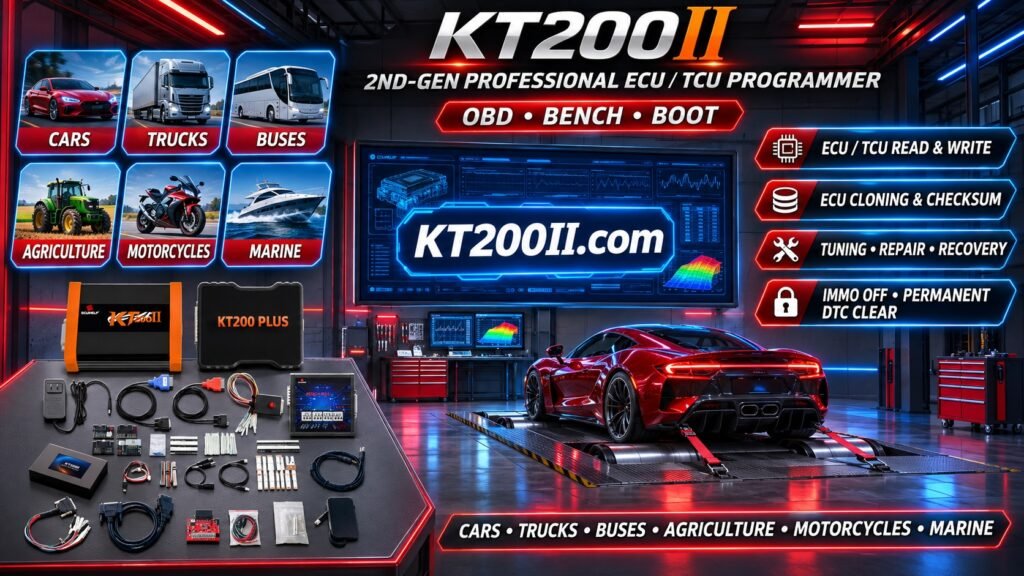
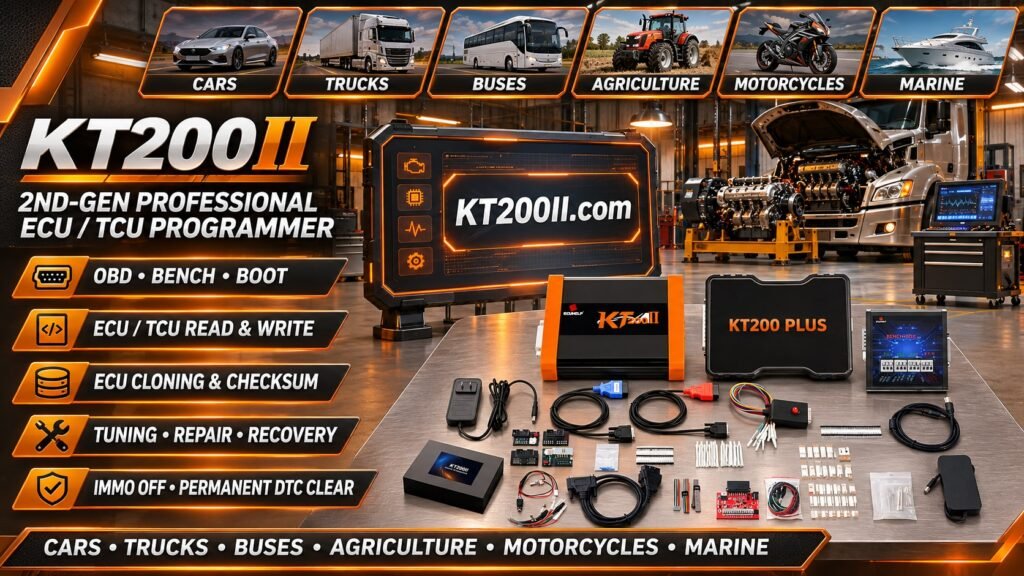
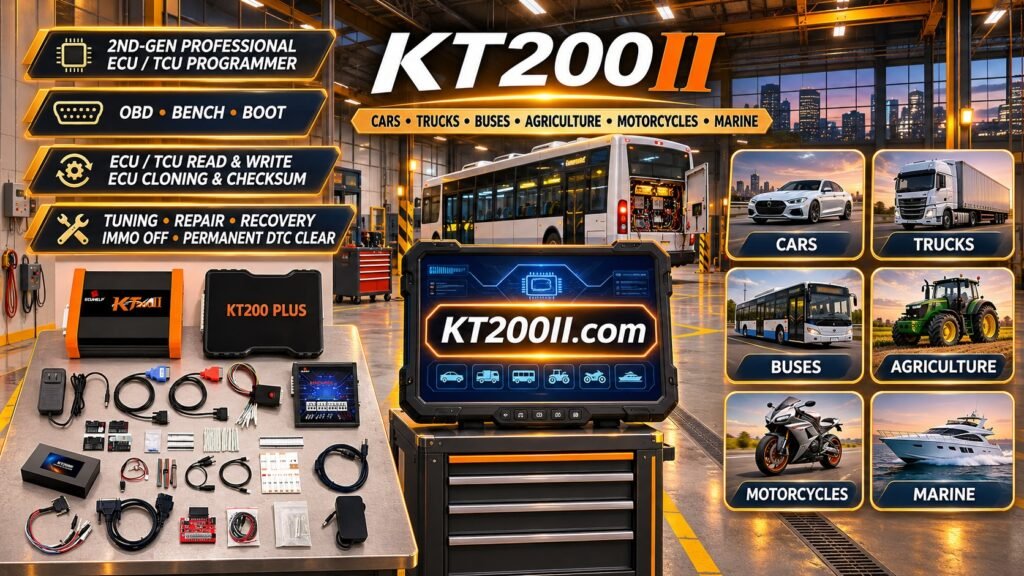
KT200II is an ECU and TCU programming device for compatible automotive controller applications. The availability of motorcycle ECU functions depends on the specific ECU, supported protocol and programming method.
Before using KT200II for motorcycle programming, verify:
- The exact motorcycle ECU is supported.
- The intended Read or Write operation is available.
- The appropriate programming mode has been selected.
- The required cables and adapters are available.
- The wiring and power requirements are understood.
- The file is compatible with the target controller.
- Original data is preserved where supported.
Do not assume that support for one motorcycle ECU guarantees support for another ECU from the same manufacturer. Verify each controller and operation separately.
Useful resources:
- KT200II Product Page
- KT200II Operation Modes
- KT200II Software
- KT200II Support List
- KT200II Technical Blog
11. Best Practices for Motorcycle ECU Technicians
A consistent workflow helps reduce avoidable errors when working with motorcycle electronics.
- Identify the ECU using its complete part number.
- Verify support for the intended programming operation.
- Use the correct wiring diagram and access method.
- Check the electrical supply before programming.
- Preserve original data where supported.
- Verify file compatibility before writing.
- Follow the documented programming procedure.
- Record error messages and operation results.
- Complete appropriate diagnostic and functional checks afterward.
These practices are useful for both routine ECU work and more complex controller replacement jobs.
Motorcycle ECU Programming Checklist
- Identify the motorcycle and exact ECU.
- Record the hardware and software information.
- Confirm the required Read or Write operation is supported.
- Choose the appropriate OBD, Bench or specialized method.
- Verify the wiring and electrical requirements.
- Back up original data where supported.
- Check file compatibility and checksum requirements.
- Follow the documented programming procedure.
- Review diagnostic results after programming.
Frequently Asked Questions
Can KT200II program every motorcycle ECU?
No universal coverage should be assumed. Compatibility depends on the specific ECU, software version, protocol and intended operation. Check the support information for the exact controller.
Can a motorcycle ECU be programmed through OBD?
Some supported controllers allow selected programming operations through OBD. Others require Bench or a specialized access method. Verify the supported procedure for the target ECU.
Should I back up a motorcycle ECU before programming?
Where the controller supports the necessary Read operation, preserving original data is good practice. Confirm which memory regions have been retrieved.
Can I use an ECU file from another motorcycle with the same engine size?
Not without verifying compatibility. Different models or production years may use different ECU hardware and software despite having similar engine capacities.
Why can an ECU be identified but not written?
Identification and Write support are separate capabilities. The selected protocol may support identification without supporting the requested memory operation.
Where can I check KT200II motorcycle ECU support?
Visit the KT200II Support List and verify the exact controller and intended operation before programming.
Conclusion
Motorcycle ECU programming requires accurate controller identification, verified compatibility, the correct electrical setup and a supported programming method.
Before starting, confirm the intended operation, preserve original data where supported and verify file compatibility. If a programming error occurs, identify the cause and follow the documented procedure rather than repeatedly attempting the same operation.
For more information about ECU programming equipment and supported applications, visit the KT200II Product Page and the KT200II Support List.