Automotive Immobilizer Systems Explained: ECU Security, Programming and Controller Replacement
Automotive Immobilizer Systems Explained: ECU Security, Programming and Controller Replacement
Modern vehicles use electronic immobilizer systems to help prevent unauthorized engine starting. These systems communicate with electronic control modules and verify whether the vehicle has received valid authorization from its security components.
For automotive electronics technicians, understanding immobilizer architecture is important when diagnosing starting problems, replacing engine control units and working with vehicle electronic security systems.
Immobilizer-related problems can involve keys, transponders, antennas, body control modules, security gateways and engine control units. Accurate identification of the affected system is essential before attempting repairs or programming operations.
This guide explains how automotive immobilizer systems work, how they communicate with ECUs, common failure symptoms, controller replacement considerations and the relationship between immobilizer systems and ECU programming.
1. What Is an Automotive Immobilizer System?
An automotive immobilizer is an electronic vehicle security system designed to prevent the engine from starting without valid authorization.
Depending on the vehicle architecture, the system may use electronic communication between several components:
- Transponder key or electronic key.
- Immobilizer antenna or reader.
- Immobilizer control module.
- Body Control Module (BCM).
- Engine Control Unit (ECU).
- Security gateway or other authorization modules.
When the vehicle detects an authorized key and the required security conditions are satisfied, the relevant control modules permit the engine starting process.
The exact architecture differs between vehicle manufacturers and production generations.
2. How Does an Immobilizer Work?
An immobilizer system typically uses electronic identification and authorization procedures to determine whether a vehicle key is recognized.
A simplified authorization process may involve:
- The driver presents a valid key or electronic credential.
- The vehicle's key reader or security system detects the credential.
- The immobilizer system verifies the available identification information.
- Relevant electronic modules exchange authorization information.
- The engine control system receives the required starting authorization.
- The engine starting process is permitted when all applicable conditions are satisfied.
Modern systems may use encrypted challenge-response communication and additional security mechanisms.
The exact authorization process depends on the vehicle manufacturer's security architecture.
3. Main Components of an Immobilizer System
Transponder Key
A traditional transponder key contains an electronic identification component that communicates with the vehicle's immobilizer reader.
Immobilizer Antenna
The antenna or reader detects and communicates with the key transponder.
Immobilizer Module
Some vehicles use a dedicated immobilizer control module to manage key recognition and security authorization.
Body Control Module
The BCM manages various body and vehicle electronic functions. In some vehicle architectures, it also participates in immobilizer authorization.
Engine Control Unit
The engine ECU manages engine operation and may require valid security authorization before allowing the engine to start.
4. Understanding Different Immobilizer Generations
Automotive immobilizer technology has evolved significantly over the years.
Different vehicle generations may use different key identification, communication and security technologies.
Traditional Transponder Systems
Earlier systems commonly use a transponder embedded in the vehicle key. The vehicle reads the transponder information and checks whether the key is authorized.
Integrated Immobilizer Systems
Some vehicles integrate immobilizer functions into the BCM, instrument cluster or another electronic control module.
Smart Key Systems
Modern smart key systems may use additional wireless communication technologies and electronic authorization procedures.
Advanced Vehicle Security Systems
Newer vehicle platforms may include encrypted communication, security gateways and centralized authorization services.
These differences are important when diagnosing security-related faults or replacing electronic modules.
5. What Happens When an Immobilizer System Fails?
An immobilizer-related fault can prevent the engine from starting even when the mechanical engine components are functioning correctly.
Common symptoms include:
- Engine cranks but does not start.
- Engine starts and then stops.
- Immobilizer warning light remains illuminated.
- Key not recognized message appears.
- Security-related diagnostic trouble codes.
- Communication problems between control modules.
- New or replacement key authorization problems.
These symptoms do not automatically indicate an ECU failure. The key, antenna, BCM, wiring and other security components should also be investigated.
6. Understanding Immobilizer Communication with the ECU
The engine ECU may participate in the vehicle's security authorization process.
Depending on the vehicle architecture, communication may involve:
- Key identification information.
- Security authorization status.
- Encrypted communication data.
- Module identification.
- Vehicle configuration information.
Some vehicles store relevant security information in the engine ECU, while others distribute it across several electronic modules.
Therefore, replacing an ECU does not always involve simply transferring its engine software.
7. ECU Replacement and Immobilizer Compatibility
When an engine ECU develops serious hardware damage, a compatible replacement controller may be required.
However, the replacement ECU must be compatible with the vehicle's engine and electronic security architecture.
Before selecting a replacement, technicians should check:
- ECU manufacturer.
- Complete hardware number.
- Software identification.
- Processor architecture.
- Memory configuration.
- Vehicle manufacturer and model.
- Engine configuration.
- Immobilizer generation.
- Manufacturer-specific replacement requirements.
Two ECUs with similar external appearances may have different software and security configurations.
8. ECU Cloning and Immobilizer Considerations
ECU cloning is a process of transferring supported memory information from an original controller to compatible replacement hardware.
Depending on the ECU architecture, a supported cloning workflow may involve:
- Original ECU identification.
- Supported Flash memory backup.
- Supported EEPROM or Data Flash backup.
- Replacement hardware verification.
- Compatible memory transfer.
- Software identification checks.
- Vehicle compatibility verification.
Some controllers store security-related information in memory regions that may be relevant to replacement procedures.
However, not every ECU supports conventional cloning, and copying memory does not guarantee successful vehicle authorization.
Some modern vehicles require additional manufacturer-specific configuration, authorized adaptation or online security procedures.
9. Understanding ECU Flash and EEPROM in Immobilizer Systems
Different ECUs use different memory technologies to store software and persistent information.
Flash Memory
Flash memory commonly stores the ECU application software and calibration information.
Depending on the controller architecture, it may contain engine management strategies, control algorithms and diagnostic software.
EEPROM and Data Flash
EEPROM or integrated Data Flash may store persistent configuration, identification and other manufacturer-specific information.
The location and organization of immobilizer-related data vary between controllers.
Technicians should not assume that all security information is stored in the same memory area or that every ECU uses a separate EEPROM chip.
10. Immobilizer Problems After ECU Replacement
Some vehicles may experience starting authorization problems after an engine ECU has been replaced.
Possible reasons include:
- Replacement ECU hardware incompatibility.
- Incorrect software version.
- Different vehicle configuration.
- Security authorization mismatch.
- Required manufacturer-specific adaptation not completed.
- Communication problems between modules.
- Incorrect replacement procedure.
Technicians should verify the replacement ECU part number and follow the vehicle manufacturer's authorized configuration procedure.
11. Common Immobilizer Diagnostic Trouble Codes
Immobilizer-related diagnostic trouble codes vary between manufacturers and vehicle generations.
Fault categories may relate to:
- Key identification failure.
- Transponder communication.
- Immobilizer antenna circuits.
- Security module communication.
- ECU authorization status.
- Module configuration mismatch.
- Incorrect or incomplete adaptation.
A diagnostic trouble code identifies a detected condition, not necessarily the exact defective component.
Technicians should review the complete diagnostic information and investigate the associated circuits and modules.
12. How to Diagnose an Immobilizer-Related Starting Problem
A systematic diagnostic procedure helps distinguish immobilizer faults from engine, electrical and fuel system problems.
Step 1: Check Battery Condition
Verify battery voltage and ensure that the vehicle electrical system is operating within the manufacturer's specifications.
Step 2: Inspect the Key
Check whether the vehicle recognizes the original key and whether a spare authorized key produces the same result.
Step 3: Read Diagnostic Trouble Codes
Scan the relevant electronic modules and record immobilizer, BCM and engine ECU fault information.
Step 4: Check Module Communication
Verify communication between the relevant vehicle security and engine control modules.
Step 5: Check ECU Identification
Record the engine ECU hardware number and software identification.
Step 6: Verify Security Configuration
Follow the applicable manufacturer procedure to check authorization and replacement configuration.
Step 7: Confirm Engine Operation
After correcting the identified fault, verify starting operation and check whether related diagnostic faults return.
13. Understanding Immobilizer Systems and CAN Communication
Modern vehicles use communication networks to exchange information between electronic control modules.
CAN communication may be used by the engine ECU, BCM, instrument cluster and other modules to exchange relevant vehicle information.
Communication problems can result from:
- Damaged CAN wiring.
- Faulty communication transceivers.
- Missing module power supply.
- Poor ground connections.
- Network interruptions.
- Gateway communication problems.
Not every immobilizer system uses the same network architecture or communication procedure.
14. Immobilizer Programming vs ECU Flash Programming
One important distinction in automotive electronics is the difference between immobilizer adaptation and ECU software programming.
| Operation | Main Purpose |
|---|---|
| ECU Flash Reading | Retrieve supported ECU software and memory data |
| ECU Flash Writing | Program compatible software into supported memory regions |
| ECU Cloning | Transfer supported memory data to compatible replacement hardware |
| Immobilizer Adaptation | Perform authorized vehicle security configuration |
| Key Programming | Register or authorize compatible vehicle keys |
| Module Coding | Configure supported vehicle-specific module settings |
These operations are related but are not interchangeable.
An ECU programmer that supports Flash reading and writing does not automatically provide key programming or immobilizer adaptation functions.
15. Modern Vehicle Security and Gateway Protection
Newer vehicle platforms may include additional security mechanisms that affect electronic module access and replacement procedures.
These systems may include:
- Secure diagnostic gateways.
- Encrypted module communication.
- Component protection.
- Online authorization requirements.
- Manufacturer-specific adaptation procedures.
- Secure software update mechanisms.
These technologies help protect vehicle electronic systems from unauthorized access.
Technicians should use authorized service procedures and compatible diagnostic equipment when working with protected vehicle systems.
16. Choosing Equipment for ECU Programming Work
Professional automotive electronics workshops may require different tools for engine ECU programming, immobilizer diagnostics and vehicle key services.
Important equipment categories include:
- ECU programmers.
- Automotive diagnostic scanners.
- Key programming equipment.
- Electronic testing instruments.
- Regulated power supplies.
- Supported ECU breakout cables.
Each tool serves a different purpose.
Before purchasing equipment, technicians should identify the exact functions required and verify the supported vehicle and controller coverage.
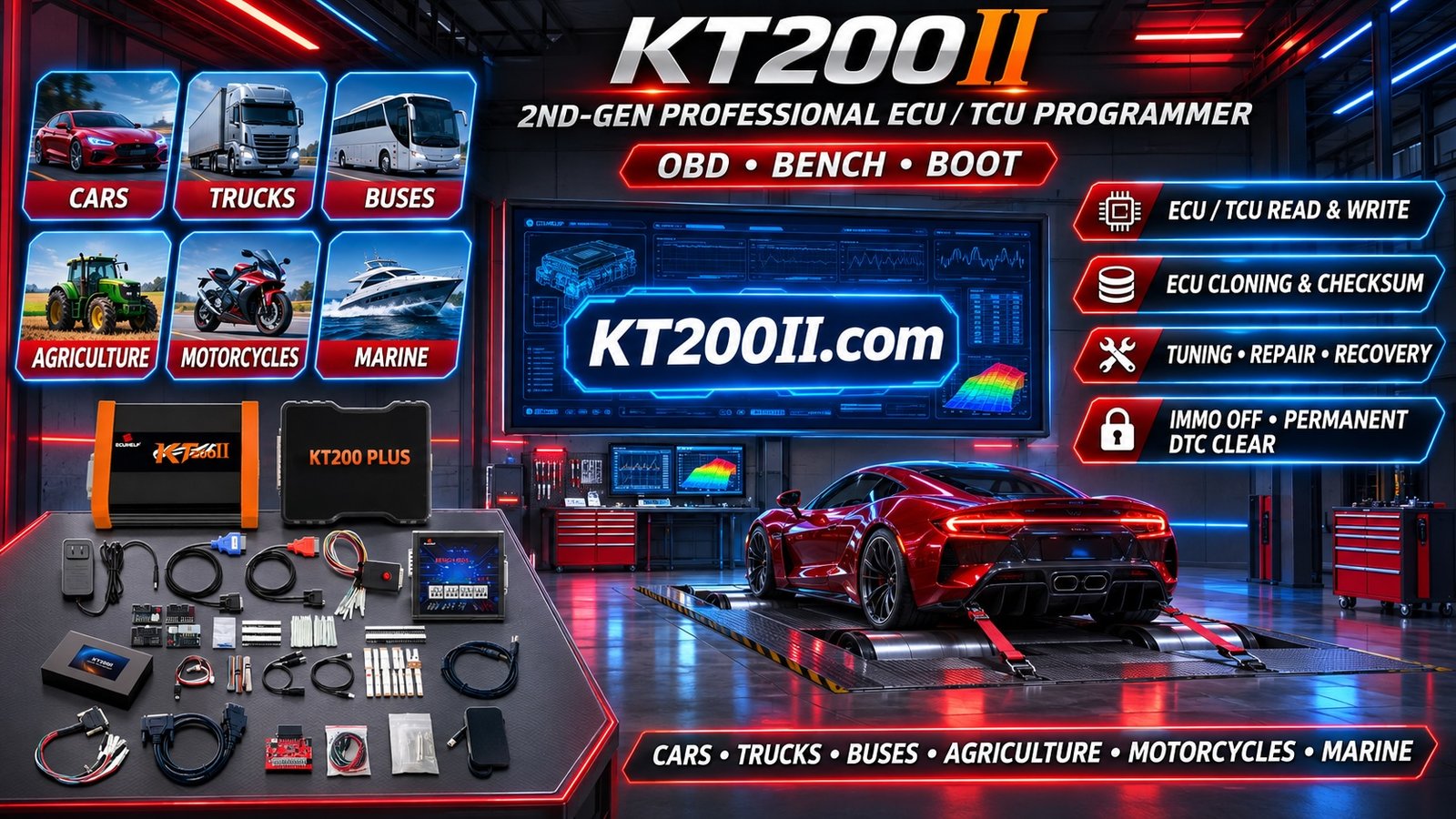
17. Using KT200II for Supported ECU Programming
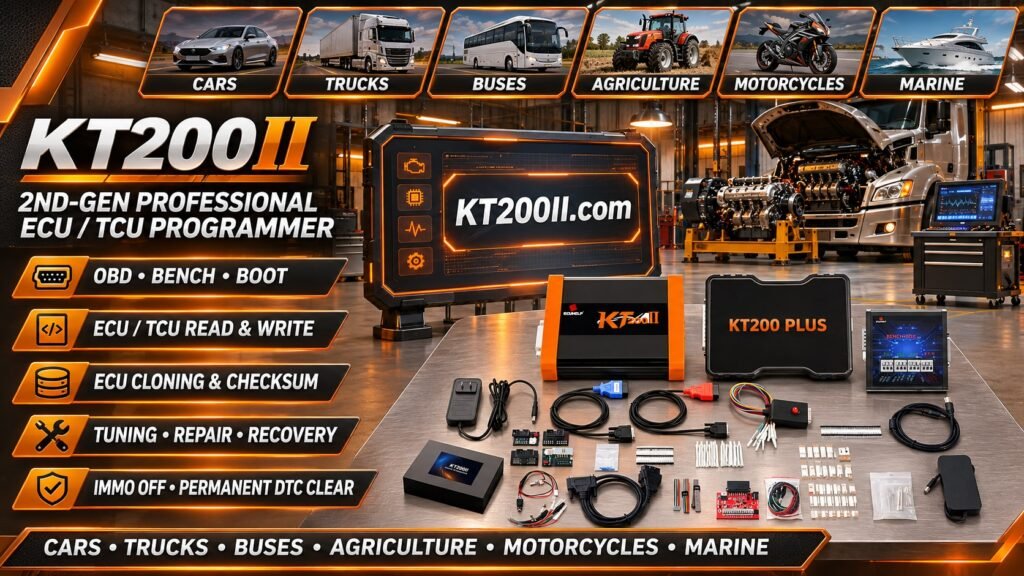
KT200II is an ECU programming tool designed for professional automotive electronics applications.
Depending on the selected protocol and supported ECU hardware, available operations may include:
- ECU identification.
- Supported Flash reading.
- Supported Flash writing.
- Selected memory operations.
- Original data backup where supported.
- Supported OBD programming.
- Supported Bench programming.
- Supported Boot operations.
Actual programming functionality depends on the exact ECU hardware number, processor architecture, memory configuration and software version.
KT200II ECU programming capabilities should not be confused with universal immobilizer or key programming functions. Key registration, security adaptation and other vehicle authorization procedures require separately supported equipment and manufacturer-specific processes.
For more information, visit the official KT200II resources:
- KT200II Product Information
- KT200II Operation Modes
- KT200II Software Information
- KT200II Support List
18. ECU Replacement and Immobilizer Compatibility Checklist
Before replacing an ECU, technicians should confirm:
- Vehicle manufacturer and model.
- Vehicle production year.
- Engine type.
- Original ECU manufacturer.
- Complete ECU hardware number.
- Original software identification.
- Replacement ECU hardware compatibility.
- Immobilizer system generation.
- Relevant module communication status.
- Manufacturer-specific adaptation requirements.
- Available original data backup.
- Final security authorization status.
Frequently Asked Questions
What is an automotive immobilizer?
An immobilizer is an electronic vehicle security system that helps prevent unauthorized engine starting by checking key or electronic credential authorization.
Can an immobilizer problem prevent an engine from starting?
Yes. If the vehicle cannot complete the required security authorization process, the engine starting process may be restricted.
Is the immobilizer stored inside the ECU?
It depends on the vehicle architecture. Security-related information may be stored or managed across the ECU, BCM, immobilizer module and other electronic systems.
Can ECU cloning solve immobilizer problems?
Selected compatible ECU replacement procedures may preserve supported original memory information. However, cloning does not guarantee successful authorization on every vehicle.
Is ECU programming the same as key programming?
No. ECU programming involves supported controller memory operations, while key programming involves vehicle-specific key registration and authorization.
Can KT200II program immobilizer keys?
KT200II is primarily an ECU programming tool. Its supported ECU memory operations should not be interpreted as universal key programming or immobilizer adaptation capabilities.
Why does a replacement ECU fail to start the vehicle?
Possible causes include hardware incompatibility, software differences, security authorization mismatch, incomplete configuration or communication problems.
What information is needed to investigate an immobilizer problem?
Useful information includes vehicle make and model, production year, engine type, ECU hardware number, relevant fault codes and a description of the starting symptoms.
Conclusion
Automotive immobilizer systems are an important part of modern vehicle electronic security architecture.
Understanding key authorization, ECU communication, module configuration and replacement requirements helps technicians diagnose starting problems more accurately.
It is especially important to distinguish between ECU Flash programming, ECU cloning, immobilizer adaptation and key programming because these operations have different requirements.
KT200II provides ECU programming solutions for professional automotive electronics applications, with available functions depending on the selected protocol and supported controller.
Visit KT200II.com to explore product information, operation modes, software resources and supported ECU protocols.