
How to Identify an ECU Before Programming: Part Numbers, Hardware and Software Guide
How to Identify an ECU Before Programming: Part Numbers, Hardware and Software Guide
Correct ECU identification is one of the most important steps in automotive electronics programming. Before reading, writing, cloning or replacing an engine control unit, technicians must determine exactly which controller is installed in the vehicle.
Two ECUs may have similar external housings, identical connectors or even belong to the same manufacturer family while using different hardware, processors and software configurations.
Selecting an incorrect programming protocol or using an incompatible file can lead to communication failures, unsuccessful programming operations or controller damage.
In this guide, we explain how to identify an ECU using its part number, hardware information, software identification and processor architecture, and how to verify compatibility before using professional programming equipment such as KT200II.
1. Why Is ECU Identification Important?
Modern vehicles use many different electronic control units. Even within one vehicle manufacturer, multiple ECU families may be used across different engines, production years and vehicle platforms.
Accurate ECU identification helps technicians:
- Select the correct programming protocol.
- Determine whether OBD, Bench or Boot is supported.
- Verify Flash and EEPROM reading availability.
- Check compatibility with replacement ECUs.
- Prevent incorrect file selection.
- Identify processor and memory architecture.
- Determine whether a cloning procedure is supported.
- Reduce unnecessary programming attempts.
Vehicle model information alone is not sufficient to establish ECU programming compatibility.
2. Find the ECU Manufacturer
The first step is identifying the manufacturer of the engine control unit.
Common ECU manufacturers include:
- Bosch: Widely used in gasoline and diesel engine management systems.
- Continental: Supplies engine and vehicle electronic control systems.
- Delphi: Provides diesel and gasoline engine management technologies.
- Denso: Develops engine management and electronic control systems.
- Magneti Marelli: Supplies various automotive electronic control systems.
- Siemens: Has supplied different generations of automotive controllers.
The manufacturer name is usually printed on the ECU identification label or housing.
However, identifying the manufacturer is only the beginning. The complete ECU part number and hardware information are needed for more accurate identification.
3. Understand the ECU Part Number
The ECU part number is one of the most useful pieces of information when determining controller compatibility.
Manufacturers use different numbering systems to identify ECU models, hardware configurations and production revisions.
For example, Bosch ECUs commonly display a Bosch number beginning with a format such as:
0 281 XXX XXX
0 261 XXX XXX
Other manufacturers use their own identification formats.
When recording an ECU part number, technicians should:
- Copy the complete number accurately.
- Include all digits and suffixes.
- Check for additional OEM part numbers.
- Record any hardware revision information.
- Avoid relying on incomplete numbers.
Even a small difference in the part number may indicate a different ECU application or hardware revision.
4. What Is an ECU Hardware Number?
The hardware number identifies the physical electronic controller configuration.
Depending on the manufacturer, it may refer to the PCB design, electronic component configuration or a particular hardware revision.
Two ECUs from the same product family may use different hardware versions.
Important hardware information may include:
- Hardware identification number.
- Hardware revision.
- ECU board version.
- Processor type.
- Memory configuration.
- Connector configuration.
Hardware compatibility is especially important when selecting a donor ECU for replacement or cloning.
5. What Is an ECU Software Number?
The software number identifies the software installed in the controller.
Depending on the ECU, software identification may include application software, calibration information or manufacturer-specific version references.
Software information can help technicians determine:
- Which software version is installed.
- Whether two controllers use compatible software.
- Whether a reference file matches the ECU.
- Which programming protocol may be appropriate.
- Whether a software update is available.
Hardware and software numbers should be treated as separate identification parameters.
Two ECUs with similar hardware may contain different software versions and require different programming procedures.
6. How to Identify an ECU Using Its Label
Most engine control units have an identification label attached to the housing.
Before removing the label or opening the ECU, take a clear photograph of all identification information.
Look for the following fields:
- ECU manufacturer.
- Manufacturer part number.
- OEM part number.
- Hardware number.
- Software number, if printed.
- Serial number.
- Production date or revision.
- Voltage specifications.
Some ECU labels contain several different numbers. Do not assume that the first number is always the programming identification number.
Record every available identifier and compare it with the programming software information when possible.
7. Identify the ECU Through Diagnostic Software
When the ECU is operational and supports diagnostic identification, technicians may obtain additional information through a compatible diagnostic tool.
Depending on the vehicle and ECU, available information may include:
- ECU identification.
- Hardware identification.
- Software identification.
- Calibration identification.
- ECU manufacturer information.
- Diagnostic communication information.
This information can be useful when the external label is damaged, missing or difficult to read.
However, diagnostic identification availability depends on the ECU's communication status and the capabilities of the diagnostic equipment.
8. Why Is Processor Identification Important?
The microcontroller or processor is a central component of the ECU and plays an important role in determining its programming architecture.
Different processor families may require different programming interfaces and memory access procedures.
Common automotive processor families include:
- Infineon TriCore.
- STMicroelectronics SPC.
- NXP MPC.
- Renesas automotive microcontrollers.
- Other manufacturer-specific processor architectures.
Processor identification is particularly useful when evaluating Bench, Boot and specialized programming applications.
However, knowing the processor family does not automatically establish complete ECU programming compatibility.
The exact processor variant, ECU hardware and protocol must also be considered.
9. How to Determine the Correct Programming Method
After identifying the ECU, technicians must determine which connection and programming methods are supported.
OBD
OBD programming communicates with a supported ECU through the vehicle diagnostic connector.
It is convenient for applications where the required memory operations are available through the vehicle network.
Bench
Bench programming connects directly to the ECU outside the vehicle using the documented power, ground and communication terminals.
It is commonly used for selected reading, writing and ECU replacement applications.
Boot
Boot programming provides supported low-level access to selected ECU processors.
Depending on the controller, it may provide additional memory access functions that are unavailable through OBD or Bench.
Not every ECU supports all three methods.
Always verify the exact programming mode using the supported protocol information and connection documentation.
10. ECU Identification and Donor ECU Compatibility
Accurate identification is especially important when replacing or cloning an ECU.
A donor ECU should be checked carefully before any original data is transferred.
Compare the following information:
- Original ECU manufacturer.
- Original ECU part number.
- Donor ECU part number.
- Hardware revisions.
- Processor type.
- Software identification.
- Memory architecture.
- Programming protocol compatibility.
A matching part number is useful, but it does not always guarantee complete compatibility.
Some replacement controllers may require software updates, configuration procedures or manufacturer-specific adaptation.
11. Common ECU Identification Mistakes
Using Only the Vehicle Model
One vehicle model may use several ECU manufacturers and hardware versions.
Always identify the actual controller installed in the vehicle.
Ignoring Part Number Suffixes
Small differences in suffixes may represent different hardware or software configurations.
Record the complete part number.
Confusing Hardware and Software Numbers
Hardware and software identification serve different purposes. Both should be checked when verifying programming compatibility.
Assuming Similar ECUs Use the Same Protocol
Two controllers from the same ECU family may require different programming methods.
Ignoring Processor Differences
Processor variants can affect memory access and programming requirements.
12. How KT200II Helps With ECU Identification and Programming
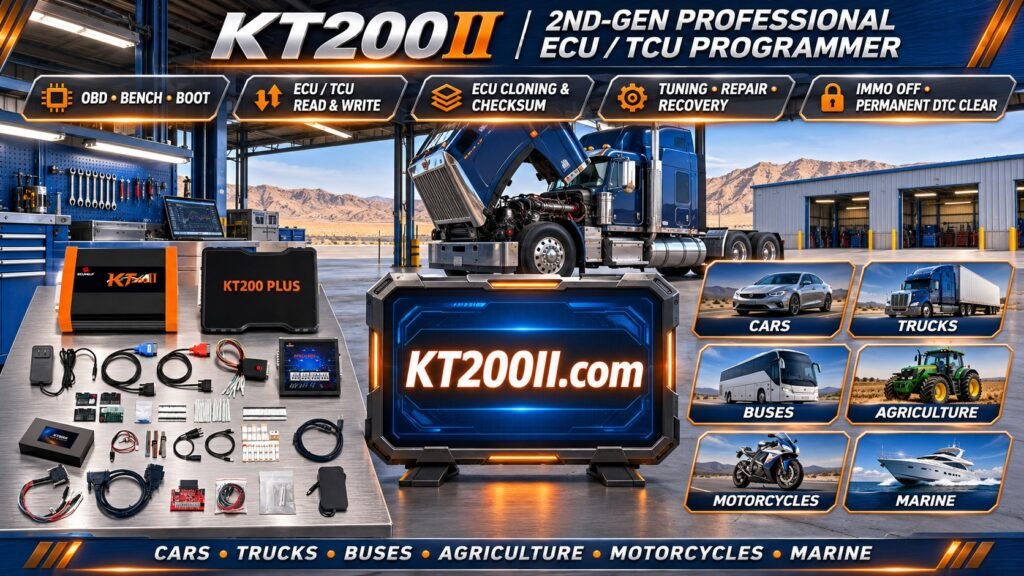
KT200II is a professional ECU and TCU programming solution designed for automotive electronics technicians and repair workshops.
For supported ECU applications, available functions may include:
- ECU identification.
- Supported Flash reading.
- Supported Flash writing.
- Selected EEPROM operations.
- OBD programming applications.
- Bench programming applications.
- Boot programming applications.
- Supported ECU replacement and cloning-related operations.
Available functions depend on the exact ECU model, hardware version, software version and selected programming protocol.
Technicians should verify the exact controller before starting any programming operation.
Learn more about KT200II:
KT200II Supported ECU and TCU List
13. ECU Identification Checklist Before Programming
Use this checklist before selecting a programming protocol:
- Vehicle manufacturer identified.
- Vehicle model and production year recorded.
- Engine model identified.
- ECU manufacturer confirmed.
- Complete ECU part number recorded.
- OEM part number checked.
- Hardware number verified.
- Software number recorded where available.
- Processor identified where necessary.
- Memory architecture reviewed.
- Programming mode confirmed.
- Exact protocol checked.
- Required memory operations verified.
- Original data backed up where supported.
Frequently Asked Questions
Where can I find the ECU part number?
The ECU part number is usually printed on the identification label attached to the controller housing. Additional information may be available through compatible diagnostic software.
Can two ECUs with the same part number have different software?
Yes. Software versions and calibration configurations may differ. Verify the actual software identification before programming.
Is the Bosch number the same as the OEM number?
No. Bosch may have its own manufacturer identification number, while the vehicle manufacturer uses a separate OEM part number.
Can I identify an ECU by its processor alone?
Processor identification is useful, but it is not sufficient by itself. The complete ECU hardware, software and memory configuration must also be considered.
Does ECU identification guarantee programming support?
No. Identification and memory programming are separate functions. A tool may identify a controller without supporting every reading or writing operation.
Why is the exact ECU hardware version important?
Different hardware revisions may use different processors, memory structures and programming requirements. Selecting an incorrect protocol can result in communication or programming failures.
Can KT200II identify all ECUs?
KT200II provides identification and programming functions for selected supported ECU and TCU applications. Coverage depends on the available protocols and software version.
Conclusion
Correct ECU identification is the foundation of successful automotive electronics programming.
Before reading, writing, cloning or replacing an ECU, technicians should verify the complete part number, hardware version, software identification and processor architecture.
Understanding these details helps prevent incorrect protocol selection, incompatible file usage and unnecessary programming failures.
With the appropriate supported protocol, KT200II can assist technicians with ECU and TCU identification and programming applications.
For more technical information, programming guides and supported applications, visit the KT200II Official Website.