TCU Programming Guide: How to Read, Write and Repair Transmission Control Modules
TCU Programming Guide: How to Read, Write and Repair Transmission Control Modules
Modern automatic transmissions rely on sophisticated electronic control systems to manage gear selection, clutch operation, hydraulic pressure and shifting performance. At the center of these systems is the Transmission Control Unit (TCU).
As automotive transmission technology develops, TCU programming has become an important service for professional automotive electronics workshops.
Technicians may need to read or write TCU memory, replace a damaged controller, transfer supported data to a compatible replacement unit or investigate transmission-related electronic faults.
However, different transmission manufacturers use different controller architectures, processors and programming protocols. Understanding these differences is essential before performing any programming operation.
This guide explains TCU functions, memory architecture, programming methods, common problems and important considerations when using professional equipment such as KT200II.
1. What Is a TCU?
TCU stands for Transmission Control Unit. It is an electronic controller responsible for managing the operation of an electronically controlled transmission.
The TCU receives information from various sensors and other vehicle control modules. It processes this information to determine the appropriate transmission operating strategy.
Depending on the transmission design, the TCU may control:
- Gear selection.
- Gear shifting timing.
- Clutch engagement.
- Hydraulic pressure regulation.
- Torque converter lock-up.
- Transmission temperature monitoring.
- Shift adaptation.
- Transmission protection strategies.
Modern TCUs communicate with other vehicle modules through networks such as CAN Bus.
For example, the TCU may receive engine speed, vehicle speed and engine torque information from the ECU to coordinate smooth gear changes.
2. Different Types of Transmission Control Systems
Not all automatic transmissions use the same electronic control architecture. Understanding the transmission type helps technicians identify the correct controller and programming procedure.
Conventional Automatic Transmission
Traditional automatic transmissions use planetary gear sets, hydraulic systems and electronically controlled solenoids.
The TCU manages gear changes by controlling hydraulic pressure and shift-related components.
Dual-Clutch Transmission (DCT)
DCT systems use two clutches to manage different gear sets.
The transmission controller coordinates clutch engagement and gear selection to provide rapid gear changes.
Automated Manual Transmission (AMT)
AMT systems use an automated mechanism to operate the clutch and select gears in a manual transmission architecture.
The electronic controller manages shifting and clutch operation according to vehicle conditions.
Continuously Variable Transmission (CVT)
CVT systems use a variable transmission ratio rather than conventional fixed gear ratios.
The controller manages the transmission ratio and associated hydraulic or mechanical control systems.
Each transmission architecture has different electronic and programming requirements.
3. Common TCU Manufacturers
Modern vehicles use transmission controllers from several major automotive electronics manufacturers.
Examples include:
- Bosch: Develops electronic transmission control systems for various automotive applications.
- Continental: Supplies transmission electronics and control technologies.
- ZF: Produces automatic transmission systems and associated electronic control units.
- Delphi: Supplies automotive electronic and transmission-related technologies.
- Magneti Marelli: Develops electronic control systems for selected transmission applications.
- Other manufacturers: Various vehicle manufacturers use dedicated transmission controllers and integrated mechatronic systems.
The transmission manufacturer and TCU manufacturer are not necessarily the same company.
For accurate identification, technicians should check the actual controller identification and transmission part number.
4. Understanding TCU Memory Architecture
TCU programming involves accessing supported memory regions inside the transmission controller.
Flash Memory
Flash memory commonly stores the main application software and calibration information.
Depending on the TCU architecture, it may contain:
- Transmission control software.
- Gear shifting strategies.
- Clutch control parameters.
- Torque management information.
- Hydraulic pressure control strategies.
- Temperature protection functions.
EEPROM and Persistent Memory
EEPROM or EEPROM-emulated memory may contain persistent information such as controller identification, configuration and adaptation-related data.
Some controllers use separate EEPROM chips, while others store persistent information in internal Flash or other memory structures.
Not every TCU uses the same memory architecture. The required memory operations must be verified for the exact controller.
5. What Is TCU Programming?
TCU programming refers to reading, writing or updating supported software and memory information inside a transmission control unit.
Depending on the controller and available protocol, programming operations may include:
- TCU identification.
- Flash memory reading.
- Flash memory writing.
- Selected EEPROM operations.
- Software updates.
- Supported calibration operations.
- TCU replacement preparation.
- Supported cloning procedures.
It is important to understand that reading a TCU does not automatically mean every memory region can be accessed.
Some protocols support identification and Flash operations but do not provide separate EEPROM access.
6. OBD, Bench and Boot Programming Methods
Different TCUs require different communication and programming methods.
OBD Programming
OBD programming communicates with a compatible transmission controller through the vehicle diagnostic connector.
It is convenient for supported applications where the TCU allows the required operations through the vehicle communication network.
Typical advantages include:
- No need to remove the controller for supported operations.
- Convenient TCU identification.
- Access to selected reading and writing functions.
- Suitable for certain software service operations.
Bench Programming
Bench programming connects directly to the TCU outside the vehicle.
The technician uses the documented power, ground and communication connections to access supported programming functions.
Bench programming is useful for selected TCU reading, writing and replacement applications.
Boot Programming
Boot programming uses a supported low-level access procedure for selected processors.
Depending on the TCU architecture, Boot mode may provide access to memory operations that are unavailable through other communication methods.
Some Boot procedures require specific processor connections and careful handling of the controller circuit board.
Not every TCU supports all three programming methods.
7. Why Is TCU Identification Important?
Accurate controller identification is essential before selecting a programming protocol.
Technicians should record:
- Vehicle manufacturer.
- Vehicle model and production year.
- Transmission manufacturer.
- Transmission model.
- TCU manufacturer.
- Complete TCU part number.
- Hardware identification.
- Software identification.
- Processor information where available.
For example, the same transmission family may have different electronic controller revisions depending on the vehicle manufacturer and production generation.
A transmission name alone is not sufficient to confirm programming compatibility.
8. TCU Cloning and Replacement
When a transmission controller becomes damaged, technicians may need to install a compatible replacement unit.
In selected applications, TCU cloning can transfer the necessary original information to a compatible donor controller.
Depending on the TCU architecture, the procedure may involve:
- Original TCU identification.
- Donor controller compatibility verification.
- Original Flash backup.
- EEPROM or persistent memory backup where supported.
- Additional controller-specific data where required.
- File compatibility verification.
- Programming and post-operation testing.
Not every TCU supports complete cloning.
Some controllers require manufacturer-specific initialization, coding, security adaptation or transmission learning procedures after replacement.
Transferring memory files alone does not guarantee that the replacement controller will operate correctly.
9. Common TCU Programming Problems
TCU Cannot Be Identified
Possible causes include incorrect wiring, insufficient power, damaged communication circuits or an unsupported programming protocol.
Flash Reading Fails
The selected protocol may not support the requested memory region, or the controller may have an electrical or internal hardware problem.
TCU Writing Fails
Possible causes include incompatible software files, unstable power, incorrect programming mode or unsupported memory operations.
Transmission Does Not Operate Correctly After Programming
Possible causes include incorrect software, missing configuration, incomplete adaptation or an incompatible controller.
Communication Failure During Bench Programming
Check power, ground, CAN-H, CAN-L and any required wake-up or ignition signals against the exact wiring diagram.
10. Understanding Transmission Adaptation
Some electronically controlled transmissions use adaptation values to compensate for mechanical wear and operating conditions.
Depending on the transmission, adaptation procedures may involve:
- Clutch engagement learning.
- Shift pressure adaptation.
- Gear change calibration.
- Transmission initialization.
- Manufacturer-specific learning procedures.
These functions are not necessarily part of Flash or EEPROM programming.
After TCU replacement or software programming, the vehicle may require separate diagnostic equipment and manufacturer-specific adaptation procedures.
11. How to Diagnose TCU Communication Problems
When a TCU cannot communicate with diagnostic equipment, technicians should investigate the electrical and network conditions before replacing the controller.
Recommended checks include:
- Check vehicle battery voltage.
- Verify TCU power supply.
- Inspect ground connections.
- Check relevant fuses and relays.
- Inspect connector terminals.
- Verify CAN-H and CAN-L connections where applicable.
- Check the vehicle communication network.
- Confirm the correct diagnostic or programming protocol.
- Inspect the TCU for water or electrical damage.
Multiple modules reporting communication faults may indicate a shared network problem rather than an individual TCU failure.
12. How KT200II Supports TCU Programming
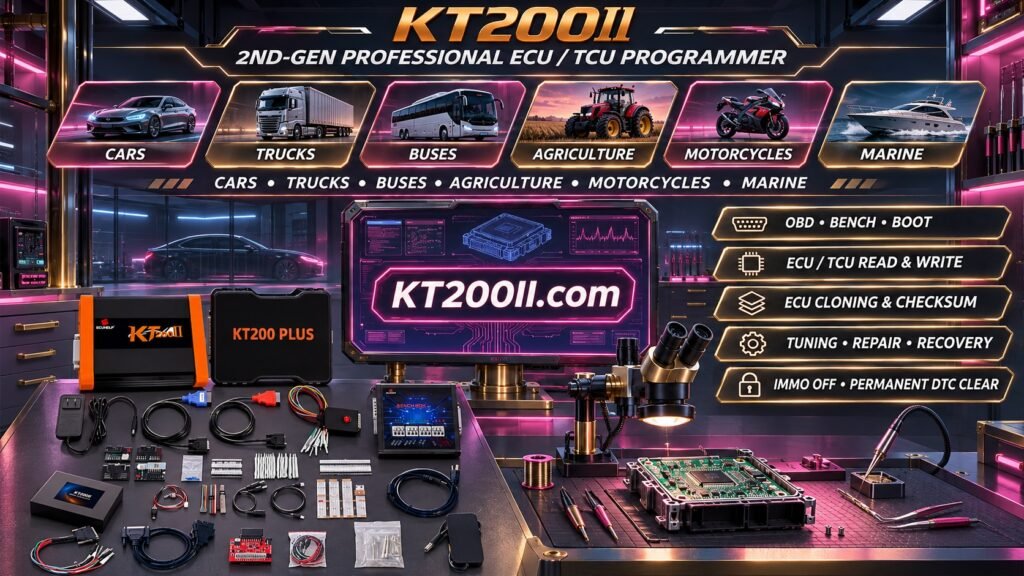
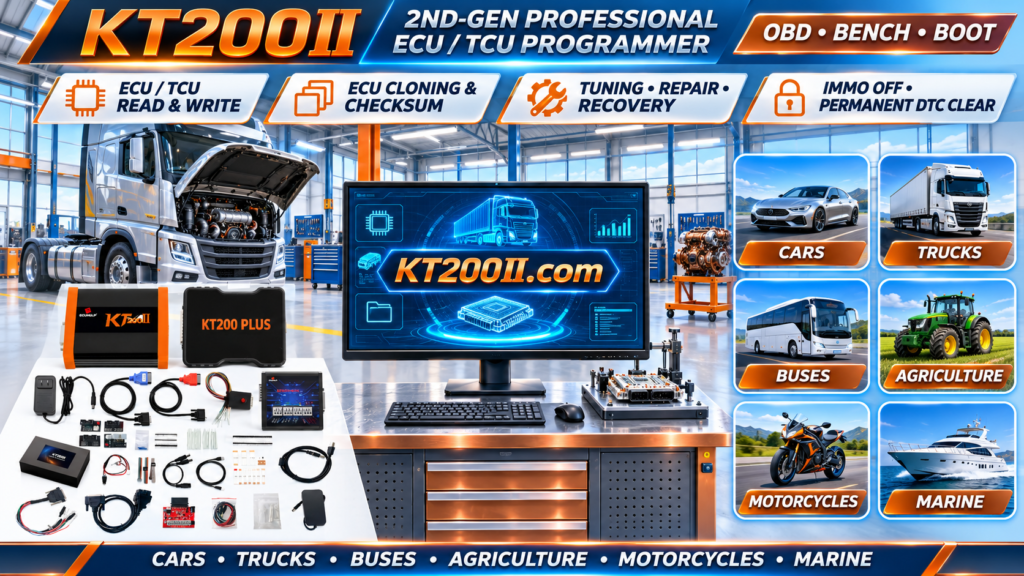
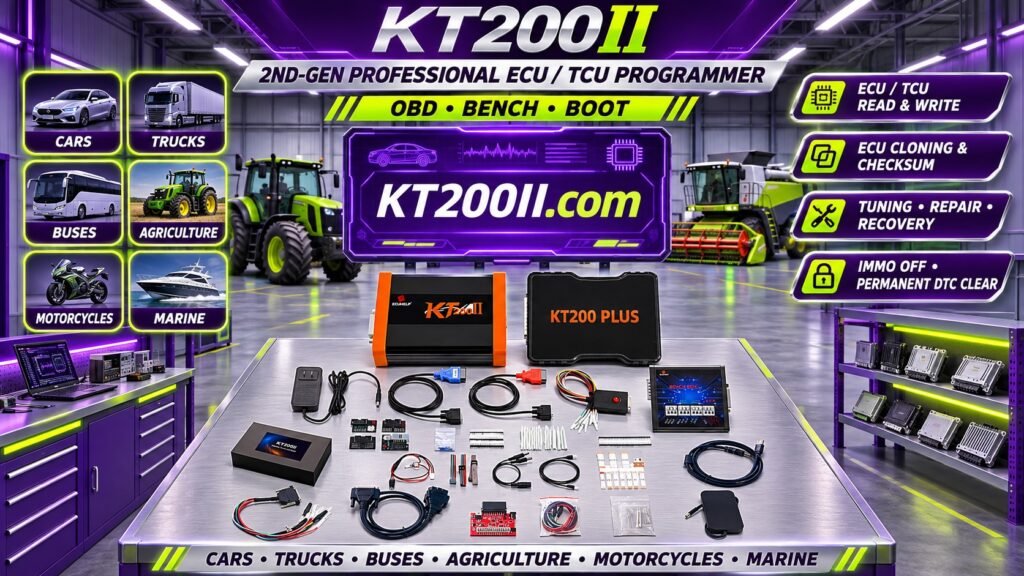
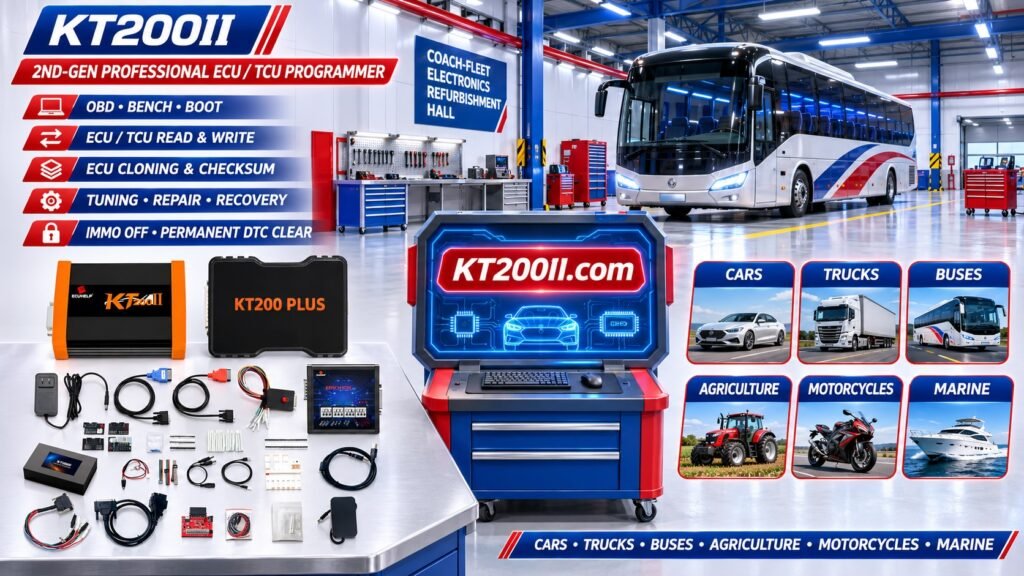
KT200II is a professional ECU and TCU programming solution designed for automotive electronics technicians and repair workshops.
For supported transmission controllers, available programming functions may include:
- TCU identification.
- Supported Flash reading.
- Supported Flash writing.
- Selected EEPROM operations.
- OBD programming applications.
- Bench programming applications.
- Boot programming applications.
- Supported TCU replacement and cloning-related operations.
Actual functions depend on the exact transmission controller, hardware version, processor and programming protocol.
Before starting a programming job, technicians should verify the exact TCU part number and required memory operations.
Explore KT200II product and technical information:
KT200II ECU and TCU Programmer
KT200II Supported ECU and TCU List
13. How to Choose a TCU Programming Tool
When selecting professional TCU programming equipment, technicians should evaluate actual controller coverage and available operations.
Important factors include:
- Supported transmission manufacturers.
- Supported TCU part numbers.
- Supported processor architectures.
- OBD programming coverage.
- Bench and Boot programming availability.
- Flash reading and writing functions.
- EEPROM operation availability.
- Connection diagrams.
- Required cables and adapters.
- Software updates and technical support.
Do not assume that support for one transmission family guarantees support for every controller in that family.
14. TCU Programming Checklist
Before starting a TCU programming operation, complete the following checks:
- Vehicle identification recorded.
- Transmission model identified.
- TCU manufacturer confirmed.
- Complete TCU part number recorded.
- Hardware and software versions checked.
- Processor information identified where necessary.
- Correct programming protocol selected.
- OBD, Bench or Boot method confirmed.
- Connection diagram reviewed.
- Power and ground verified.
- Communication wiring inspected.
- Original memory backed up where supported.
- Target file compatibility checked.
- Programming operation completed.
- Post-programming diagnostics performed.
- Required transmission adaptation completed.
Frequently Asked Questions
What is the difference between ECU and TCU?
The ECU manages engine operation, while the TCU manages transmission operation. Both controllers exchange information to coordinate engine torque and gear shifting.
Can KT200II program automatic transmission controllers?
KT200II supports selected TCU programming applications. Exact compatibility and available functions depend on the transmission controller and supported protocol.
Can all TCUs be programmed through Bench mode?
No. Some controllers support Bench programming, while others require OBD, Boot or different manufacturer-specific access methods.
Can a TCU be cloned?
Selected TCUs support cloning-related procedures. Feasibility depends on hardware compatibility, accessible original data and the required memory operations.
Does TCU programming require EEPROM reading?
Not always. The required memory operations depend on the controller architecture and the intended programming procedure.
Why does a TCU fail to communicate?
Possible causes include power supply problems, damaged wiring, CAN communication faults, defective transceiver circuits or an unsupported diagnostic protocol.
Does programming a TCU automatically reset transmission adaptations?
Not necessarily. Software programming and transmission adaptation are separate operations on many vehicle platforms. Additional diagnostic procedures may be required.
Can a used TCU replace the original controller?
Some used controllers can be used as replacements when hardware and software compatibility are confirmed. Additional programming, configuration or security procedures may be required.
Conclusion
TCU programming is an important part of modern automotive transmission electronics repair.
Successful programming requires accurate controller identification, knowledge of memory architecture and selection of the correct OBD, Bench or Boot programming method.
Whether performing Flash reading, software writing, TCU replacement or supported cloning, technicians should always verify the exact controller and programming protocol before beginning.
KT200II provides ECU and TCU programming functions for selected automotive applications, helping professional technicians handle supported electronic control unit operations.
For product information, technical resources and supported applications, visit the KT200II Official Website.