Heavy-Duty Diesel ECU Programming: A Complete Guide for Truck Technicians
Heavy-Duty Diesel ECU Programming: A Complete Guide for Truck Technicians
Modern heavy-duty trucks rely on sophisticated electronic control systems to manage engine performance, fuel injection, emissions, torque delivery and vehicle operation. As commercial vehicle technology continues to develop, ECU programming has become an increasingly important service for professional truck repair workshops.
Unlike many passenger car applications, heavy-duty diesel vehicles may use specialized engine controllers, different communication networks and manufacturer-specific programming procedures.
For technicians working with commercial vehicles, understanding diesel ECU architecture, memory operations and programming methods is essential when performing electronic repairs, controller replacement and supported data recovery operations.
This guide explains the fundamentals of heavy-duty diesel ECU programming, common programming methods, important precautions and how professional equipment such as KT200II can assist with supported truck ECU applications.
1. What Is a Heavy-Duty Diesel ECU?
A diesel Engine Control Unit (ECU) is an electronic controller responsible for managing important engine operating functions.
It receives information from sensors, processes operating conditions and controls different engine components according to programmed strategies.
Depending on the engine and vehicle manufacturer, a diesel ECU may control:
- Fuel injection quantity and timing.
- Common rail fuel pressure.
- Turbocharger boost pressure.
- Engine torque management.
- Exhaust gas recirculation (EGR).
- Diesel particulate filter (DPF) management.
- Selective catalytic reduction (SCR) systems.
- Engine temperature protection.
- Engine speed limitations.
- Emission control strategies.
Heavy-duty diesel engines often operate under demanding conditions, including high loads, long operating hours and significant temperature variations. Reliable ECU operation is therefore important for vehicle performance and operational availability.
2. Common ECU Manufacturers in Heavy-Duty Vehicles
Commercial vehicles use different engine control systems depending on the manufacturer, engine platform and production generation.
Common ECU suppliers and electronic control system manufacturers include:
- Bosch: Supplies various diesel engine management systems used in commercial vehicles.
- Continental: Develops electronic control systems for different automotive and commercial vehicle applications.
- Delphi: Provides diesel fuel injection and engine management technologies.
- Siemens: Has supplied electronic control systems for selected vehicle applications.
- Other specialized manufacturers: Different commercial vehicle platforms use manufacturer-specific engine controllers and electronic architectures.
The same truck manufacturer may use different ECU suppliers across different engine generations.
For this reason, technicians should identify the actual ECU rather than selecting a programming protocol based only on the vehicle brand.
3. Why Do Heavy-Duty Trucks Need ECU Programming?
ECU programming is required for various commercial vehicle repair and maintenance applications.
ECU Replacement
When an original engine controller becomes damaged, a compatible replacement ECU may need software programming or configuration before the engine can operate correctly.
ECU Cloning
Selected ECU architectures support transferring required original data to a compatible replacement controller.
This may involve Flash memory, EEPROM or other persistent memory regions, depending on the controller.
Software Updates
Some engine controllers require software updates or manufacturer-specific programming procedures to address supported technical issues.
ECU Recovery
If an ECU experiences a software-related failure, a supported recovery procedure may help restore its operation.
Electronic Repair
Professional workshops may need to read and write ECU memory during supported electronic repair and replacement procedures.
4. Understanding Flash and EEPROM in Diesel ECUs
Understanding ECU memory is essential before performing any programming operation.
Flash Memory
Flash memory commonly stores engine control software and calibration information.
Depending on the ECU architecture, this may include:
- Engine application software.
- Fuel injection calibration.
- Torque management parameters.
- Boost control strategies.
- Engine protection functions.
- Emission-related calibration.
EEPROM and Persistent Memory
EEPROM or EEPROM-emulated memory may contain persistent controller information, such as identification, configuration and other vehicle-specific data.
Not every diesel ECU uses a separate EEPROM chip. Some modern controllers store persistent information in internal Flash or other memory structures.
Technicians should identify the exact memory architecture before attempting backup, cloning or recovery.
5. Common Programming Methods for Heavy-Duty Diesel ECUs
Different commercial vehicle ECUs support different programming methods. The appropriate method depends on the controller hardware, processor and available protocol.
OBD Programming
OBD programming communicates with a supported ECU through the vehicle diagnostic connector.
It is convenient when the required reading and writing functions are available through the vehicle communication network.
Advantages may include:
- No need to remove the ECU for supported operations.
- Convenient ECU identification.
- Access to selected memory operations.
- Suitable for certain software service procedures.
Bench Programming
Bench programming connects directly to the ECU outside the vehicle.
The technician uses the documented power, ground and communication connections to establish communication with the controller.
Bench programming is useful for selected ECU replacement, reading, writing and repair applications.
Boot Programming
Boot programming provides supported low-level access to selected ECU processors.
Depending on the controller, it may allow memory operations that are unavailable through normal diagnostic communication.
Some Boot procedures require specific processor connections and detailed wiring documentation.
OBD, Bench and Boot are not interchangeable. Always select the method specified by the exact ECU protocol.
6. How to Identify a Heavy-Duty Diesel ECU
Accurate ECU identification is one of the most important steps in truck ECU programming.
Before selecting a protocol, technicians should collect the following information:
- Truck manufacturer.
- Vehicle model and production year.
- Engine manufacturer and engine model.
- ECU manufacturer.
- Complete ECU part number.
- Hardware identification.
- Software identification.
- Processor information where available.
- Required programming operation.
Two controllers installed in similar trucks may have different hardware revisions and programming requirements.
Identifying the exact ECU helps prevent incorrect protocol selection and unnecessary programming attempts.
7. Important Steps Before Reading a Diesel ECU
Before starting a reading operation, technicians should prepare the vehicle or ECU and verify the electrical conditions.
Check the Power Supply
Use an appropriate and stable power supply that meets the ECU's documented requirements.
Inspect Ground Connections
Verify the ground terminals and connector condition. Poor grounding can cause unstable communication.
Check Communication Wiring
Inspect CAN-H, CAN-L and other required communication connections according to the exact wiring diagram.
Confirm the Programming Protocol
Make sure the selected protocol matches the ECU hardware and intended programming operation.
Prepare Original Data Backup
Whenever supported, preserve the original ECU data before modifying or writing any files.
8. Why Is Original ECU Data Backup Important?
Original ECU data backup is an important part of professional electronic repair.
Before performing supported programming operations, technicians should save the available original memory files.
A backup can help with:
- Preserving original software information.
- Preparing compatible replacement controllers.
- Comparing original and modified files.
- Investigating programming problems.
- Supporting selected recovery procedures.
- Maintaining repair records.
However, one Flash file does not necessarily represent a complete ECU backup.
Depending on the controller, additional persistent memory or processor-specific information may be required.
Keep original files separate from modified and final programming files.
9. Common Problems During Heavy-Duty ECU Programming
ECU Cannot Be Identified
Possible causes include incorrect wiring, unstable power, communication faults or an unsupported programming protocol.
Flash Reading Fails
The selected protocol may not support the requested memory operation, or the controller may have an electrical or internal hardware problem.
Writing Operation Is Interrupted
Unstable power, loose connections or communication interruptions can cause programming failures.
Incorrect Software File
Using software from an incompatible hardware or software version may cause controller malfunction.
ECU Does Not Communicate After Programming
Possible causes include incomplete programming, incorrect memory data, incompatible files or an internal hardware issue.
Technicians should investigate the actual failure before attempting additional writing operations.
10. Heavy-Duty Vehicle Brands and ECU Compatibility
Commercial vehicle workshops frequently work with different truck and industrial engine manufacturers.
Examples include:
- Scania.
- Iveco.
- Volvo Trucks.
- MAN.
- Mercedes-Benz Trucks.
- DAF.
- Weichai.
- John Deere.
However, vehicle brand coverage should not be confused with complete ECU programming coverage.
A particular truck manufacturer may use several engine controllers across different generations. Support for one ECU does not automatically guarantee support for every ECU installed in that manufacturer's vehicles.
Always verify the exact controller and required programming operation in the supported protocol list.
11. How KT200II Helps With Heavy-Duty ECU Programming
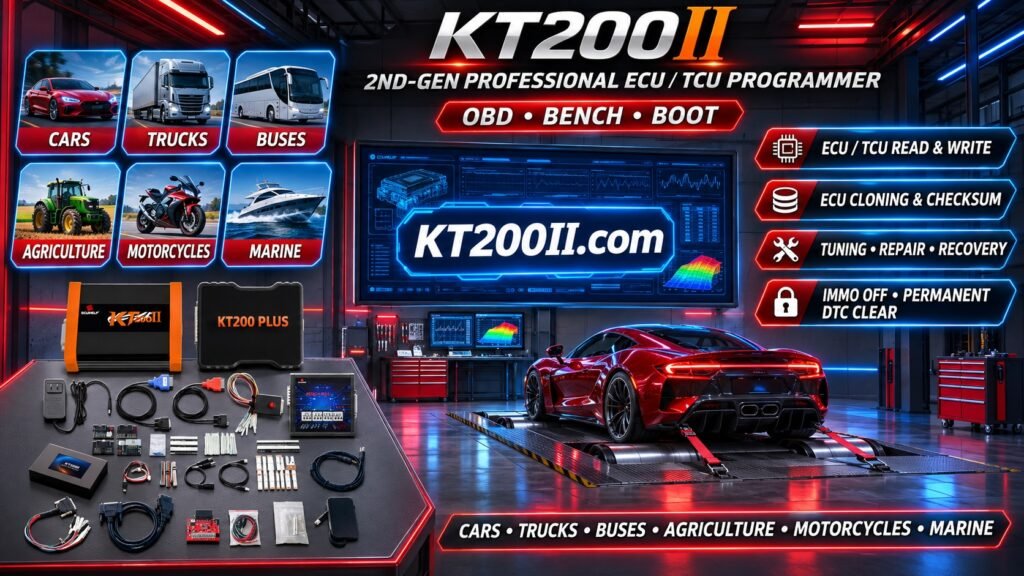
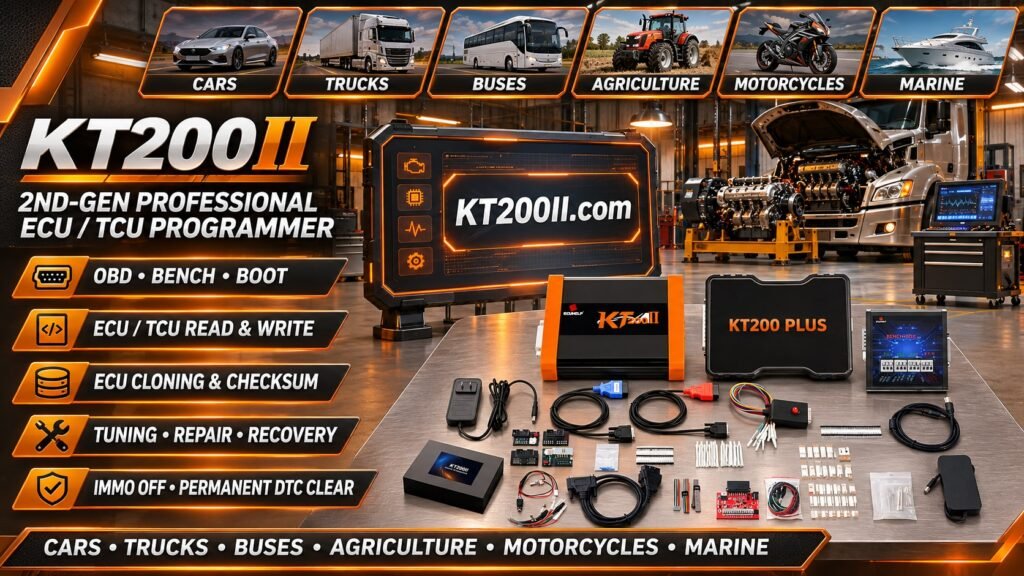
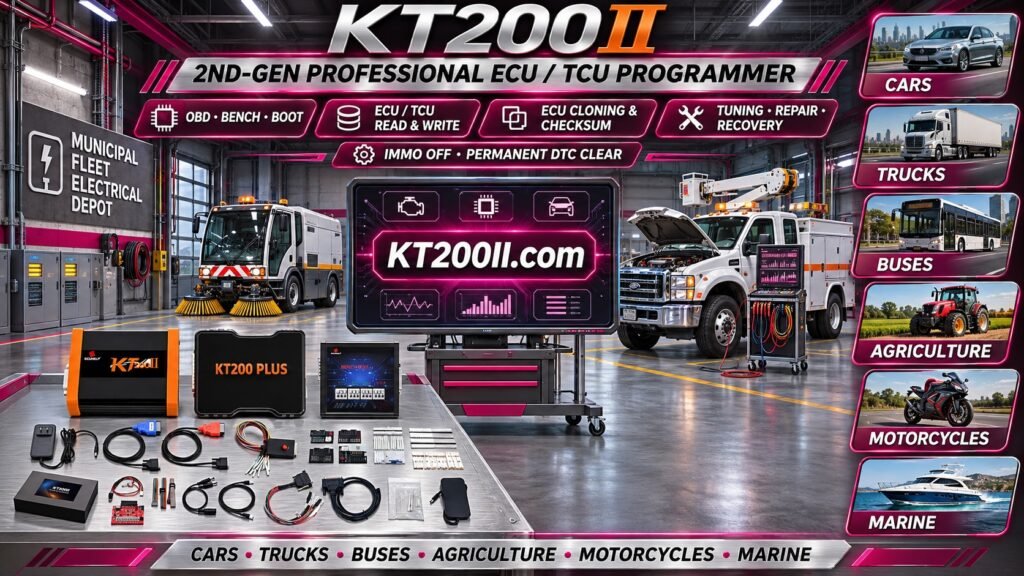
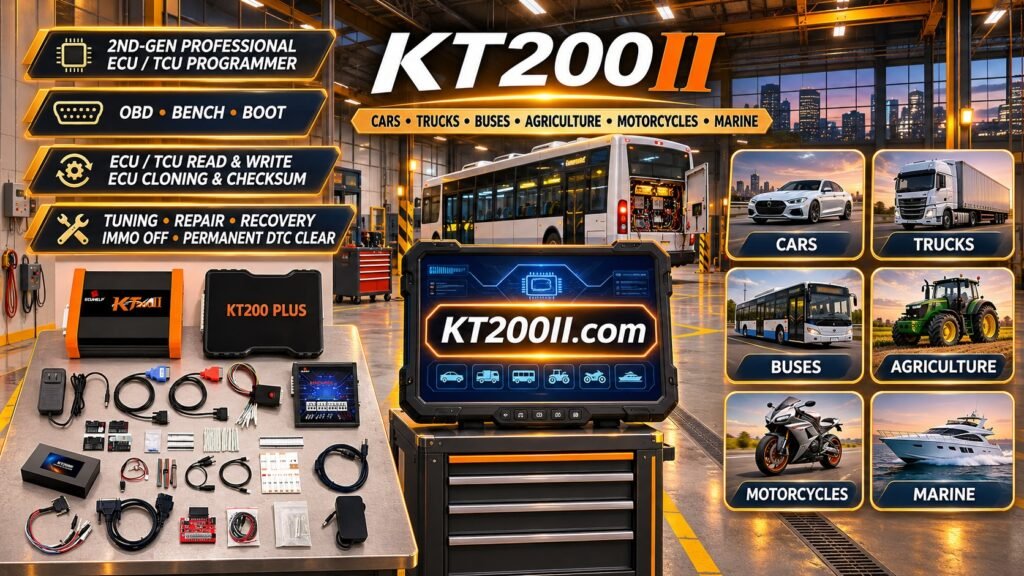
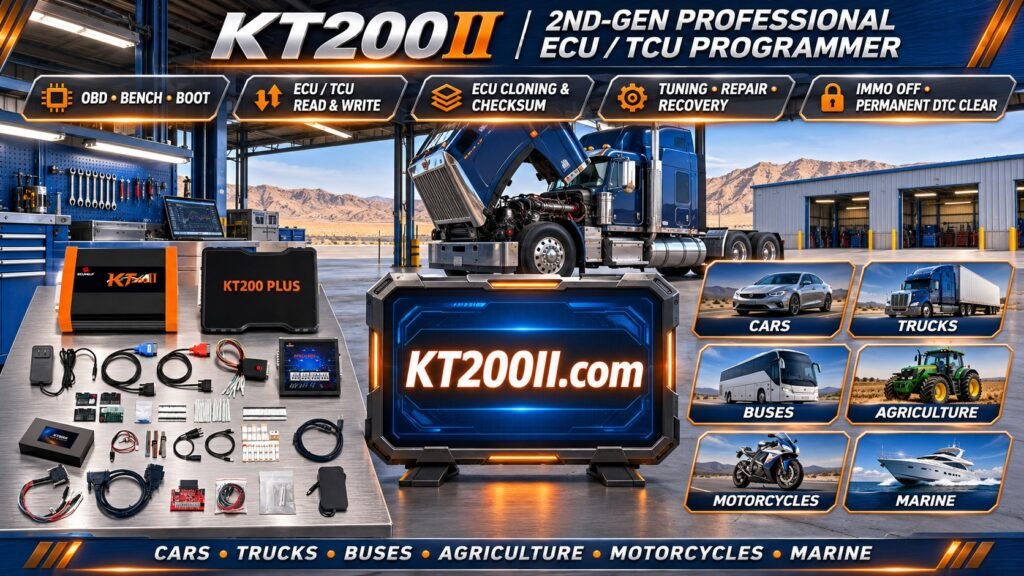
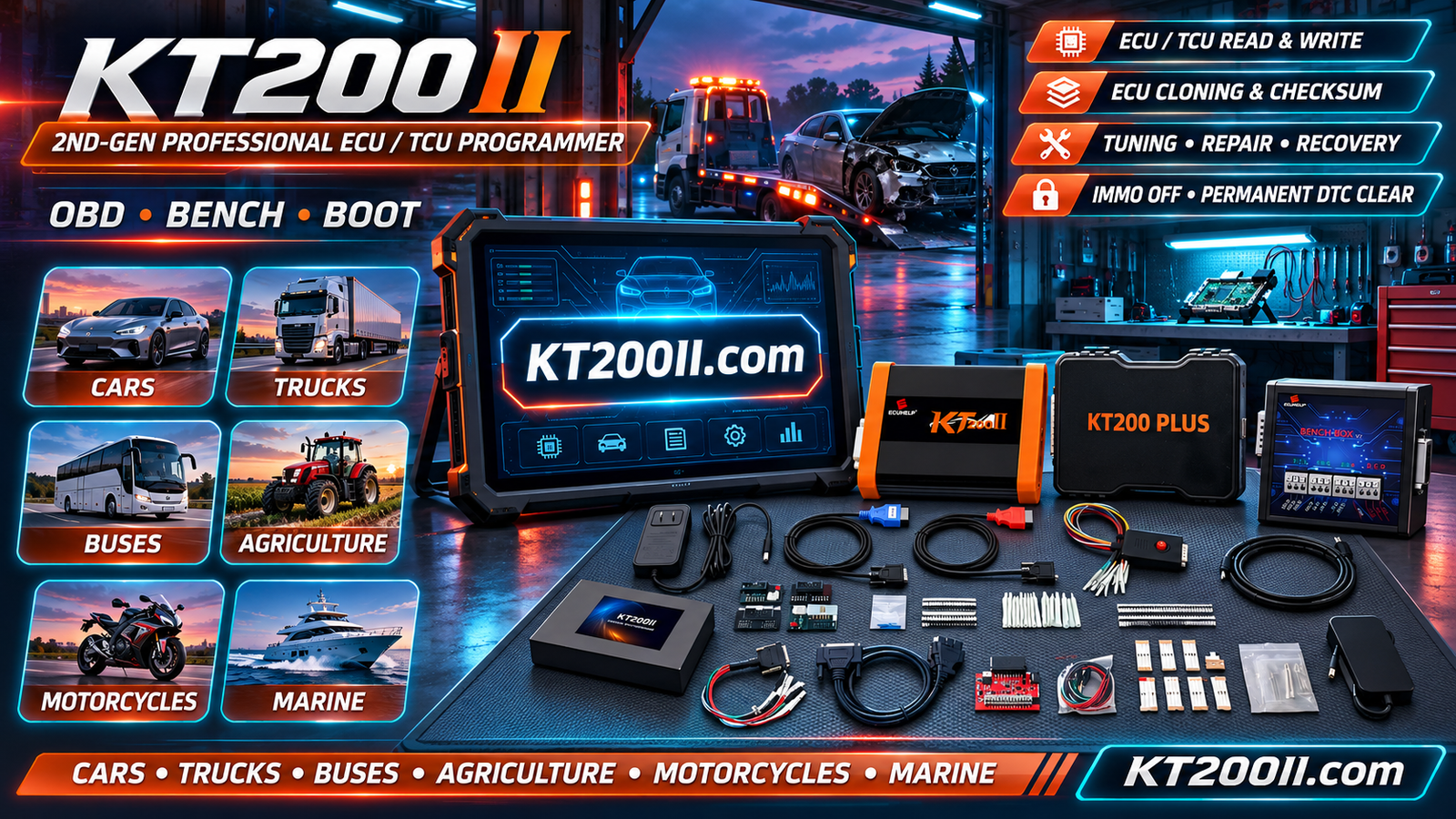
KT200II is a professional ECU and TCU programming solution designed for automotive electronics technicians and repair workshops.
For supported heavy-duty vehicle applications, KT200II can provide access to selected ECU programming operations according to the available protocol.
Depending on the exact controller, available functions may include:
- ECU identification.
- Supported Flash reading.
- Supported Flash writing.
- Selected EEPROM operations.
- OBD programming applications.
- Bench programming applications.
- Boot programming applications.
- Supported ECU replacement and cloning-related operations.
Available functions vary according to the ECU manufacturer, hardware version, processor and selected protocol.
Before starting a truck programming job, technicians should confirm the exact ECU part number and the required operations.
Explore product information and programming resources:
12. How to Choose an ECU Programmer for Truck Workshops
Choosing a suitable programming tool requires evaluating actual workshop requirements rather than relying only on general vehicle coverage claims.
Important considerations include:
- Supported commercial vehicle ECU models.
- Supported engine controller manufacturers.
- OBD programming coverage.
- Bench and Boot programming availability.
- Flash reading and writing functions.
- EEPROM operation availability.
- Required cables and adapters.
- Connection diagrams.
- Software updates.
- Technical support and documentation.
For workshops specializing in heavy-duty vehicles, verifying the exact ECU coverage before purchasing programming equipment is particularly important.
13. Heavy-Duty ECU Programming Checklist
Use this checklist before performing a truck ECU programming operation:
- Vehicle and engine identification completed.
- ECU manufacturer identified.
- Complete ECU part number recorded.
- Hardware and software versions checked.
- Processor information verified where necessary.
- Supported programming protocol confirmed.
- Correct OBD, Bench or Boot method selected.
- Connection diagram reviewed.
- Power supply and ground verified.
- Communication wiring inspected.
- Original data backed up where supported.
- Target file compatibility checked.
- Programming operation completed successfully.
- ECU communication verified.
- Final vehicle diagnostic checks performed.
Frequently Asked Questions
Can KT200II program heavy-duty truck ECUs?
KT200II supports selected heavy-duty ECU applications. The exact supported controllers and available operations depend on the protocol, hardware version and software coverage.
Does truck ECU programming always require Bench mode?
No. Some controllers support OBD programming, while others require Bench or Boot access. The correct method depends on the exact ECU and operation.
Can a truck ECU be cloned?
Selected heavy-duty ECUs support cloning-related procedures. Feasibility depends on original data accessibility, donor hardware compatibility and the available memory operations.
Why does a truck ECU fail to communicate?
Possible causes include insufficient power, poor grounding, CAN communication faults, incorrect wiring, unsupported protocols or internal ECU damage.
Is Flash reading enough for truck ECU cloning?
Not always. Some controllers require additional persistent memory or processor-specific information. The exact requirements depend on the ECU architecture.
Can all Scania, Iveco and Volvo ECUs be programmed with one tool?
No universal coverage should be assumed. Each manufacturer uses different ECU families and hardware generations. Always verify the exact controller in the supported protocol database.
What should I check before buying a truck ECU programmer?
Confirm the exact ECU models you work with, the required programming methods, Flash and EEPROM functions, cable requirements and available protocol coverage.
Conclusion
Heavy-duty diesel ECU programming requires accurate controller identification, a clear understanding of memory architecture and the correct programming method.
Whether working with truck ECU replacement, Flash backup, software updates or supported cloning procedures, technicians should always verify the exact hardware and protocol before starting.
KT200II provides professional ECU and TCU programming functions for selected automotive and commercial vehicle applications.
To learn more about supported programming methods, software and product information, visit the KT200II Official Website.