ECU Identification Guide: How to Identify ECU Part Numbers, Hardware and Software Versions
ECU Identification Guide: How to Identify ECU Part Numbers, Hardware and Software Versions
Correct ECU identification is one of the most important steps in automotive electronics programming. Before reading, writing, cloning or replacing an engine control unit, technicians need to establish exactly which controller they are working with.
Two ECUs may look almost identical but use different hardware revisions, processors, software versions and memory structures. Selecting the wrong programming protocol or software file can result in communication problems, unsuccessful programming or incorrect vehicle operation.
Understanding ECU identification helps technicians select compatible programming methods, verify replacement controllers and avoid unnecessary risks during electronic repairs.
This KT200II technical guide explains how to identify an ECU using its manufacturer label, part number, hardware reference, software identification and processor architecture.
1. What Is ECU Identification?
ECU identification is the process of determining the technical identity and configuration of an electronic control unit.
It involves collecting information that helps establish the controller's manufacturer, hardware design, software configuration and vehicle application.
Common identification information includes:
- ECU manufacturer.
- Complete ECU part number.
- Hardware number.
- Software number.
- Calibration identification.
- Processor family.
- Memory configuration.
- Vehicle manufacturer and application.
This information is important because programming compatibility is determined by more than the physical appearance of the ECU.
2. Where Can You Find ECU Identification Information?
There are several ways to identify an automotive ECU.
ECU Manufacturer Label
Most automotive ECUs have an identification label attached to the housing.
Depending on the manufacturer, the label may include:
- Manufacturer name.
- Part number.
- Hardware reference.
- Production information.
- Serial number.
- Barcode or QR code.
Photograph the complete label before removing or installing a controller. This provides a useful reference during programming and replacement work.
Diagnostic Software Identification
When the ECU communicates with diagnostic equipment, additional identification information may be available electronically.
This can include software references, calibration identifiers and controller-specific information.
Programming Software
Some ECU programming applications can identify supported controllers and display relevant information before a memory operation begins.
The information available depends on the ECU, communication method and software support.
3. Understanding the ECU Part Number
The ECU part number is one of the most important references when identifying a controller.
It is generally assigned by the vehicle manufacturer or ECU supplier to identify a specific product or configuration.
Part numbers may distinguish between:
- Different engine applications.
- Different vehicle models.
- Different production generations.
- Different hardware configurations.
- Different software or calibration variants.
Even a small difference in a part number can indicate an important technical distinction.
When searching for a compatible replacement ECU, compare the complete part number rather than relying on only the first few characters.
4. What Is an ECU Hardware Number?
The hardware number identifies the physical electronic configuration of a controller.
It may relate to the circuit board design, processor arrangement, electrical interfaces and other hardware characteristics.
Different hardware revisions may use:
- Different processors.
- Different memory components.
- Different circuit board layouts.
- Different communication interfaces.
- Different power supply arrangements.
This is why two ECUs with similar software references may still require different programming procedures.
Hardware identification is especially important when selecting a donor ECU for cloning or replacement.
5. What Is an ECU Software Number?
The software number identifies a particular software configuration or version associated with the controller.
Depending on the manufacturer, the software information may include application software, calibration references or other version identifiers.
Software identification helps technicians determine:
- Which software version is installed.
- Whether a replacement controller has a compatible configuration.
- Whether a software update may be available.
- Whether a programming file matches the target application.
- Whether two controllers use different software configurations.
Hardware compatibility does not automatically guarantee software compatibility.
Both should be evaluated before programming or replacement.
6. ECU Processor Identification
Modern ECUs use different microcontrollers and processor architectures to execute software and manage vehicle functions.
Processor identification can provide additional technical information about a controller.
Common processor manufacturers and families found in automotive electronics include:
- Infineon TriCore.
- NXP automotive microcontrollers.
- STMicroelectronics microcontrollers.
- Renesas automotive processors.
- Other automotive-specific microcontroller families.
Different processor architectures may require different programming protocols, memory access methods and connection procedures.
Identifying the processor can therefore help technicians understand which programming methods may be relevant.
However, processor identification alone does not establish complete ECU programming compatibility.
7. Understanding ECU Flash and EEPROM Identification
ECU identification should also consider the controller's memory architecture.
Flash Memory
Flash memory commonly stores executable software and may also contain calibration information.
Depending on the ECU, technicians may need to identify the Flash memory type, size and supported access method.
EEPROM Memory
EEPROM or equivalent persistent storage may contain configuration information and other controller-specific data.
Some ECU architectures use separate memory devices, while others integrate persistent storage into the main microcontroller.
Internal and External Memory
Some controllers use internal processor memory, while others use additional external memory components.
This distinction can affect the programming procedure and the data available for reading or writing.
Never assume that two ECUs use the same memory arrangement simply because they belong to the same vehicle family.
8. ECU Identification Through OBD
OBD communication is one of the common methods for obtaining ECU identification information.
When the controller supports the required diagnostic services, technicians may retrieve:
- ECU identification numbers.
- Software identification.
- Calibration references.
- Diagnostic trouble codes.
- Available controller information.
OBD identification is convenient because the ECU normally remains installed in the vehicle.
However, the information available depends on the controller and diagnostic protocol.
Some ECUs may provide only limited identification information through OBD.
9. ECU Identification Through Bench Programming
Bench programming involves connecting a removed ECU directly to compatible programming equipment using documented electrical connections.
Depending on the controller and supported protocol, Bench access may provide additional identification or memory access functions.
Before connecting the ECU, technicians should confirm:
- Complete ECU part number.
- Correct connector identification.
- Power supply connections.
- Ground connections.
- Communication pins.
- Required ignition or wake-up signals.
- Supported programming protocol.
Bench identification can be useful when the controller cannot be accessed through the vehicle diagnostic connector, provided the ECU remains electrically functional and supports the required method.
10. ECU Identification Through Boot Mode
Some ECU architectures support specialized Boot access procedures.
Depending on the processor and controller design, Boot access may provide identification and selected programming functions.
However, Boot procedures vary between ECU families.
Technicians should verify the exact processor, controller hardware and supported access procedure before attempting a Boot connection.
Boot access should not be assumed to be available on every ECU.
11. Why Similar ECU Part Numbers Can Be Misleading
One common mistake in ECU replacement and programming is assuming that similar part numbers always indicate compatible controllers.
In practice, different controllers may share similar housings or part number structures while using different hardware and software configurations.
Potential differences include:
- Processor generation.
- Hardware revision.
- Flash memory configuration.
- Software version.
- Engine application.
- Transmission configuration.
- Regional vehicle specifications.
Always compare the complete identification information before selecting a donor ECU or programming file.
12. ECU Identification Before Cloning or Replacement
Accurate identification is essential before performing an ECU cloning procedure.
When evaluating a donor controller, compare:
| Identification Item | Why It Matters |
|---|---|
| ECU manufacturer | Confirms controller supplier |
| Part number | Helps establish application compatibility |
| Hardware number | Identifies physical controller configuration |
| Software number | Identifies installed software configuration |
| Processor | Helps determine programming architecture |
| Memory structure | Determines required memory operations |
Some replacement procedures require additional coding, configuration or authorized immobilizer synchronization.
Do not assume that transferring memory data automatically resolves every vehicle compatibility requirement.
13. Common ECU Identification Mistakes
Using Only the Vehicle Model
The same vehicle model may use different ECUs depending on engine type, production year and market.
Ignoring Hardware Revisions
Controllers with similar software references may have different physical hardware.
Confusing Part Numbers
Manufacturer numbers, supplier numbers and software identifiers serve different purposes.
Assuming Processor Compatibility Means Full Support
Two controllers may use the same processor family but require different programming protocols.
Ignoring Memory Architecture
Different memory arrangements can change the available Read and Write operations.
Using an Unverified Programming File
A file that appears similar to the original software may still be incompatible with the target ECU.
14. Using KT200II for Supported ECU Identification and Programming
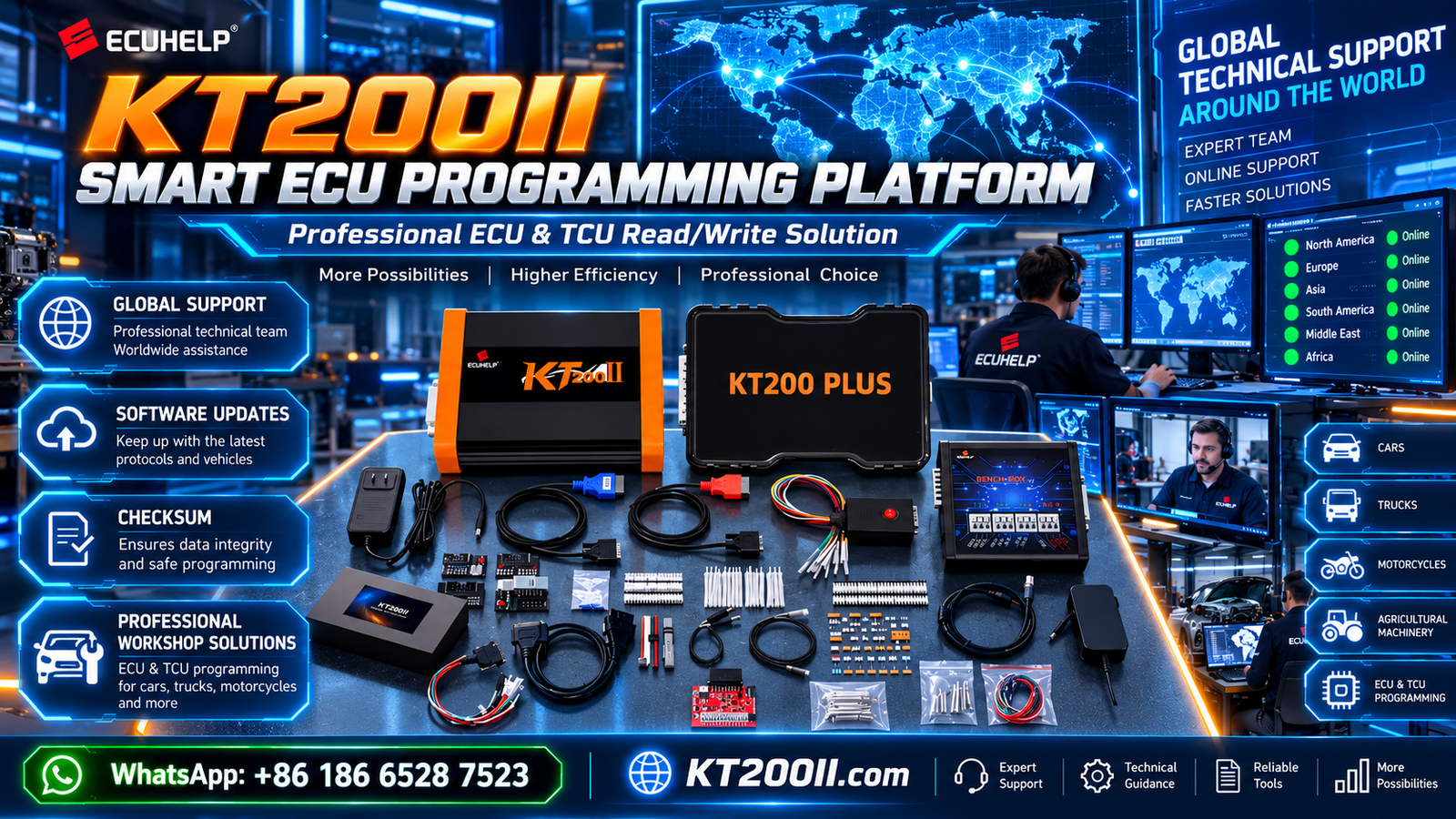
KT200II is an ECU and TCU programming device designed for compatible automotive controller applications.
Depending on the exact ECU, software version and supported programming method, available operations may include controller identification and selected memory Read and Write functions.
Before starting a programming job, technicians should verify:
- ECU manufacturer and complete part number.
- Hardware and software identification.
- Processor and memory architecture where relevant.
- Whether the exact ECU is supported.
- Whether OBD, Bench or Boot mode is required.
- Whether Flash Read and Write operations are available.
- Whether EEPROM or equivalent memory operations are supported.
Successful ECU identification does not automatically guarantee support for every programming operation.
Always check the exact controller and intended operation before proceeding.
Useful resources:
- KT200II Product Page
- KT200II Operation Modes
- KT200II Software
- KT200II Support List
- KT200II Technical Blog
For purchasing information, visit the ECUHELP Official Store.
15. ECU Identification Checklist for Professional Technicians
Before programming or replacing an ECU, review the following information:
- Vehicle manufacturer and model recorded.
- Engine type identified.
- Production year confirmed.
- ECU manufacturer identified.
- Complete ECU part number recorded.
- Hardware number checked.
- Software identification recorded.
- Processor family identified where necessary.
- Memory architecture investigated.
- Programming mode confirmed.
- Required memory operations verified.
- Replacement compatibility checked where applicable.
Frequently Asked Questions
Where can I find my ECU part number?
Most ECUs have a label on the housing containing the manufacturer, part number and other identification information. Additional details may be available through compatible diagnostic or programming equipment.
Are ECU hardware and software numbers the same?
No. Hardware numbers identify the physical controller configuration, while software numbers identify software or calibration versions.
Can two ECUs have the same part number but different software?
Depending on the manufacturer and production configuration, controllers may have different software versions even when certain hardware references are identical.
Can I identify an ECU without removing it?
Often, yes. Supported diagnostic equipment may retrieve ECU identification through the vehicle's OBD connector.
Does the ECU processor determine programming compatibility?
Processor information is important, but complete compatibility also depends on hardware, software, memory architecture and the supported programming protocol.
Can I use a donor ECU with a different hardware number?
It depends on the manufacturer's compatibility information and the specific replacement procedure. A different hardware number should never be assumed compatible without verification.
Does KT200II support all ECU manufacturers?
No programming device should be assumed to support every controller. Check the exact ECU identification against the KT200II support information.
Conclusion
Accurate ECU identification is the foundation of reliable automotive electronics programming. Part numbers, hardware references, software versions, processor architecture and memory configuration all provide important information about a controller.
Before performing ECU Read, Write, cloning or replacement procedures, technicians should verify the complete controller identity rather than relying only on vehicle model or connector appearance.
A careful identification process helps reduce compatibility problems, improve programming preparation and support more reliable automotive electronic repairs.
For more ECU programming information, software resources and controller compatibility details, visit the KT200II Official Website.