Automotive ECU Communication Protocols Explained: CAN, K-Line, UDS and KWP2000
Automotive ECU Communication Protocols Explained: CAN, K-Line, UDS and KWP2000
Modern vehicles contain numerous electronic control units responsible for engine management, transmission operation, braking systems, body electronics and other important functions. These modules communicate with diagnostic equipment and each other through different automotive communication technologies.
For automotive technicians working with ECU programming, understanding communication protocols is essential. The selected protocol determines how diagnostic equipment exchanges information with a controller and, in supported applications, accesses programming functions.
CAN, K-Line, UDS and KWP2000 are commonly encountered in automotive electronics. Although they are related, they do not represent exactly the same type of technology.
This KT200II technical guide explains the major automotive communication protocols, their differences and what technicians should understand before performing ECU diagnostics or programming.
1. What Are ECU Communication Protocols?
ECU communication protocols define how electronic control units exchange information with diagnostic equipment and other vehicle modules.
Depending on the vehicle architecture, communication systems can be used for:
- Reading diagnostic trouble codes (DTCs).
- Retrieving ECU identification information.
- Monitoring live vehicle data.
- Performing supported diagnostic routines.
- Accessing supported ECU programming functions.
- Communicating between different vehicle modules.
Different manufacturers and vehicle generations use different communication technologies.
Some older vehicles rely on K-Line communication, while many modern vehicles use CAN-based networks. Newer vehicle architectures may also incorporate Ethernet-based communication.
Understanding the communication system helps technicians select suitable diagnostic interfaces and programming methods.
2. What Is CAN Bus?
CAN stands for Controller Area Network. It is a communication network designed to allow electronic control units to exchange information efficiently.
Instead of requiring a separate communication connection between every pair of modules, CAN allows multiple controllers to communicate over a shared network.
Common characteristics include:
- Communication between multiple electronic control units.
- Message-based data transmission.
- Arbitration that allows messages to receive different priorities.
- Error detection mechanisms.
- Reduced wiring requirements compared with many point-to-point architectures.
CAN-H and CAN-L
High-speed CAN commonly uses two communication lines:
- CAN-H: CAN High signal line.
- CAN-L: CAN Low signal line.
These two lines work together to transmit differential signals, improving communication reliability in electrically noisy automotive environments.
Technicians should identify CAN-H and CAN-L using the correct wiring diagram before making electrical connections.
Where Is CAN Used?
CAN communication is widely used in modern vehicles for systems such as:
- Engine control modules.
- Transmission control modules.
- ABS and electronic stability systems.
- Body control modules.
- Instrument clusters.
- Other vehicle electronic systems.
CAN is a communication network technology. It does not automatically mean that every ECU connected through CAN supports programming or memory access.
3. What Is K-Line Communication?
K-Line is an older automotive serial communication technology used in many vehicle diagnostic systems.
It is commonly associated with ISO 9141-2 and ISO 14230 communication standards.
Unlike high-speed CAN, traditional K-Line diagnostic communication generally uses a single communication wire.
Common characteristics include:
- Single-wire communication.
- Serial data transmission.
- Use in older automotive diagnostic architectures.
- Compatibility with certain manufacturer-specific diagnostic systems.
- Communication initialization requirements that depend on the applicable standard.
Where Is K-Line Used?
K-Line can be found in various older vehicle diagnostic applications, including:
- Engine control units.
- Transmission electronics.
- ABS modules.
- Body electronic systems.
- Manufacturer-specific diagnostic interfaces.
Some vehicles use K-Line for certain modules while using CAN for other systems.
Therefore, technicians should not assume that an entire vehicle uses only one communication technology.
4. What Is UDS Protocol?
UDS stands for Unified Diagnostic Services. It is an automotive diagnostic application-layer protocol standardized under ISO 14229.
UDS provides a structured set of diagnostic services that allow suitable diagnostic equipment to communicate with electronic control units.
Depending on the controller and its supported services, UDS can provide functions such as:
- Diagnostic trouble code management.
- Reading ECU identification information.
- Reading supported data identifiers.
- Executing diagnostic routines.
- Entering diagnostic sessions.
- Security access.
- Supported software download and programming procedures.
Common UDS Diagnostic Services
UDS uses service identifiers to identify different diagnostic operations.
| Service | Function |
|---|---|
| 0x10 | Diagnostic Session Control |
| 0x11 | ECU Reset |
| 0x14 | Clear Diagnostic Information |
| 0x19 | Read DTC Information |
| 0x22 | Read Data By Identifier |
| 0x27 | Security Access |
| 0x2E | Write Data By Identifier |
| 0x31 | Routine Control |
| 0x34 | Request Download |
| 0x36 | Transfer Data |
| 0x37 | Request Transfer Exit |
Not every ECU implements every UDS service. The available functions depend on the controller, diagnostic session, security permissions and manufacturer configuration.
UDS and ECU Programming
UDS is particularly relevant to modern ECU programming because its diagnostic services can support software download procedures on compatible controllers.
However, the presence of UDS communication does not guarantee that a particular programmer can access every memory region or perform every programming operation.
Programming support must be verified for the exact ECU and intended operation.
5. What Is KWP2000?
KWP2000 stands for Keyword Protocol 2000 and is standardized under ISO 14230.
It is an automotive diagnostic communication protocol that has been used in numerous vehicle applications.
KWP2000 supports diagnostic services that allow suitable equipment to communicate with vehicle control modules.
Depending on the implementation, these functions may include:
- Reading diagnostic trouble codes.
- Clearing fault codes.
- Retrieving controller identification.
- Accessing diagnostic sessions.
- Reading supported data.
- Performing certain programming-related operations.
KWP2000 is commonly associated with K-Line implementations, although related protocol implementations can also use CAN transport.
It is important to distinguish KWP2000 from K-Line itself: KWP2000 defines diagnostic communication services, while K-Line describes a communication interface commonly used to carry those messages.
6. What Is DoIP?
DoIP stands for Diagnostics over Internet Protocol. It is an automotive diagnostic communication technology standardized under ISO 13400.
DoIP allows diagnostic communication to take place over Ethernet-based vehicle networks.
As vehicle electronic architectures become more complex, Ethernet provides higher communication bandwidth than many traditional automotive diagnostic interfaces.
DoIP is relevant to newer vehicle architectures and diagnostic systems that require faster data exchange.
Typical applications may include:
- Advanced vehicle diagnostics.
- Communication with modern electronic control modules.
- Manufacturer-specific diagnostic procedures.
- Supported software programming workflows.
DoIP is not simply ordinary internet access to a vehicle. It is a standardized automotive diagnostic transport technology with specific communication requirements.
Support depends on the vehicle architecture and the diagnostic equipment being used.
7. CAN vs K-Line vs UDS vs KWP2000 vs DoIP
Although these technologies are often discussed together, they operate at different levels or serve different communication purposes.
| Technology | Category | Typical Application |
|---|---|---|
| CAN | Communication network / data link technology | Communication between vehicle modules |
| K-Line | Physical communication interface | Older vehicle diagnostic connections |
| UDS | Diagnostic application protocol | Modern ECU diagnostics and supported programming |
| KWP2000 | Diagnostic application protocol | Legacy ECU diagnostics and programming applications |
| DoIP | Automotive diagnostic communication over IP | Ethernet-based vehicle diagnostics |
One important distinction is that CAN and K-Line are not direct alternatives to UDS and KWP2000 in every context.
For example, UDS can operate over CAN, while KWP2000 can also be transported through different supported communication arrangements.
The actual combination depends on the vehicle and ECU implementation.
8. Why Do Communication Protocols Matter in ECU Programming?
When using an ECU programmer, selecting the correct communication method is essential.
A programming tool must establish communication using the appropriate interface and protocol before performing supported controller operations.
Incorrect protocol selection may result in:
- ECU identification failure.
- Communication timeouts.
- Unexpected diagnostic responses.
- Unavailable Read or Write functions.
- Programming operations being rejected.
Before beginning, technicians should verify:
- The exact ECU manufacturer and part number.
- The vehicle and controller generation.
- The supported communication interface.
- The required diagnostic or programming protocol.
- The available programming mode.
- The specific Read or Write operation.
Do not assume that a vehicle using CAN communication automatically supports every CAN-based programming function.
9. Why Can an ECU Communicate but Still Fail to Read or Write?
This is a common question among ECU programming technicians.
Successful communication only confirms that the equipment can establish some level of communication with the controller. It does not necessarily mean that every programming function is available.
Possible reasons include:
- The selected protocol supports identification but not memory access.
- The ECU requires another diagnostic session.
- The requested operation is not implemented by the controller.
- Additional authorized security access is required.
- The selected programming mode is incorrect.
- The ECU requires a different connection method.
- The programming equipment does not support the requested memory operation.
Technicians should distinguish between diagnostic communication, ECU identification and actual memory programming capabilities.
10. Troubleshooting Common ECU Communication Problems
CAN Communication Failure
Check CAN-H and CAN-L wiring, connector condition, power supply and ground connections. Where appropriate, inspect the network using suitable diagnostic instruments and the vehicle's wiring documentation.
K-Line Communication Failure
Verify the K-Line connection, diagnostic interface compatibility and required initialization procedure.
UDS Communication Timeout
Check the selected diagnostic session, controller response requirements, communication configuration and electrical stability.
ECU Identification Works but Programming Fails
Confirm that the exact memory operation is supported and that the required programming access conditions have been met.
Communication Is Intermittent
Inspect connectors, wiring and power supply stability. Avoid beginning a Write operation until communication is reliable.
11. Using KT200II for Supported ECU Programming Applications
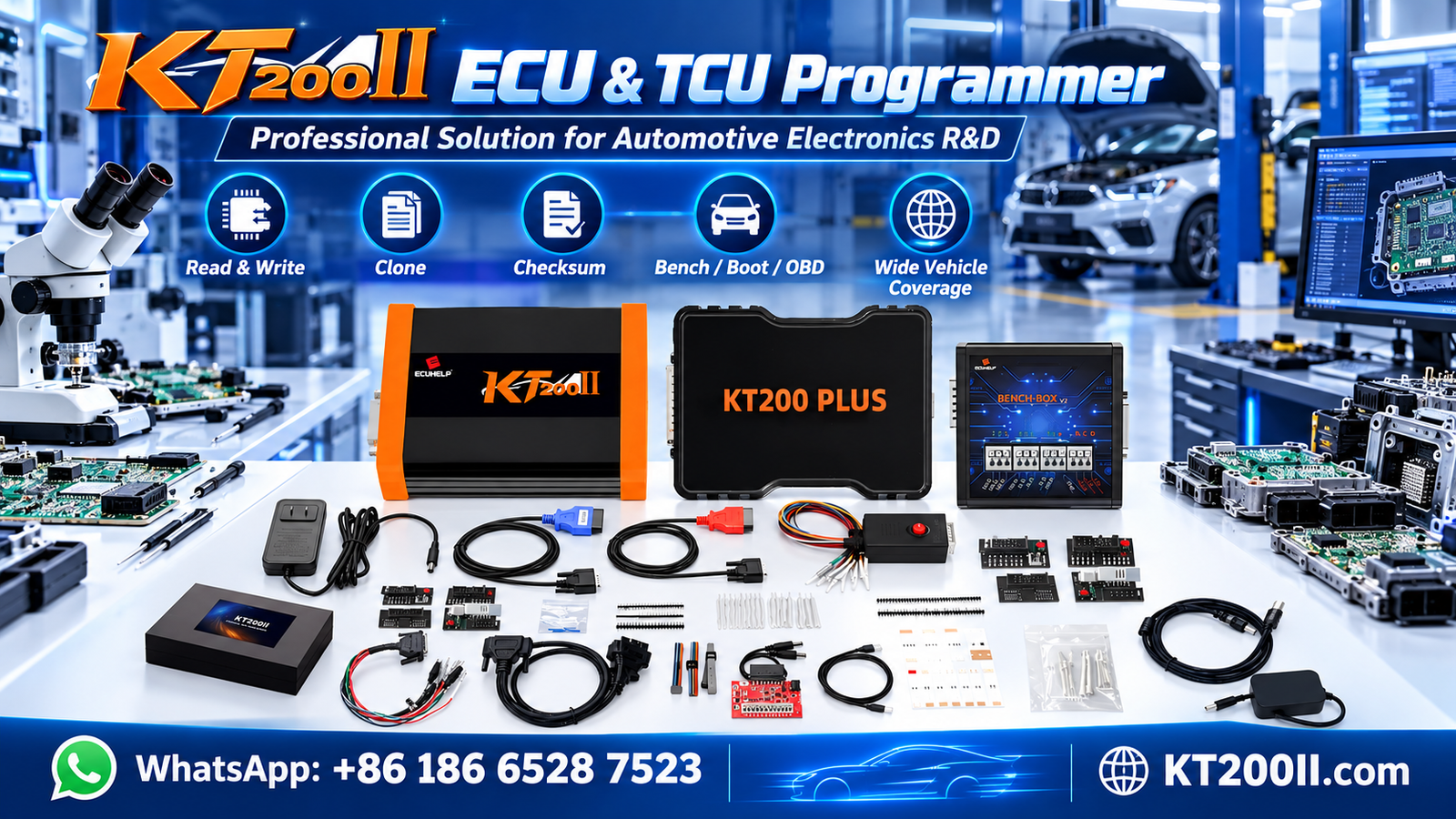
KT200II is an ECU and TCU programming device designed for compatible controller applications.
Depending on the exact ECU, supported protocol and programming method, available functions may include controller identification and selected memory Read and Write operations.
Before using KT200II, technicians should verify:
- Whether the target ECU is supported.
- The appropriate programming mode.
- The required communication connections.
- Whether the intended Read operation is available.
- Whether the corresponding Write operation is supported.
- Whether additional cables or adapters are required.
- Any controller-specific security or electrical requirements.
Protocol identification alone does not establish complete ECU programming support. Always verify the exact controller and operation.
Useful resources:
- KT200II Product Page
- KT200II Operation Modes
- KT200II Software
- KT200II Support List
- KT200II Technical Blog
12. Best Practices for ECU Communication and Programming
Professional technicians should follow a consistent process when working with vehicle communication systems.
- Identify the exact controller before connecting equipment.
- Check the vehicle wiring diagram.
- Understand the difference between communication interfaces and diagnostic protocols.
- Verify the selected programming method.
- Check electrical connections and power supply stability.
- Confirm the intended memory operation is supported.
- Preserve original data where supported.
- Record communication errors and diagnostic responses.
- Follow the manufacturer's programming requirements.
ECU Communication Protocol Checklist
- Vehicle and ECU identified.
- ECU part number recorded.
- Communication interface confirmed.
- CAN, K-Line or Ethernet connections verified where applicable.
- Diagnostic protocol identified where available.
- Programming tool compatibility checked.
- Required Read or Write operation confirmed.
- Electrical connections inspected.
- Communication successfully established.
- Programming results verified.
Frequently Asked Questions
Is CAN the same as UDS?
No. CAN is a communication network technology, while UDS is a diagnostic application-layer protocol. UDS can operate over CAN in supported vehicle architectures.
What is the difference between CAN-H and CAN-L?
CAN-H and CAN-L are the two signal lines used in common high-speed CAN communication. They transmit differential signals to improve communication reliability.
Is K-Line an old communication technology?
K-Line is commonly associated with older automotive diagnostic systems. It is still relevant when servicing vehicles that use compatible K-Line interfaces and protocols.
Is KWP2000 the same as K-Line?
No. KWP2000 is a diagnostic communication protocol, while K-Line is a physical communication interface commonly used to carry KWP2000 messages.
Can UDS be used for ECU programming?
UDS provides services that can support programming procedures on compatible controllers. Actual programming availability depends on the ECU implementation and authorized access requirements.
Does CAN communication mean an ECU supports Bench programming?
No. CAN communication alone does not establish Bench programming support. The controller must support the specific programming method and operation.
Why does my ECU programmer identify the ECU but fail to read it?
Identification and memory reading are separate functions. The selected protocol may support identification without providing access to the requested memory region.
Conclusion
Understanding automotive ECU communication protocols is essential for modern diagnostic and programming work.
CAN, K-Line, UDS, KWP2000 and DoIP serve different roles in vehicle electronic communication. Knowing the differences helps technicians understand controller connections, select appropriate programming methods and investigate communication failures more effectively.
Most importantly, successful communication does not automatically guarantee ECU Read or Write support. Always verify the exact controller, programming protocol and intended operation before beginning.
For more information about ECU and TCU programming equipment, visit the KT200II Product Page and the KT200II Support List.