
Motorcycle ECU Programming: Compatibility, Read Write and Technical Guide
Motorcycle ECU Programming: Compatibility, Read Write and Technical Guide
Modern motorcycles increasingly rely on electronic engine management systems to control fuel injection, ignition timing, engine performance and emissions-related functions. As motorcycle technology develops, electronic control unit (ECU) programming has become an important part of professional motorcycle diagnostics and repair.
When a motorcycle develops an electronic problem or requires ECU replacement, technicians may need to identify the controller, retrieve available software information or perform supported programming operations.
However, motorcycle ECU programming is not identical across manufacturers. Different motorcycle models use different ECU hardware, communication protocols and memory configurations.
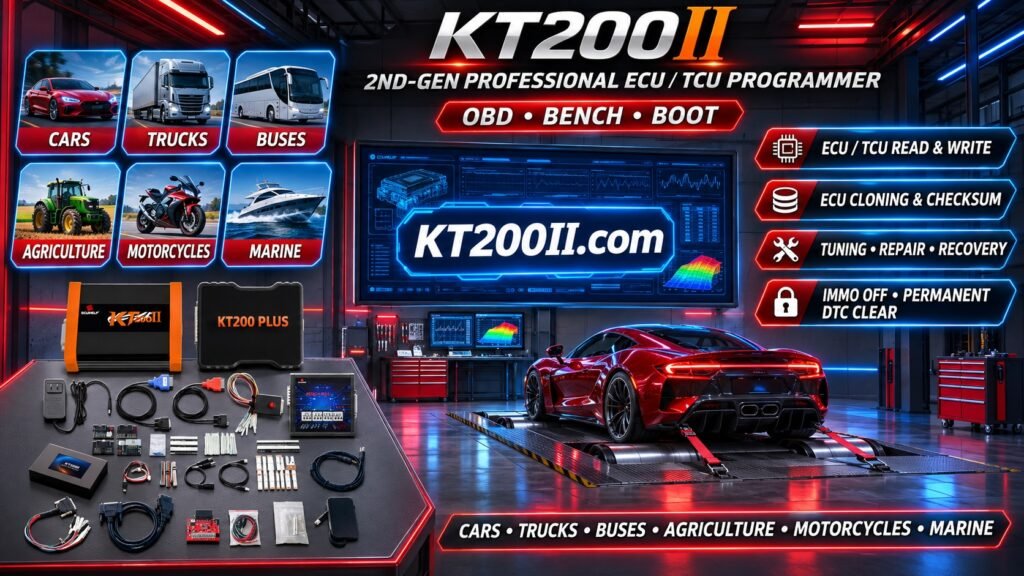
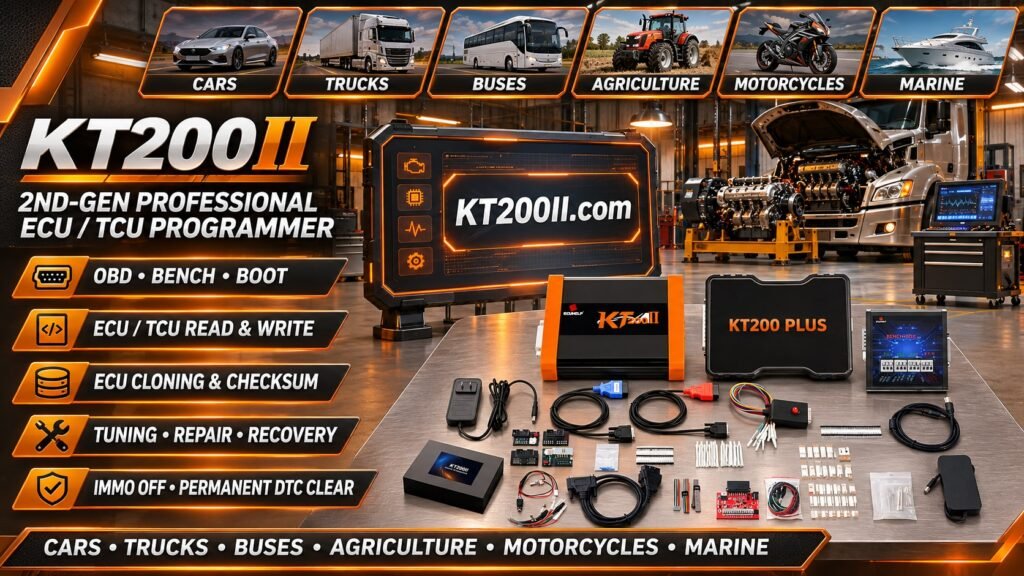
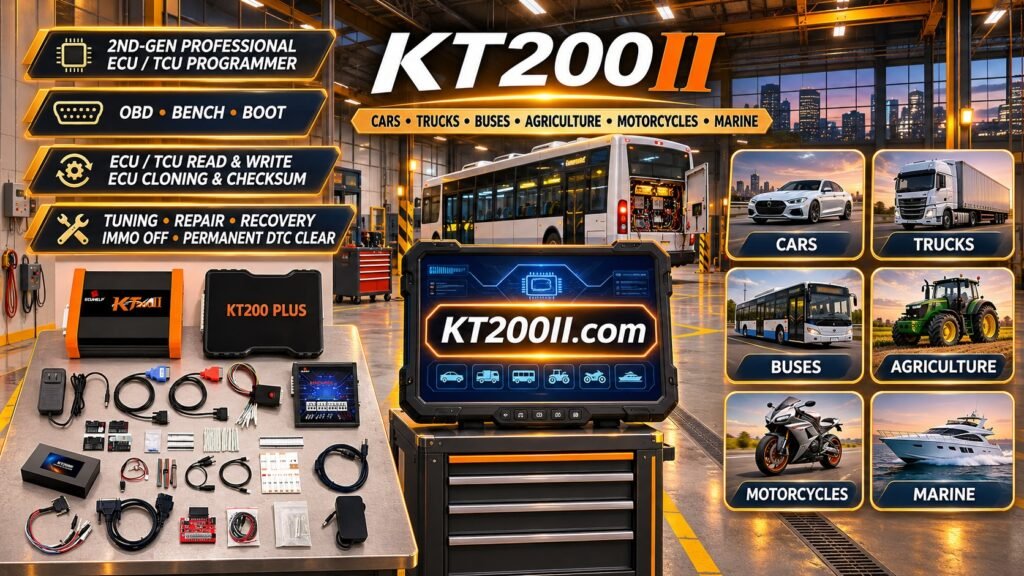
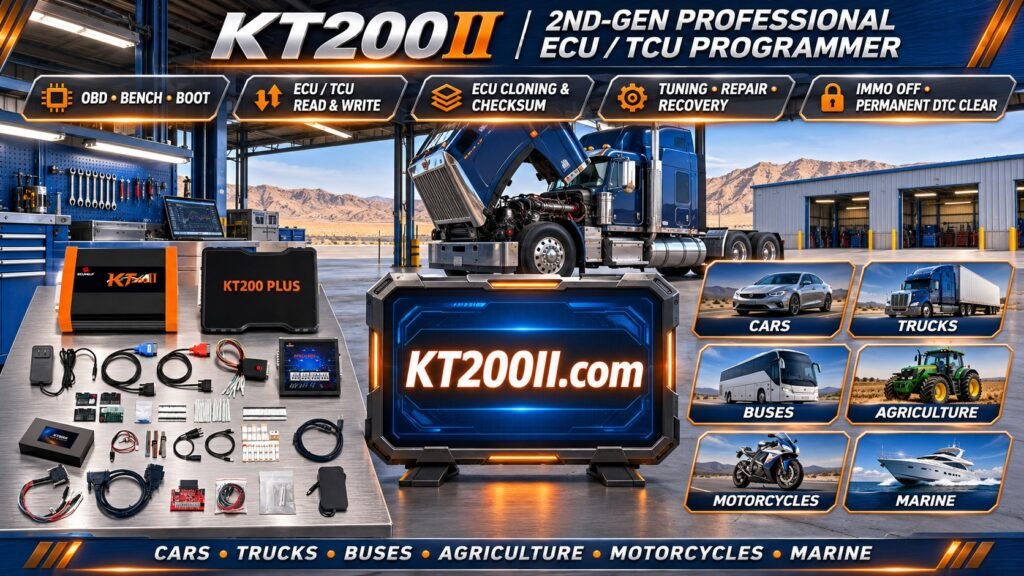
This KT200II guide explains motorcycle ECU programming fundamentals, compatibility checks, programming methods and important precautions for technicians working with motorcycle electronic control systems.
1. What Is a Motorcycle ECU?
A motorcycle ECU is an electronic controller responsible for managing various engine operating functions. On fuel-injected motorcycles, it processes information from multiple sensors and controls the engine according to programmed operating strategies.
Depending on the motorcycle and ECU architecture, the controller may manage:
- Electronic fuel injection.
- Ignition timing.
- Engine speed and load calculations.
- Throttle position information.
- Air and engine temperature inputs.
- Emission-related engine management functions.
- Communication with other electronic systems.
Different motorcycles use different ECU manufacturers and controller families. Even motorcycles from the same manufacturer may have different electronic configurations depending on their engine, production year and market.
For this reason, technicians should identify the exact ECU rather than relying only on the motorcycle model name.
2. What Is Motorcycle ECU Programming?
Motorcycle ECU programming involves reading or writing supported software and data within an electronic engine controller.
Depending on the controller and programming equipment, available operations may include:
- Reading available ECU identification information.
- Retrieving supported memory regions.
- Backing up accessible original ECU data.
- Writing compatible software files.
- Performing certain supported ECU replacement procedures.
- Supporting specific controller repair and recovery operations.
Not every motorcycle ECU supports all these operations. Some controllers allow identification but have limited Read or Write functionality through a particular programming method.
Before starting, establish the exact ECU and determine which operation is supported.
3. Identify the Motorcycle ECU Before Programming
Accurate ECU identification is essential for selecting the correct programming protocol and avoiding incompatible files.
Record the following information wherever available:
- Motorcycle manufacturer and model.
- Production year and engine displacement.
- ECU manufacturer.
- Complete ECU part number.
- Hardware number and revision.
- Software identification or calibration reference.
- Processor information, where relevant.
The ECU label is usually a useful starting point. If the controller can communicate with diagnostic equipment, electronic identification may provide additional information.
Do not assume that two motorcycles with the same engine displacement use identical ECU software or programming protocols.
4. Understand Different Motorcycle ECU Systems
Motorcycle manufacturers use different electronic architectures depending on the vehicle category and engine design.
Common categories include:
Small-Displacement Motorcycles
Many small-displacement motorcycles use relatively compact engine management systems. Their ECU architecture and available programming functions vary according to the manufacturer and production generation.
Sport Motorcycles
Performance-oriented motorcycles may use more sophisticated engine management systems, with multiple sensors and additional electronic control functions.
Touring Motorcycles
Touring models may integrate engine management with other electronic systems, depending on the manufacturer and model.
Adventure and Off-Road Motorcycles
These motorcycles may use different engine control configurations depending on their intended operating environment, engine type and emissions requirements.
These categories are useful for understanding the motorcycle market, but they do not establish ECU programming compatibility. Always verify the exact controller.
5. Motorcycle ECU OBD and Diagnostic Connections
Some motorcycles provide diagnostic access through dedicated connectors, while others use manufacturer-specific communication arrangements.
Before selecting a programming method, technicians should establish:
- The motorcycle's diagnostic connector type.
- The applicable communication protocol.
- Whether the ECU supports the intended operation through diagnostics.
- Whether a specific adapter is required.
- Whether additional electrical connections are necessary.
A motorcycle diagnostic connector does not automatically provide access to every ECU memory region.
Successful diagnostic communication and ECU programming are also different capabilities. A diagnostic tool may read fault codes without supporting software Read or Write operations.
6. Motorcycle ECU Bench Programming
Bench programming involves connecting a removed ECU directly to compatible programming equipment using documented electrical connections.
For supported motorcycle controllers, Bench programming may provide access to selected memory operations that are unavailable through the vehicle's diagnostic connector.
Before starting a Bench operation, verify:
- The exact ECU part number and hardware revision.
- The correct connector and pin assignments.
- Power supply and ground requirements.
- Communication line assignments.
- Required ignition or wake-up signals.
- Compatibility of the selected cable and adapter.
- Support for the intended Read or Write operation.
Motorcycle ECUs may use compact connectors and manufacturer-specific pin arrangements. Never assume that a wiring diagram for a similar motorcycle is suitable for the target controller.
Always use verified technical documentation before applying power.
7. Motorcycle ECU Flash and EEPROM Data
Understanding memory organization is important when reading or writing motorcycle ECU data.
Flash Memory
Flash memory commonly contains executable ECU software and may also store calibration information, depending on the controller.
Depending on the application, Flash data may relate to:
- Engine management software.
- Fuel injection strategies.
- Ignition control strategies.
- Engine operating parameters.
- Other controller-specific functions.
EEPROM or Persistent Storage
EEPROM or equivalent storage may contain configuration information, adaptation data and other controller-specific information.
The actual memory arrangement differs between manufacturers and ECU generations.
Not every motorcycle ECU exposes separate Flash and EEPROM operations. Some controllers use integrated or alternative memory architectures.
Before reading or writing data, determine which memory regions are supported by the selected programming protocol.
8. Back Up Original Motorcycle ECU Data
Where supported, preserving original ECU data before programming is an important workshop practice.
An original backup may provide a reference for certain repair, comparison and replacement procedures.
A recommended workflow includes:
- Record the complete ECU identification information.
- Confirm which memory Read operations are supported.
- Retrieve the required data using the documented method.
- Verify that the Read operation completed successfully.
- Save original files separately from modified working copies.
- Record which memory regions are included in each backup.
A successful Read operation does not necessarily mean that every memory region has been retrieved.
Keep original data unchanged whenever possible and maintain an additional backup of important files.
9. Verify Software Compatibility Before Writing
Motorcycle ECU software must match the target controller and intended application. A file from a similar motorcycle may still contain incompatible hardware or calibration information.
Before writing, check:
- ECU manufacturer and part number.
- Hardware revision.
- Software identification.
- Motorcycle model and engine configuration.
- File source and intended application.
- Target memory region.
- Applicable checksum requirements.
Checksum validation, where required, helps maintain data integrity. However, a valid checksum does not guarantee that the file is compatible with the motorcycle ECU.
Use verified files and follow the appropriate programming documentation.
10. Common Motorcycle ECU Programming Problems
The ECU Cannot Be Identified
Check the power supply, ground, communication connections and selected protocol. Confirm that the exact ECU is supported.
The Motorcycle ECU Is Not Supported Through OBD
Determine whether another documented programming method is available for that controller. Do not assume that Bench access automatically supports the same operations.
The Read Operation Fails
Verify the requested memory region, selected protocol, electrical connections and programming software requirements.
The Write Operation Is Rejected
Check the file compatibility, hardware and software identification, target memory region and applicable validation requirements.
The Motorcycle Has Fault Codes After Programming
Perform an appropriate diagnostic scan and investigate whether the issue relates to software, configuration, communication, sensors or another vehicle system.
Communication Is Interrupted During Programming
Record the error message and follow the controller-specific recovery procedure. Avoid repeating a failed Write operation without identifying the cause.
11. Motorcycle ECU Programming with KT200II
KT200II is an ECU and TCU programming solution for compatible controller applications. Its available functions depend on the exact ECU, software version and supported programming protocol.
When considering KT200II for motorcycle ECU work, technicians should verify:
- Whether the exact motorcycle ECU is supported.
- Whether the required identification function is available.
- Whether the intended Read and Write operations are supported.
- Which OBD, Bench or specialized access method is required.
- Whether additional cables or adapters are necessary.
- Whether the software file matches the target controller.
- Whether additional manufacturer-specific procedures are required.
Do not assume that support for one motorcycle ECU guarantees support for every controller from the same manufacturer.
Useful resources:
- KT200II Product Page
- KT200II Operation Modes
- KT200II Software
- KT200II Support List
- KT200II Technical Blog
12. Best Practices for Motorcycle ECU Technicians
Following a consistent procedure helps reduce programming mistakes and improve workshop efficiency.
- Identify the exact motorcycle ECU before connecting equipment.
- Verify hardware and software compatibility.
- Confirm support for the intended programming operation.
- Use the correct wiring diagram and programming method.
- Check electrical connections before starting.
- Preserve original data where supported.
- Verify file compatibility before writing.
- Record programming errors and operation results.
- Perform appropriate diagnostics after programming.
- Follow applicable manufacturer and emissions requirements.
Motorcycle ECU Programming Checklist
- Record motorcycle model and engine information.
- Identify the ECU manufacturer and part number.
- Check hardware and software identification.
- Confirm programming tool compatibility.
- Verify the correct OBD or Bench method.
- Check power, ground and communication connections.
- Back up original data where supported.
- Verify the intended file before writing.
- Complete the programming procedure.
- Perform appropriate diagnostic and functional checks.
Frequently Asked Questions
Can KT200II program every motorcycle ECU?
No universal coverage should be assumed. Compatibility depends on the exact ECU, software version, programming protocol and intended operation. Check the support information before starting.
Can motorcycle ECUs be programmed through OBD?
Some supported controllers allow selected operations through diagnostic connections. Others may require Bench or another specialized method.
Can motorcycle ECU data be backed up?
Where the controller and programming protocol support the necessary Read operations, original data can be retrieved and saved. Verify which memory regions are included.
Do motorcycle ECUs use Flash and EEPROM?
Many controller architectures use Flash and persistent storage, but the exact memory arrangement varies. Some controllers use integrated or alternative memory technologies.
Can I use an ECU from another motorcycle as a replacement?
Only after verifying hardware and software compatibility and any required coding, security or initialization procedures. Similar motorcycle models do not guarantee interchangeable ECUs.
Why can a motorcycle ECU communicate but fail to write?
Identification and Write operations are separate capabilities. The selected protocol may identify the ECU without supporting the required memory operation.
Conclusion
Motorcycle ECU programming requires accurate controller identification, verified compatibility, correct electrical connections and an appropriate programming method.
Before reading or writing motorcycle ECU data, confirm the exact controller, preserve original information where supported and verify the intended software file. After programming, complete the appropriate diagnostic and functional checks.
For more information about ECU and TCU programming equipment, visit the KT200II Product Page and the KT200II Support List.