TCU Programming Explained: Transmission Control Module Reading, Writing and Replacement
TCU Programming Explained: Transmission Control Module Reading, Writing and Replacement
Modern automatic transmissions rely on sophisticated electronic control systems to manage gear selection, hydraulic pressure, torque conversion and shifting performance. At the center of these systems is the Transmission Control Unit (TCU), an electronic controller responsible for coordinating transmission operation.
As automotive technology develops, transmission control modules have become increasingly complex. Many modern TCUs contain microcontrollers, Flash memory, EEPROM or equivalent non-volatile storage, communication interfaces and specialized electronic driver circuits.
When a transmission controller develops a fault or requires replacement, professional technicians may need specialized programming equipment to identify the module, read its memory, back up relevant data and perform supported programming operations.
Understanding TCU programming is essential for automotive electronics specialists who work with automatic transmissions, mechatronic units and electronic control module replacement.
In this KT200II technical guide, we explain TCU architecture, memory technologies, programming methods, replacement procedures and common problems encountered during transmission control module programming.
1. What Is a Transmission Control Unit (TCU)?
A Transmission Control Unit is an electronic controller responsible for managing the operation of an electronically controlled transmission.
Depending on the transmission design, the TCU receives information from different vehicle sensors and uses programmed control strategies to determine when and how gear changes should occur.
Typical TCU responsibilities include:
- Automatic gear selection.
- Gear shifting control.
- Clutch engagement management.
- Hydraulic pressure regulation.
- Torque converter lock-up control.
- Transmission temperature monitoring.
- Shift adaptation management.
- Communication with the engine ECU.
- Transmission protection strategies.
The exact functions depend on the transmission manufacturer, vehicle architecture and controller generation.
2. How Does a TCU Work?
The TCU receives electrical signals from sensors and other vehicle control modules. It processes this information and sends commands to transmission actuators.
Important input information may include:
- Vehicle speed.
- Engine speed.
- Transmission input shaft speed.
- Transmission output shaft speed.
- Transmission fluid temperature.
- Accelerator pedal position.
- Brake pedal status.
- Selected gear position.
- Engine torque information.
Based on these signals, the TCU determines the appropriate transmission operating strategy.
For example, during acceleration, the controller evaluates vehicle speed, engine load and other operating conditions to determine the appropriate gear and shifting behavior.
It then communicates with the relevant transmission control components to execute the required operation.
3. Difference Between ECU and TCU
Although engine control units and transmission control units work together, they have different primary responsibilities.
| Feature | ECU | TCU |
|---|---|---|
| Full name | Engine Control Unit | Transmission Control Unit |
| Main function | Engine management | Transmission management |
| Typical control | Fuel, ignition and engine torque | Gear selection and shifting |
| Input information | Engine and vehicle sensors | Transmission and vehicle sensors |
| Output control | Injectors, ignition and engine actuators | Solenoids and transmission actuators |
| Programming | ECU-specific operations | TCU-specific operations |
In some modern vehicles, engine and transmission control functions may be integrated or distributed across different electronic modules.
Therefore, the physical location and architecture of the transmission controller can vary significantly between vehicles.
4. Different Types of Transmission Control Modules
Transmission control electronics are available in different configurations.
Separate External TCU
Some vehicles use a dedicated transmission controller installed outside the transmission housing.
The controller communicates with the transmission through electrical wiring and manages the relevant electronic functions.
Integrated TCU
Some transmission systems integrate control electronics into the transmission assembly.
This arrangement may reduce external wiring and place the control electronics closer to the transmission components.
Mechatronic Control Unit
Modern automatic transmissions may use mechatronic assemblies that combine electronic control components with hydraulic control functions.
These assemblies may include sensors, solenoid valves, electronic circuits and hydraulic passages.
Mechatronic units can require specialized identification, diagnostic and replacement procedures.
5. Understanding TCU Memory Architecture
Like engine ECUs, transmission controllers contain memory used to store software, calibration and persistent configuration information.
Common memory technologies include:
- Internal microcontroller Flash.
- External Flash memory.
- EEPROM.
- Internal non-volatile memory.
- Flash-based EEPROM emulation.
- RAM for temporary operating information.
The exact memory architecture depends on the transmission manufacturer and controller generation.
Before performing TCU programming, technicians should identify the controller hardware, microcontroller family and supported memory operations.
6. What Is TCU Flash Memory?
Flash memory is non-volatile storage used by many transmission control modules.
Depending on the controller design, Flash memory may contain:
- Transmission control software.
- Gear shifting strategies.
- Torque management logic.
- Hydraulic pressure control strategies.
- Transmission calibration data.
- Diagnostic routines.
- Application-specific software information.
Supported Flash reading operations allow technicians to retrieve selected memory data from the TCU.
Flash writing operations may be used for supported software updates, replacement module programming and other authorized applications.
However, not every controller provides complete Flash access through every programming method.
7. What Is TCU EEPROM?
EEPROM is a non-volatile memory technology used to retain information when the controller is disconnected from electrical power.
Depending on the TCU architecture, EEPROM or equivalent storage may contain:
- Transmission configuration information.
- Persistent adaptation values.
- Controller identification data.
- Vehicle-specific parameters.
- Other application-specific information.
Some transmission controllers use separate EEPROM chips, while others use internal memory or alternative non-volatile storage arrangements.
Technicians should not assume that every TCU contains a separate EEPROM component.
8. What Is TCU Programming?
TCU programming refers to supported operations that access or modify the electronic data stored in a transmission control module.
Depending on the application and equipment capabilities, these operations may include:
- TCU identification.
- Flash memory reading.
- Flash memory writing.
- EEPROM reading.
- EEPROM writing.
- Software updates.
- Supported configuration operations.
- Replacement module programming.
- Supported data backup.
Not all TCU programming tools support every operation.
Compatibility must be confirmed using the exact transmission controller identification and the software protocols available in the programming equipment.
9. OBD, Bench and Boot Programming for TCUs
Different transmission controllers require different programming access methods.
OBD Programming
OBD programming communicates with a supported TCU through the vehicle's diagnostic connector.
This method is convenient because the transmission controller usually remains installed in the vehicle.
However, access to memory and programming functions depends on the specific ECU application and vehicle communication architecture.
Bench Programming
Bench programming connects directly to the external electrical terminals of a removed transmission controller.
Depending on the supported application, it may allow controller identification and memory operations without using the complete vehicle network.
Correct power, ground and communication connections are essential.
Boot Programming
Boot programming uses a microcontroller-specific startup or programming access procedure.
Some applications require access to designated Boot connections or direct connections to the controller PCB.
Boot access may provide programming capabilities that are unavailable through normal diagnostic communication, but this depends on the exact microcontroller and supported software protocol.
| Programming Method | Connection | Typical Application |
|---|---|---|
| OBD | Vehicle diagnostic connector | Supported in-vehicle operations |
| Bench | External TCU connector | Supported external memory access |
| Boot | Boot-specific connections | Supported low-level programming |
10. Why Do Transmission Control Modules Need Programming?
There are several situations in which TCU programming may be required.
TCU Replacement
When an original transmission controller becomes defective, a compatible replacement may require supported software or configuration programming.
Software Updates
Some manufacturers release software updates to address specific transmission operating issues or improve control strategies.
Module Repair
After certain electronic repairs, supported memory operations may be required to restore the controller's intended software configuration.
Transmission Replacement
When replacing a transmission assembly or related electronic module, compatibility and configuration may need to be verified.
Data Backup
Technicians may read supported memory areas before performing repair or replacement operations to preserve important original information.
11. Understanding TCU Cloning
TCU cloning is a process of transferring supported electronic data from an original transmission controller to a compatible replacement module.
The objective is to reproduce the relevant original controller information in the replacement unit.
Depending on the TCU architecture, cloning may involve:
- Reading original TCU identification.
- Backing up supported Flash memory.
- Reading EEPROM or equivalent memory.
- Identifying relevant configuration information.
- Checking replacement hardware compatibility.
- Programming compatible data.
- Verifying the replacement controller.
Not every TCU supports complete cloning.
Some controllers require additional coding, adaptation, security authorization or manufacturer-specific procedures after replacement.
12. Understanding Transmission Adaptation
Automatic transmissions may use adaptive control strategies to compensate for component characteristics, operating conditions and wear.
Depending on the transmission design, adaptation information may relate to:
- Clutch engagement behavior.
- Shift timing.
- Hydraulic pressure control.
- Torque converter operation.
- Transmission temperature.
After certain transmission repairs or module replacements, the manufacturer may require specific adaptation or relearning procedures.
These procedures are different from Flash and EEPROM programming.
Resetting adaptation values without following the correct service procedure may affect transmission behavior.
13. Common Symptoms of TCU Problems
Transmission control module problems can cause different driving symptoms.
Common warning signs include:
- Delayed gear engagement.
- Harsh gear changes.
- Unexpected gear selection.
- Transmission stuck in one gear.
- Transmission emergency mode.
- Intermittent communication with the TCU.
- Transmission warning lights.
- Abnormal shift behavior.
- Multiple transmission-related DTCs.
These symptoms do not automatically confirm an internal TCU failure.
Mechanical transmission faults, hydraulic pressure problems, sensor failures, damaged wiring and low system voltage can produce similar symptoms.
14. Why Does a TCU Fail to Communicate?
Communication problems are among the most common challenges encountered during transmission diagnostics and programming.
Possible causes include:
- Missing power supply.
- Poor ground connections.
- Incorrect communication wiring.
- Damaged CAN transceiver.
- Defective TCU power supply circuit.
- Incorrect ignition or wake-up signal.
- Gateway communication restrictions.
- Unsupported programming protocol.
- Internal controller damage.
Before replacing a TCU, technicians should verify the external electrical connections and communication network.
A controller that cannot communicate is not necessarily permanently damaged.
15. TCU Programming Errors and Troubleshooting
Programming failures may occur during identification, reading, writing or verification.
Common problems include:
| Problem | Possible Cause |
|---|---|
| TCU not detected | Power, ground or communication problem |
| Identification failure | Incorrect application or unsupported controller |
| Flash reading failure | Unsupported memory access or communication interruption |
| EEPROM error | Incorrect memory selection or connection |
| Writing interrupted | Power instability or communication loss |
| Checksum error | Incompatible data or checksum processing problem |
| TCU does not initialize | Incomplete programming or hardware fault |
When a programming error occurs, identify the exact stage of failure before attempting another operation.
Repeated programming attempts without diagnosing the underlying problem may create additional complications.
16. Important Precautions Before TCU Programming
Transmission control modules can contain sensitive electronic circuits and important vehicle-specific data.
Before starting a programming operation, technicians should:
- Identify the exact TCU part number.
- Confirm the hardware version.
- Check the software identification.
- Verify the microcontroller where possible.
- Confirm the supported programming method.
- Obtain the correct wiring diagram.
- Verify power and ground connections.
- Use a suitable regulated power supply.
- Back up original data where supported.
- Check replacement module compatibility.
- Follow the programming software instructions.
Never assume that two transmission controllers are compatible simply because they have similar housings or connectors.
17. TCU Replacement: What Should Technicians Check?
Replacing a transmission control module involves more than physically installing another controller.
Depending on the vehicle, additional programming or configuration procedures may be necessary.
Before replacement, compare:
- Original TCU part number.
- Replacement TCU part number.
- Hardware revision.
- Software version.
- Transmission model.
- Vehicle application.
- Microcontroller family.
- Memory architecture.
- Available programming methods.
- Manufacturer-specific replacement requirements.
Some replacement modules may require software configuration or authorized synchronization before the vehicle can operate normally.
18. How to Select a TCU Programmer
Not all ECU programmers provide the same transmission control module coverage.
Before selecting programming equipment, workshops should evaluate several important factors.
TCU Application Coverage
Check whether the equipment supports the exact transmission controller models used by your customers.
Memory Operations
Verify whether Flash reading, Flash writing and EEPROM operations are available for the required applications.
Programming Methods
Determine whether OBD, Bench or Boot access is available for the target TCU.
Microcontroller Compatibility
Different TCU generations use different microcontroller families and memory architectures.
Connection Accessories
Check the required cables, adapters and wiring harnesses before purchasing.
Software Development
Regular software development is important because new transmission controllers and vehicle applications continue to appear.
Always verify actual application coverage instead of relying only on general statements such as support for a particular transmission brand.
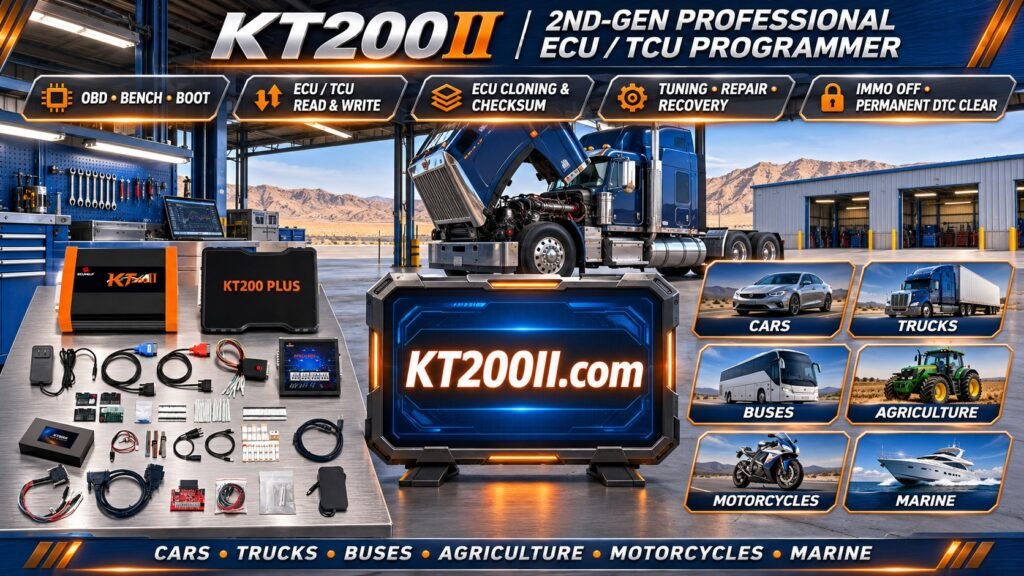
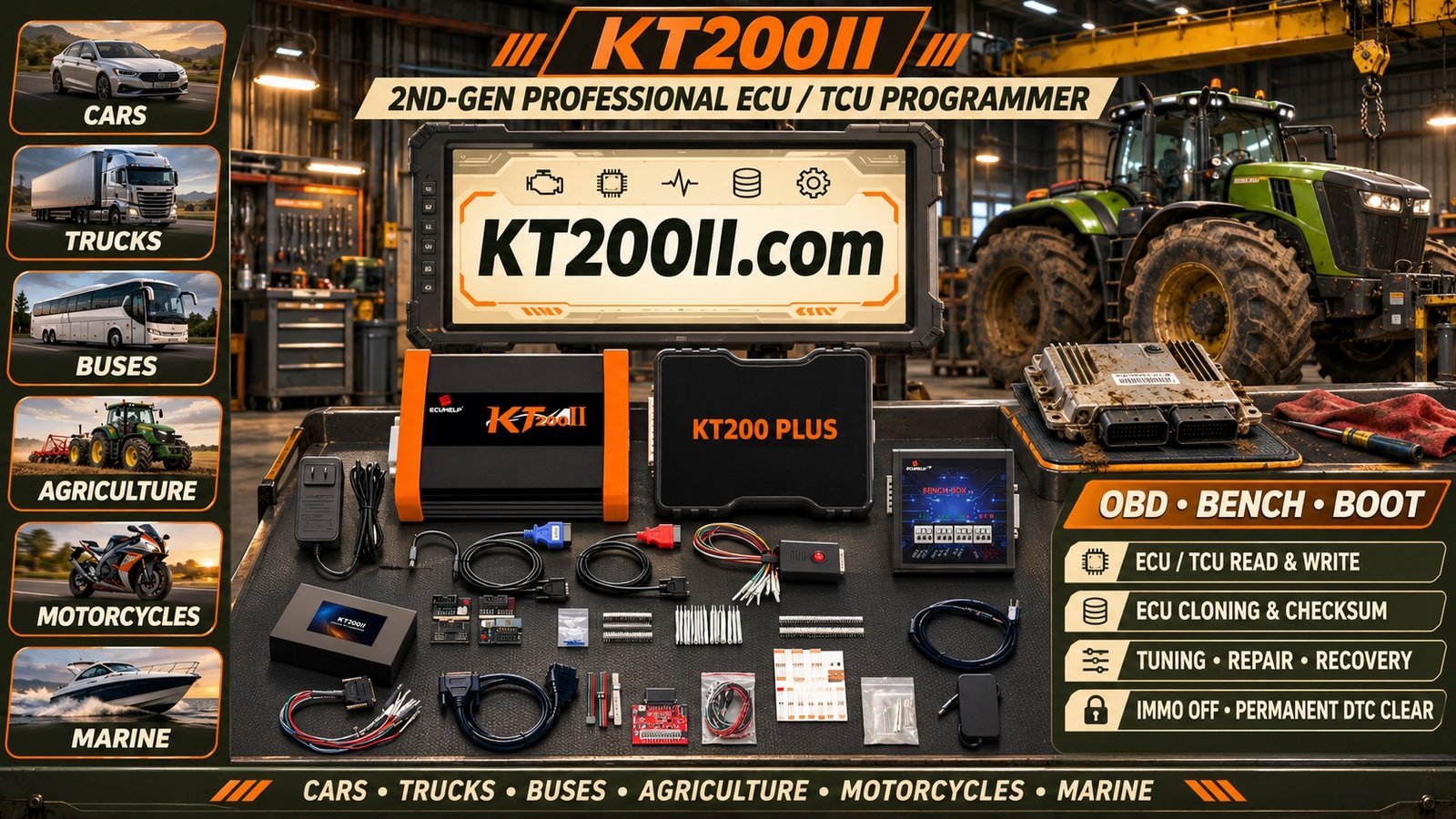
19. How KT200II Fits into Professional TCU Programming
KT200II is a professional ECU and TCU programming tool designed for supported automotive control modules.
Depending on the released software protocols and exact transmission controller application, KT200II may provide different identification and memory programming operations.
Before selecting KT200II for a TCU application, technicians should verify:
- Transmission manufacturer.
- Exact TCU hardware part number.
- Hardware and software versions.
- Microcontroller family where available.
- Supported OBD, Bench or Boot method.
- Flash reading and writing availability.
- EEPROM operation availability.
- Required connection adapters.
Supporting a particular transmission manufacturer does not automatically mean that every TCU model from that manufacturer is supported.
Compatibility must be confirmed using the exact controller identification and the available software protocol.
Explore the KT200II ECU and TCU Programmer for product information.
Visit KT200II Operation Modes to understand available connection methods.
Check the KT200II Support List before selecting a specific TCU application.
For software information, visit the KT200II Software page.
20. Professional TCU Programming Workflow
A systematic programming workflow helps reduce errors and improves the reliability of transmission controller replacement operations.
Step 1: Identify the Vehicle and Transmission
Record the vehicle model, production year, transmission type and relevant controller information.
Step 2: Identify the Original TCU
Record the part number, hardware version and software identification where available.
Step 3: Perform Diagnostic Checks
Read available transmission fault codes and evaluate the controller's communication status.
Step 4: Verify Electrical Conditions
Check power supply, ground connections and communication wiring.
Step 5: Confirm Programming Compatibility
Verify that the programming equipment supports the exact TCU application and required operations.
Step 6: Select the Correct Programming Mode
Choose the supported OBD, Bench or Boot procedure according to the controller documentation.
Step 7: Back Up Original Data
Read and save the required memory areas wherever supported.
Step 8: Perform the Required Programming Operation
Follow the application-specific instructions and maintain stable electrical conditions.
Step 9: Verify Programming Results
Check the controller identification and supported memory verification information.
Step 10: Complete Vehicle Configuration
Perform any required coding, adaptation, synchronization or manufacturer-specific replacement procedures.
Step 11: Final Diagnostic Inspection
Check for transmission-related DTCs and verify that the vehicle operates according to the manufacturer's requirements.
Frequently Asked Questions
What is a TCU programmer?
A TCU programmer is specialized equipment used to perform supported identification, memory reading, writing and programming operations on transmission control modules.
What is the difference between ECU and TCU programming?
ECU programming focuses on engine control modules, while TCU programming focuses on transmission control modules. Both may involve Flash, EEPROM and other supported memory operations, but their hardware and software applications are different.
Can a TCU be cloned?
Some transmission controllers support cloning through compatible memory reading and writing operations. The required data and procedures depend on the specific TCU architecture.
Does TCU cloning require Flash and EEPROM?
Not always. Some applications require selected Flash data, while others require additional non-volatile information. The correct memory operations depend on the controller.
Can TCU programming be performed through OBD?
Some supported transmission controllers allow programming through OBD. Others require Bench or Boot access.
What is the difference between TCU programming and transmission adaptation?
TCU programming involves supported software and memory operations. Transmission adaptation involves procedures that allow the control system to learn or adjust selected operating parameters.
Why does a transmission enter emergency mode?
Possible causes include transmission mechanical faults, hydraulic problems, sensor failures, electrical wiring issues or TCU-related problems. Proper diagnosis is required before replacing the controller.
Can a TCU fail because of low voltage?
Yes. Insufficient or unstable voltage can affect controller operation, communication and programming procedures.
Can KT200II program every automatic transmission TCU?
No. KT200II supports specific ECU and TCU applications. Compatibility depends on the exact controller hardware and released software protocols.
How can I check whether KT200II supports my TCU?
Check the KT200II Support List and verify the exact TCU identification and available programming method.
Conclusion
TCU programming is an important part of modern automotive transmission electronics repair.
Understanding transmission control module architecture, Flash and EEPROM memory, OBD, Bench and Boot programming methods helps technicians select the correct approach for different transmission systems.
However, successful TCU programming requires more than simply connecting a programmer. Accurate controller identification, compatible hardware, stable power supply, correct wiring and suitable software protocols are all essential.
When replacing or repairing a transmission control module, technicians should also consider any additional coding, adaptation and manufacturer-specific procedures required to restore normal vehicle operation.
KT200II provides ECU and TCU programming capabilities for supported applications. Visit the KT200II Product Page, review the Supported ECU and TCU List and explore the KT200II Technical Blog for more automotive programming information.
Accurate TCU identification and the correct programming procedure are essential for reliable transmission control module repair and replacement.