
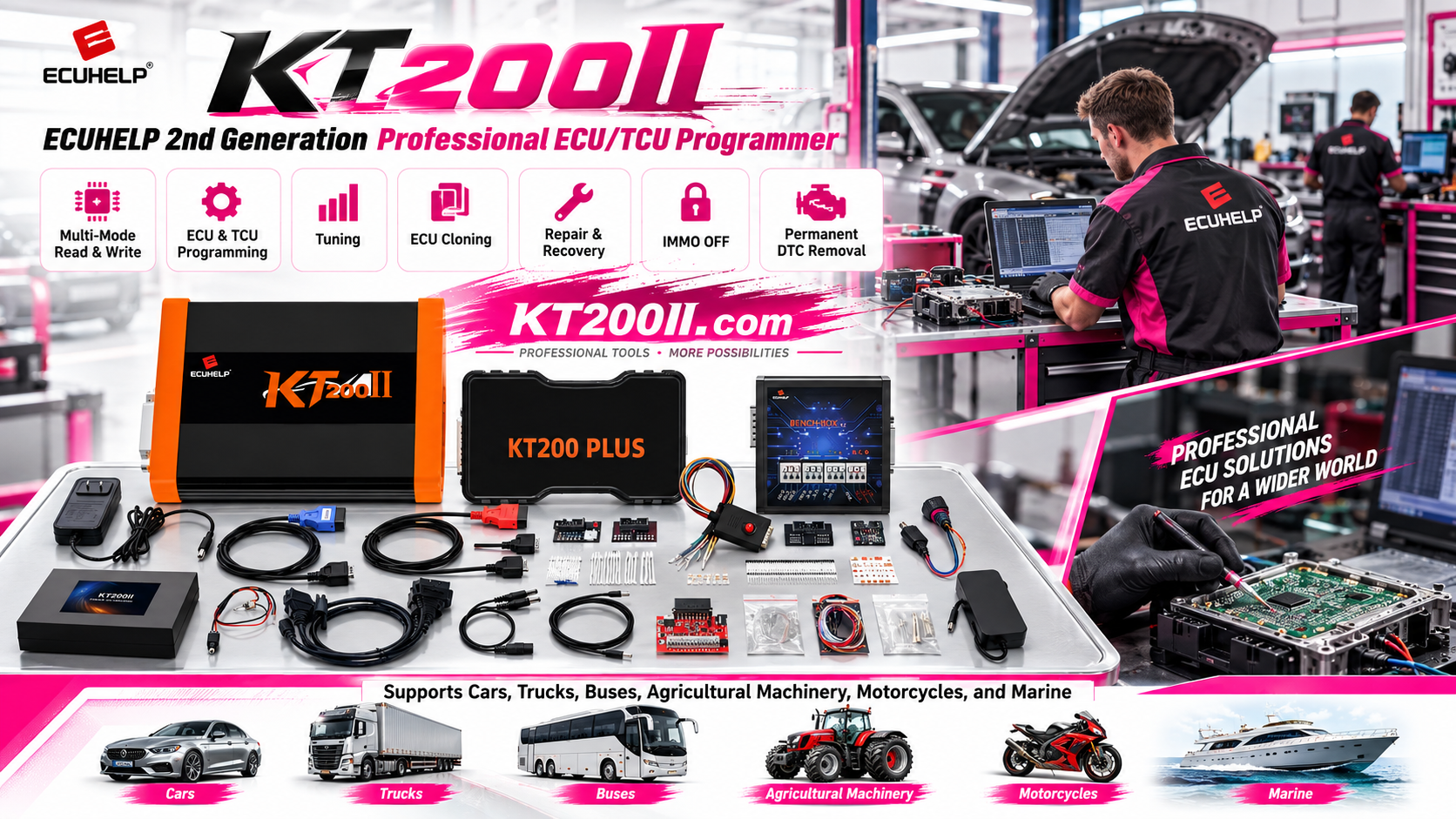
KT200II ECU Programming Workflow Guide
KT200II ECU Programming Workflow: Complete Guide for Safe ECU Read & Write Operations
Modern vehicles depend on electronic control units (ECUs) and transmission control units (TCUs) to manage engine performance, transmission behavior, emissions systems, and many other functions. For professional technicians, a correct ECU programming workflow is essential to protect original data and complete operations safely.
The KT200II ECU Programmer is designed for professional ECU and TCU read/write operations, supporting different connection methods depending on vehicle type, ECU model, protocol, and supported application.
This guide explains the complete ECU programming workflow, from vehicle identification to final verification.
Step 1: Identify the Vehicle and ECU Information
Before connecting any programming tool, technicians should first collect accurate vehicle and ECU information.
Important information includes:
- Vehicle brand and model
- Production year
- Engine type
- ECU or TCU manufacturer
- ECU hardware number
- Software version
- Processor and EEPROM information
The exact ECU information determines which communication method and programming procedure should be selected.
Step 2: Check KT200II Supported Vehicle Database
Compatibility checking is one of the most important steps before ECU programming.
The KT200II Support List provides information about supported vehicles, ECU types, processors, and available read/write methods.
Technicians should confirm:
- Vehicle compatibility
- ECU type support
- Available programming mode
- Required accessories
Step 3: Select the Correct ECU Programming Mode
Different ECUs require different communication methods. KT200II supports multiple operation modes for supported applications.
Learn more about each mode: KT200II Operation Modes
OBD Mode
OBD mode communicates with the ECU through the vehicle diagnostic connector when supported.
Advantages:
- No ECU removal required in supported cases
- Fast vehicle-side communication
- Convenient workshop operation
Bench Mode
Bench mode connects directly to the ECU or TCU using a controlled workshop setup.
It is commonly used for:
- ECU backup
- ECU replacement preparation
- Read and write operations
- Professional ECU service
Boot Mode
Boot mode provides deeper access to selected ECUs when standard communication methods are unavailable.
It is commonly used for advanced ECU programming, recovery, and specialized operations.
JTAG and BDM Mode
JTAG and BDM are advanced programming methods used on selected ECU generations requiring direct microcontroller-level access.
Step 4: Create Original ECU Backup
Before writing any data, creating a complete backup of the original ECU information is an important professional procedure.
Depending on ECU type and supported protocol, backup data may include:
| Data Type | Purpose |
|---|---|
| Flash | Main software and calibration information |
| EEPROM | Configuration and vehicle-related data |
| Microcontroller Data | Advanced ECU service operations |
Keeping original files allows technicians to restore data if unexpected situations occur.
Step 5: Perform ECU Read Operation
After selecting the correct protocol and connection method, technicians can begin the ECU reading process.
During reading:
- Maintain stable power supply
- Do not disconnect communication cables
- Save original files securely
- Record ECU information
Step 6: ECU Write and Verification
After preparing the required file, the ECU writing process can be performed according to the supported operation.
After writing:
- Wait until the process is fully completed
- Allow verification to finish
- Confirm ECU communication
- Check vehicle operation
KT200II ECU Clone Workflow
ECU cloning is one of the common professional applications in ECU repair.
A typical ECU clone workflow includes:
- Read original ECU data
- Save complete backup files
- Prepare compatible replacement ECU
- Write original data into replacement ECU
- Verify communication and vehicle function
KT200II Software Resources
The latest KT200II software packages are available through the official download page:
Users should always use official software resources and follow recommended installation procedures.
Common Mistakes During ECU Programming
Using the Wrong ECU Protocol
Similar ECU models may require different programming methods. Always confirm the exact ECU type before operation.
Skipping Backup
Programming without keeping original data increases recovery difficulty if problems occur.
Unstable Power Supply
Voltage interruption during ECU writing may cause communication failure or programming errors.
Why Professional Technicians Choose KT200II
Professional ECU programming requires accurate vehicle coverage information, flexible communication methods, and reliable workflow management.
KT200II provides:
- ECU and TCU programming support
- OBD, Bench, Boot, JTAG and BDM operation modes
- Vehicle compatibility database
- Professional read/write workflow
- ECU backup and cloning support for selected applications
Conclusion
A professional ECU programming workflow is not only about writing data into a control unit. Correct identification, compatibility checking, backup procedures, connection selection, and verification are all essential steps.
The KT200II ECU Programmer provides professional technicians with a structured solution for supported ECU and TCU programming operations.
For more technical information, visit the KT200II Official Technical Blog.




