
KT200II Bosch EDC17CP14 Programming Guide
KT200II Bosch EDC17CP14 Guide: Protocol Check, Backup and Safe Read/Write
Bosch EDC17CP14 programming should begin with exact ECU identification and a current protocol check. A reliable workflow also requires stable power, verified wiring, a protected original backup and a file that matches the real controller. This guide explains how technicians can prepare an EDC17CP14 job with KT200II without assuming that every EDC17 variant uses the same procedure.
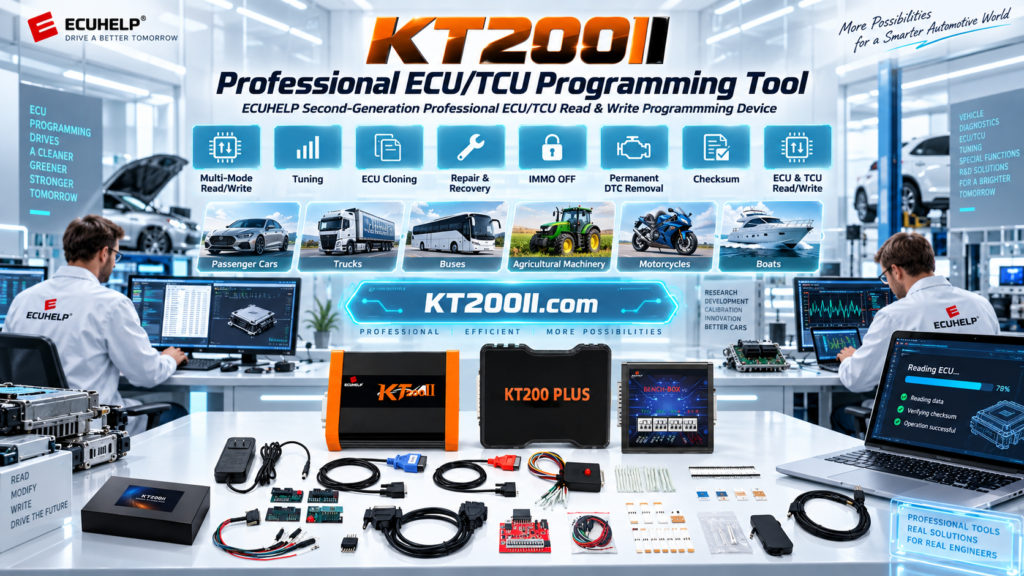
KT200II is a professional ECU and TCU programming platform for supported reading, writing, backup, cloning, tuning and repair workflows. Depending on the confirmed controller and protocol, operations may use OBD, Bench, Boot, JTAG or BDM mode.
EDC17CP14 is an ECU-family keyword, not a complete programming instruction. Hardware revision, software version, vehicle application, processor and available memory operations must be confirmed in the current KT200II software before connecting or writing the ECU.
Identify the Exact EDC17CP14 ECU
Start with the physical controller and record as much information as possible. Vehicle brand and model alone are not enough because the same platform can use different ECU revisions and software configurations.
Vehicle Details
Record the manufacturer, model, production year, engine code, fuel type and the authorized service objective.
ECU Label
Photograph the complete Bosch number, OEM number, hardware reference, barcode and secondary identifiers.
Software Identity
Save the original software, calibration and identification data returned by the selected protocol.
| Identification Item | What to Record | Why It Matters |
|---|---|---|
| ECU family | Complete EDC17CP14 designation | Separates the controller from other EDC17 variants. |
| Bosch part number | Complete number printed on the ECU | Helps identify the physical hardware and application. |
| OEM part number | Vehicle-manufacturer reference | Connects the ECU to the original vehicle configuration. |
| Hardware number | Hardware revision and controller reference | Important for file and donor compatibility. |
| Software number | Software, calibration and dataset identifiers | Required for original and modified file matching. |
| Processor information | MCU or microcontroller shown by the protocol | Can affect communication mode and available memory access. |
How to Search EDC17CP14 in KT200II
- Install the correct software. Use the official package intended for your KT200II version and confirm that the device driver is recognized.
- Search the complete ECU family. Enter EDC17CP14 rather than searching only for the vehicle brand.
- Compare the protocol result. Check the ECU family, vehicle application and processor information where displayed.
- Review available operations. Confirm identification, Read, Write, backup, cloning or recovery functions separately.
- Confirm the connection method. Use only the OBD, Bench, Boot, JTAG or BDM method specified by the exact protocol.
- Open the wiring instructions. Verify connector orientation, power, ground, ignition and communication terminals.
For a wider explanation of supported ECU search methods, visit the official KT200II support list and the KT200II technical blog.
Choose the Correct EDC17CP14 Programming Mode
There is no universal EDC17CP14 mode. The correct method depends on the exact controller and required operation.
| Mode | Connection | Confirm Before Use | Typical Preparation |
|---|---|---|---|
| OBD | Vehicle diagnostic connector | Confirm that the protocol provides the required OBD function. | Use stabilized vehicle voltage and follow ignition instructions. |
| Bench | Direct ECU connector outside the vehicle | Verify power, ground, ignition and communication pins. | Use a regulated supply and secure all terminals before powering. |
| Boot | Direct ECU and processor-level access | Confirm board revision, processor and exact access instructions. | Follow only the controller-specific diagram supplied by the software. |
| JTAG or BDM | Direct debug interface for selected ECUs | Confirm adapter, pad layout and processor compatibility. | Inspect every contact and never reuse an unverified layout. |
The official KT200II operation modes guide explains how OBD, Bench, Boot, JTAG and BDM differ. Use the least invasive supported method that provides the required operation.
Prepare Stable Power and Wiring
Correct protocol selection cannot compensate for unstable power or an incorrect connection. A controller may identify successfully and still lose communication during a long Read, erase or Write operation.
- Use a regulated ECU programming power supply.
- Follow the voltage range displayed by the selected protocol.
- Verify every permanent power and ground terminal.
- Confirm ignition or wake-up connections where required.
- Check CAN or other communication lines against the current diagram.
- Inspect cables, adapters and ECU connectors for damage.
- Connect the programming computer to reliable power.
- Disable sleep, hibernation and automatic restart.
- Use a stable direct USB connection.
- Do not move the ECU or cables during an active operation.
Read EDC17CP14 Identification Before Programming
When the selected protocol provides an ID function, run it before reading or writing ECU memory. Save the result together with the ECU label photo and job information.
Record the following where available:
- ECU family and manufacturer
- Bosch and OEM part numbers
- Hardware number and revision
- Software and calibration number
- Processor or MCU information
- Vehicle identification information
- Selected protocol and connection mode
If the software identification does not match the physical ECU or expected vehicle application, stop and recheck the protocol before proceeding.
Create the Original EDC17CP14 Backup
Original ECU data is the primary recovery reference for a programming job. Save every useful memory area provided by the confirmed protocol.
| Data Area | Possible Purpose | Recommended Practice |
|---|---|---|
| ECU identification | Documents the controller before modification. | Save a screenshot or text report in the job folder. |
| Flash | May contain program and calibration data. | Keep the first successful original read untouched. |
| EEPROM | May contain controller-specific configuration data. | Save separately when the protocol provides EEPROM access. |
| Micro or MCU | May be required for supported advanced recovery or cloning workflows. | Label the memory area and mode clearly. |
| Full backup | Provides additional recovery data where supported. | Keep two copies in separate storage locations. |
| Virtual read | May provide a matching original software file. | Do not automatically treat it as a full physical backup. |
Verify the EDC17CP14 File Before Writing
A file named “EDC17CP14” is not automatically suitable for every EDC17CP14 ECU. Compare the file with the real controller and selected memory operation.
- Compare the complete ECU family and suffix.
- Compare Bosch and OEM part numbers.
- Compare hardware and software identifiers.
- Confirm vehicle, engine and production application.
- Confirm whether the file is full, calibration-only, physical or virtual.
- Verify file size and format expected by the protocol.
- Match the file to the selected Flash, EEPROM, Micro or full-write operation.
- Confirm the file source and modification history.
- Understand checksum correction requirements.
- Keep the original backup files unchanged.
Professional KT200II EDC17CP14 Workflow
- Document the ECU. Photograph the entire label and record the vehicle information.
- Search the exact protocol. Select EDC17CP14 only after comparing the database result with the physical controller.
- Confirm the mode. Verify OBD, Bench, Boot, JTAG or BDM for the required operation.
- Prepare the workbench. Check power, grounds, communication wiring, adapters and computer stability.
- Read ECU identification. Compare software data with the label and job information.
- Create original backups. Save every available memory area before writing.
- Verify the file. Match hardware, software, application, memory area and file format.
- Perform the write. Follow the software prompts and do not interrupt power or USB communication.
- Identify the ECU again. Confirm that communication and expected software information return.
- Complete post-write checks. Perform a diagnostic scan, verify authorized vehicle operation and archive the written file.
Post-Write Verification Checklist
| Check | Required Action | Purpose |
|---|---|---|
| Communication | Run ECU identification again through the confirmed protocol. | Confirms that the ECU remains accessible. |
| Software identity | Review the expected software and calibration information. | Helps verify that the intended data was written. |
| Diagnostic scan | Check for unexpected communication or programming faults. | Identifies issues before vehicle delivery. |
| Functional test | Verify normal authorized vehicle behavior under controlled conditions. | Confirms the result beyond a completed progress bar. |
| Job archive | Store original files, written file, ID report, logs and technician notes. | Creates a traceable record for future support. |
KT200II EDC17CP14 Recovery Preparation
Prepare for recovery before the first write. Confirm which original files are available and whether the exact protocol provides another supported access method.
If an operation is interrupted, record:
- Selected EDC17CP14 protocol
- Connection mode and memory operation
- Progress percentage at interruption
- Complete error message or screenshot
- Power-supply behavior
- Whether the ECU still identifies
- Exact file selected for writing
- Whether the ECU still communicates through Bench or vehicle connection
Do not repeatedly select unrelated EDC17 protocols or apply a random Boot diagram. Review the official KT200II technical support page when the exact recovery path is uncertain.
Official KT200II Resources
Use these navigation pages to continue the EDC17CP14 workflow:
- KT200II product introduction for the official ECU and TCU programming platform.
- KT200II operation modes for OBD, Bench, Boot, JTAG and BDM explanations.
- KT200II software download for online and offline packages.
- KT200II support list for live ECU and TCU compatibility checks.
- KT200II technical blog for additional ECU programming and workshop guides.
Frequently Asked Questions
Can KT200II program Bosch EDC17CP14?
Use the official KT200II support list and current software to confirm the exact EDC17CP14 application, operation and connection method before starting. Coverage can vary by hardware, software and protocol.
Does every EDC17CP14 ECU use the same mode?
No. The required mode may be OBD, Bench, Boot, JTAG or another supported method depending on the exact ECU and requested operation.
Can EDC17CP14 be read through OBD?
Use OBD only when the exact KT200II protocol provides the required OBD identification, Read or Write function. Confirm each operation separately.
Is a virtual read a complete EDC17CP14 backup?
Not necessarily. A virtual read may provide a matching original software file without EEPROM, Micro or other data required for cloning or recovery.
Can I use an EDC17CP14 file from another vehicle?
Do not assume that files are interchangeable. Compare hardware, software, application, processor, memory area, file source and checksum requirements before writing.
Where can I buy the official KT200II ECU Programmer?
International customers can order the official KT200II through the ECUHELP global store. The product is available in Basic, Full and Ultimate configurations.
Check EDC17CP14 Support and Order Official KT200II
Confirm the exact ECU, protocol, operation and connection mode before programming. Then choose the KT200II version that matches your professional workshop requirements.
Check Support List Buy KT200II View ECUHELP Details