Diesel ECU Programming Guide: Common Rail Systems, EDC Controllers and Repair
Diesel ECU Programming Guide: Common Rail Systems, EDC Controllers and Repair
Modern diesel engines depend on sophisticated electronic control systems to achieve efficient combustion, reliable operation and emissions compliance. At the center of these systems is the Diesel Engine Control Unit (ECU).
From passenger cars and light commercial vehicles to heavy-duty trucks and agricultural machinery, diesel ECUs manage fuel injection, turbocharger operation, engine torque and numerous emission-related functions.
For professional automotive electronics technicians, understanding diesel ECU architecture and programming methods is essential when performing ECU reading, writing, replacement, cloning and recovery operations.
This guide explores common rail diesel technology, Bosch EDC controllers, ECU memory architecture, programming methods and common problems encountered during diesel ECU repair. It also explains how KT200II can be used for supported ECU programming applications.
1. What Is a Diesel ECU?
A diesel ECU is an electronic controller responsible for managing the operation of a diesel engine.
It receives information from various sensors and uses programmed control strategies to determine how the engine should operate under different conditions.
Depending on the engine platform, a diesel ECU may control:
- Fuel injection quantity.
- Injection timing.
- Common rail pressure.
- Injector activation.
- Turbocharger boost pressure.
- Exhaust gas recirculation (EGR).
- Diesel particulate filter (DPF) management.
- Selective catalytic reduction (SCR) systems.
- Engine torque management.
- Engine temperature protection.
Accurate electronic control is particularly important in modern diesel engines because injection pressure, timing and fuel quantity directly influence combustion efficiency and engine performance.
2. Understanding Common Rail Diesel Technology
Common rail is one of the most widely used fuel injection technologies in modern diesel engines.
Unlike older mechanical injection systems, common rail systems use a shared high-pressure fuel rail to supply fuel to electronically controlled injectors.
The main components typically include:
- High-pressure fuel pump.
- Common rail accumulator.
- Fuel pressure sensor.
- Pressure control valve.
- Electronic fuel injectors.
- Diesel ECU.
The ECU continuously monitors engine operating conditions and adjusts fuel injection parameters according to the required operating strategy.
How Does Common Rail Injection Work?
The high-pressure pump supplies fuel to the common rail. The rail stores pressurized fuel and distributes it to the injectors.
The ECU calculates the required injection quantity and timing based on information such as engine speed, accelerator position, fuel pressure and temperature.
Depending on the injection system, multiple injection events may occur during one combustion cycle.
These may include pilot injection, main injection and post-injection.
Accurate ECU control helps optimize combustion, noise, fuel consumption and emissions.
3. Common Bosch Diesel ECU Families
Bosch is one of the major suppliers of diesel engine management systems used in passenger vehicles and commercial applications.
Several Bosch ECU families are commonly encountered in automotive electronics workshops.
Bosch EDC15
EDC15 is an earlier generation of Bosch diesel engine management systems.
It was used in various diesel vehicles and introduced electronic control functions for injection timing, fuel quantity and engine management.
Bosch EDC16
EDC16 represents a later generation of diesel engine control systems.
Depending on the variant, these controllers may support more advanced injection management, torque control and emission-related functions.
Bosch EDC17
EDC17 is a widely used family of modern diesel engine controllers.
Different EDC17 variants use different processors, memory architectures and programming procedures.
Some applications include advanced electronic security and software protection mechanisms.
Important Identification Note
EDC15, EDC16 and EDC17 are broad ECU families rather than individual programming protocols.
Technicians must identify the exact ECU part number, hardware version, software version and processor before selecting a programming method.
4. Other Diesel ECU Manufacturers
Diesel vehicles use control systems from multiple electronic manufacturers.
Besides Bosch, technicians may encounter controllers produced by:
- Continental: Diesel engine management systems for selected passenger and commercial vehicles.
- Delphi: Electronic diesel injection and engine control technologies.
- Denso: Diesel fuel injection and engine management systems.
- Siemens: Selected generations of automotive electronic control systems.
- Other specialized suppliers: Manufacturer-specific control systems for trucks, industrial engines and agricultural machinery.
Each manufacturer may use different hardware, processor architectures and programming protocols.
5. Diesel ECU Memory: Flash and EEPROM
Understanding ECU memory is essential when performing diesel ECU programming.
Flash Memory
Flash memory commonly stores the main engine control software and calibration information.
Depending on the ECU, this information may include:
- Fuel injection maps.
- Injection timing strategies.
- Rail pressure control parameters.
- Torque management data.
- Boost pressure calibration.
- Engine protection strategies.
- Emission control calibration.
EEPROM and Persistent Memory
EEPROM or EEPROM-emulated storage may contain persistent information such as controller identification, vehicle-specific configuration and other data required for normal operation.
Not every diesel ECU has a separate EEPROM chip. Some modern controllers store persistent information inside internal Flash or other memory structures.
Before performing ECU cloning or replacement, technicians should identify the exact memory architecture and required data regions.
6. OBD, Bench and Boot Programming for Diesel ECUs
Different diesel ECUs support different programming methods.
OBD Programming
OBD programming communicates with a compatible ECU through the vehicle diagnostic connector.
It is convenient for supported applications where reading and writing can be performed without removing the controller.
Typical functions may include:
- ECU identification.
- Supported Flash reading.
- Supported Flash writing.
- Selected software operations.
Bench Programming
Bench programming connects directly to the ECU outside the vehicle.
The technician uses documented power, ground and communication connections to access supported memory operations.
Bench programming is useful for selected ECU replacement, backup and repair applications.
Boot Programming
Boot programming uses a supported low-level processor access procedure.
Depending on the ECU architecture, it may provide access to memory operations that are unavailable through normal diagnostic communication.
Some Boot procedures require specific processor connections and careful identification of the ECU hardware.
Not every ECU supports all three methods, and the correct procedure must be confirmed for each controller.
7. Why Is Diesel ECU Identification Important?
Correct ECU identification helps prevent programming errors and compatibility problems.
Before programming, technicians should record:
- Vehicle manufacturer.
- Vehicle model and production year.
- Engine manufacturer and engine model.
- ECU manufacturer.
- Complete ECU part number.
- Hardware identification.
- Software identification.
- Processor information where available.
- Required programming operation.
A single vehicle model may use multiple ECU variants depending on its engine and production generation.
Therefore, identifying the actual controller is more reliable than selecting a protocol based only on vehicle information.
8. Diesel ECU Cloning and Replacement
When an original diesel ECU becomes damaged, technicians may need to install a compatible replacement controller.
Selected diesel ECUs support cloning-related procedures that transfer the required original data to a compatible donor unit.
Depending on the controller architecture, this may involve:
- Original ECU identification.
- Donor ECU compatibility verification.
- Flash memory backup.
- EEPROM or persistent memory backup where supported.
- Additional processor-specific data where required.
- File compatibility verification.
- Programming and final testing.
Not every ECU supports complete cloning.
Some replacement procedures require manufacturer-specific programming, configuration or security adaptation instead of direct memory transfer.
9. Common Diesel ECU Programming Problems
ECU Cannot Communicate
Possible causes include insufficient power, poor grounding, damaged wiring, communication network problems or an unsupported protocol.
Flash Reading Failure
The selected programming protocol may not support the requested memory region, or the ECU may have an electrical or internal hardware problem.
Flash Writing Failure
Unstable voltage, incorrect files, incompatible hardware or interrupted communication can cause writing operations to fail.
Incorrect Software Version
Using software intended for another ECU hardware or software configuration can cause engine control problems.
Engine Does Not Start After ECU Replacement
Possible causes include incompatible software, missing configuration, immobilizer-related issues or other vehicle-specific initialization requirements.
10. Diesel ECU Programming for Heavy-Duty Vehicles
Heavy-duty diesel engines use advanced electronic control systems to manage high-load operating conditions and commercial vehicle performance.
Truck and industrial engine controllers may be found in vehicles and equipment from manufacturers such as:
- Scania.
- Iveco.
- Volvo Trucks.
- MAN.
- Mercedes-Benz Trucks.
- DAF.
- Weichai.
- John Deere.
These manufacturers may use different ECU families across different engine generations.
For example, one manufacturer may use several Bosch, Continental or proprietary engine controller platforms.
Therefore, general truck brand coverage does not guarantee that every ECU installed in that brand's vehicles is supported.
Always verify the exact ECU part number and programming protocol.
11. How KT200II Supports Diesel ECU Programming
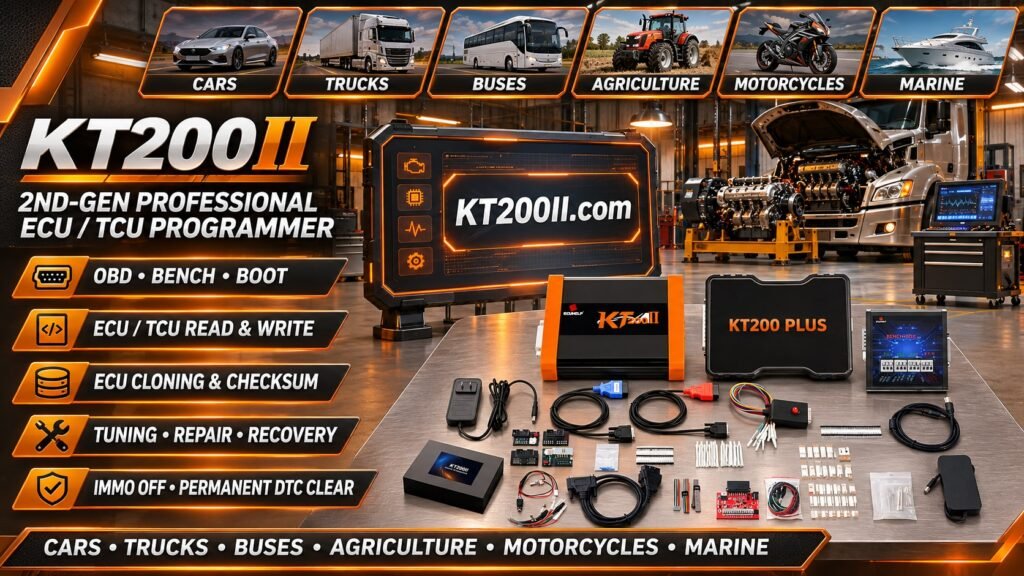
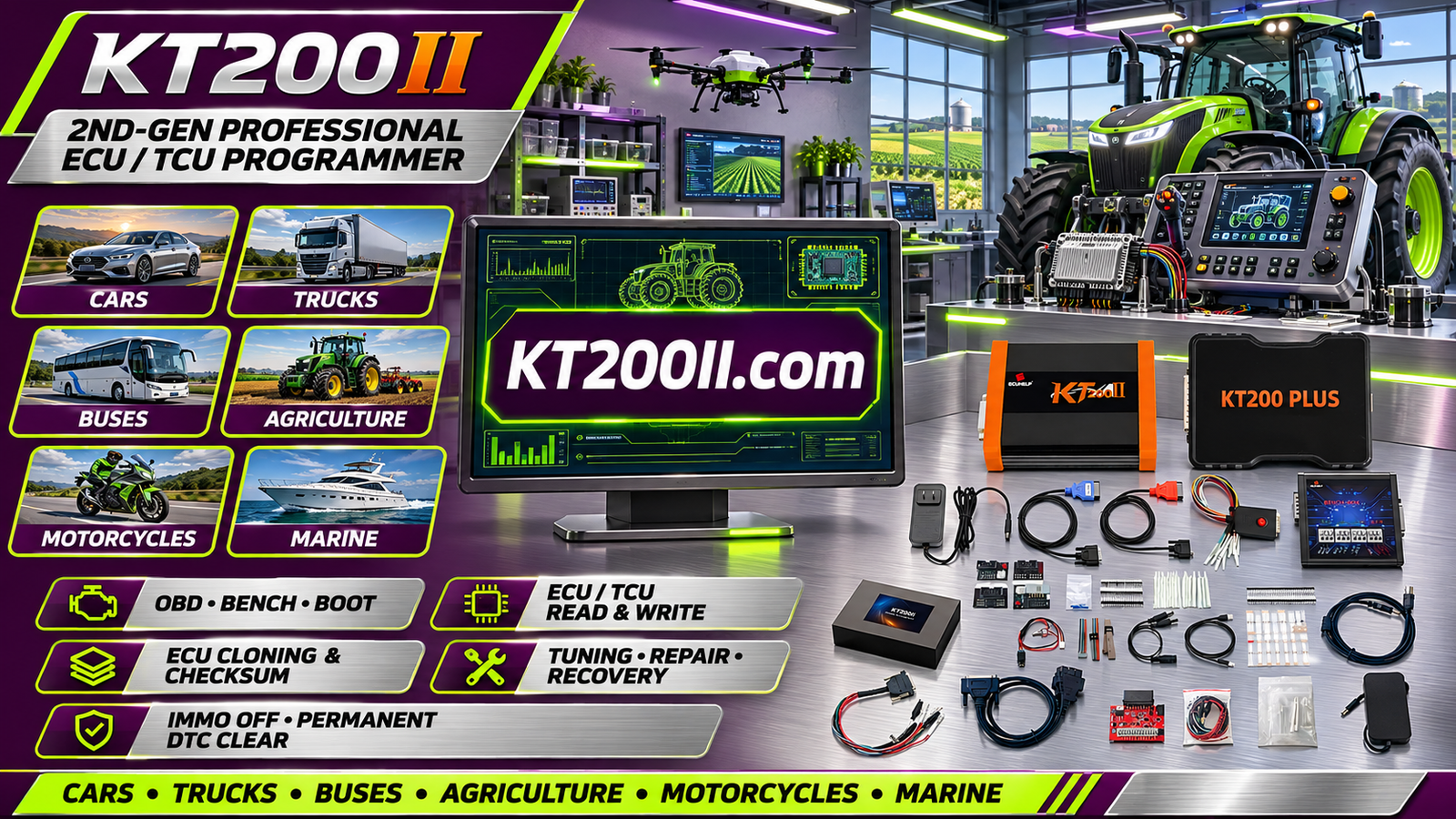
KT200II is a professional ECU and TCU programming solution designed for automotive electronics technicians and repair workshops.
For supported diesel ECU applications, available operations may include:
- ECU identification.
- Supported Flash reading.
- Supported Flash writing.
- Selected EEPROM operations.
- OBD programming applications.
- Bench programming applications.
- Boot programming applications.
- Supported ECU replacement and cloning-related operations.
Available functions depend on the exact ECU model, hardware version, processor and programming protocol.
Before starting a diesel ECU programming operation, technicians should confirm the controller's compatibility and required memory functions.
Explore KT200II product and technical information:
KT200II Supported ECU and TCU List
12. How to Choose a Diesel ECU Programmer
Choosing suitable programming equipment requires checking the actual ECU coverage and available programming functions.
Important considerations include:
- Supported diesel ECU manufacturers.
- Supported EDC15, EDC16 and EDC17 variants.
- Exact ECU part number coverage.
- OBD programming availability.
- Bench and Boot programming support.
- Flash reading and writing functions.
- EEPROM operation availability.
- Processor compatibility.
- Required cables and adapters.
- Connection diagrams and software updates.
A programmer supporting one Bosch EDC17 controller does not necessarily support every EDC17 variant.
Always verify the specific controller before purchasing equipment or starting a programming operation.
13. Diesel ECU Programming Checklist
Use this checklist before performing a diesel ECU programming operation:
- Vehicle and engine identification recorded.
- ECU manufacturer identified.
- Complete ECU part number recorded.
- Hardware version checked.
- Software version recorded.
- Processor information verified where necessary.
- Programming protocol confirmed.
- OBD, Bench or Boot method selected.
- Correct wiring diagram reviewed.
- Power supply and ground connections verified.
- Communication wiring inspected.
- Original memory backed up where supported.
- Target file compatibility confirmed.
- Programming completed successfully.
- Post-programming diagnostic checks performed.
Frequently Asked Questions
What is the difference between EDC16 and EDC17?
EDC16 and EDC17 are different generations of Bosch diesel engine management systems. They may use different processors, memory architectures, software structures and programming procedures.
Can KT200II read and write diesel ECUs?
KT200II supports selected diesel ECU reading and writing applications. Exact functions depend on the ECU model and available programming protocol.
Can all diesel ECUs be programmed through OBD?
No. Some controllers support OBD programming, while others require Bench, Boot or specialized access methods.
Does diesel ECU cloning require both Flash and EEPROM?
Not always. The required memory regions depend on the ECU architecture and the intended replacement procedure.
Can a damaged diesel ECU be recovered?
Some software-related failures can be recovered through supported programming methods. Recovery may not be possible when critical processor, memory or power circuit components are physically damaged.
Does supporting Bosch EDC17 mean supporting every EDC17 ECU?
No. EDC17 includes multiple controller variants with different processors, hardware revisions and programming requirements. Exact protocol coverage must be checked.
Can a truck ECU programmer also support passenger car ECUs?
Some professional programmers cover both passenger cars and commercial vehicles. Actual compatibility depends on the software protocols and supported controller list.
Conclusion
Diesel ECU programming is an important part of modern automotive electronics repair. Understanding common rail technology, Bosch EDC controllers, Flash and EEPROM memory and different programming methods helps technicians work more efficiently.
Accurate ECU identification is essential before performing reading, writing, cloning or replacement operations.
KT200II provides ECU and TCU programming functions for selected passenger car, commercial vehicle and other automotive applications.
For more information about programming modes, supported controllers and product features, visit the KT200II Official Website.