
KT200II ECU Identification Guide: How to Identify an ECU Before Programming
ECU vs TCU Programming: Key Differences Every Technician Should Know
Modern vehicles rely on multiple electronic control modules to manage engine, transmission and other vehicle systems. Among the most important modules are the Engine Control Unit and Transmission Control Unit.
Both ECU and TCU programming are important services for professional automotive electronics workshops, but the modules perform different functions and can require different programming procedures.
What Is an ECU?
An ECU, commonly referring to an Engine Control Unit, manages many functions related to engine operation.
Depending on the vehicle, the ECU may control parameters such as:
- Fuel injection
- Ignition timing
- Turbocharger control
- Throttle operation
- Torque management
- Engine protection functions
The ECU receives information from sensors and other vehicle systems and uses programmed software and calibration data to control engine operation.
What Is a TCU?
A TCU, or Transmission Control Unit, manages the operation of an electronically controlled transmission.
Depending on the transmission system, the TCU can control:
- Gear selection
- Shift timing
- Clutch operation
- Transmission pressure
- Torque converter operation
- Transmission protection strategies
The TCU communicates with other vehicle modules to coordinate transmission operation with engine torque and vehicle conditions.
ECU vs TCU: Main Differences
| Category | ECU | TCU |
|---|---|---|
| Main Function | Engine management | Transmission management |
| Common Data | Engine software and calibration | Transmission software and calibration |
| Typical Applications | Engine performance, engine control and repair | Gear shifting, transmission control and repair |
| Programming | Depends on ECU architecture | Depends on TCU architecture |
Why ECU and TCU Programming Is Needed
Electronic control modules can require programming for several different repair and service situations.
Common applications include:
- ECU replacement
- TCU replacement
- ECU cloning
- TCU cloning
- Software updates
- Calibration modification
- Module recovery
- Electronic repair
The exact programming procedure depends on the vehicle, module hardware and software architecture.
ECU Programming
ECU programming involves communication with the engine control unit and may include reading, writing, backing up or transferring supported data.
Before programming an ECU, technicians should identify:
- Vehicle model
- Engine type
- ECU manufacturer
- Part number
- Hardware number
- Software version
Accurate identification helps technicians select the correct programming procedure and avoid using incompatible files.
TCU Programming
TCU programming follows a similar basic concept, but the transmission module has its own hardware, software and calibration structure.
TCU programming may be required when:
- A transmission control module is replaced
- A compatible TCU needs to be cloned
- Supported software needs to be programmed
- Transmission-related electronic repairs are performed
Technicians should verify the exact transmission and TCU information before starting.
ECU and TCU Cloning
Cloning involves transferring appropriate data from an original module to a compatible replacement module when the specific application supports this procedure.
A typical workflow includes:
- Identify the original module
- Identify the replacement module
- Confirm compatibility
- Read the original data
- Save the original backup
- Transfer supported data
- Verify the replacement module
- Perform vehicle-level testing
Some modules require data from multiple memory areas, while others may require a specific programming procedure.
ECU and TCU Programming Methods
OBD Programming
OBD programming communicates with supported modules through the vehicle diagnostic connector.
It is convenient when the required ECU or TCU operation is supported through the vehicle network.
Bench Programming
Bench programming allows technicians to communicate directly with the module outside the vehicle.
It can be useful for supported reading, writing, backup, cloning and replacement module preparation.
Boot Programming
Boot programming provides deeper access to selected processors and memory areas.
It can be required for certain advanced ECU or TCU repair and recovery procedures.
Why Original Data Backup Matters
Before writing data, technicians should create an original backup whenever the module and programming procedure allow it.
The original backup can provide a reference for:
- ECU or TCU cloning
- Replacement module preparation
- Data comparison
- Recovery
- Future troubleshooting
Original files should be stored securely and clearly separated from modified files.
Common ECU and TCU Programming Problems
Incorrect Module Identification
Different modules can have similar physical appearances while using different hardware or software configurations.
Always confirm the module identification before selecting a programming procedure.
Wrong Programming Mode
Some applications support OBD programming while others require Bench or Boot access. Selecting the wrong method can result in communication failure.
Incorrect Wiring
Bench and Boot operations may require direct connections to power, ground and communication lines. Incorrect wiring can prevent communication with the module.
Unstable Power Supply
Stable power is essential during ECU and TCU writing operations. Power interruption can cause incomplete programming and require recovery procedures.
Incorrect File
A programming file must match the appropriate module and application. Checksum processing alone does not make an incompatible file suitable for another ECU or TCU.
ECU and TCU Programming Workflow
A professional workflow should be systematic.
- Identify the vehicle
- Identify the ECU or TCU
- Confirm hardware and software information
- Check programming support
- Select the correct programming method
- Verify wiring and power
- Read and save original data
- Perform the supported programming operation
- Verify the programmed module
- Complete vehicle-level testing
Professional ECU and TCU Programming Equipment
Professional programming equipment should support the module types and programming methods required by the workshop.
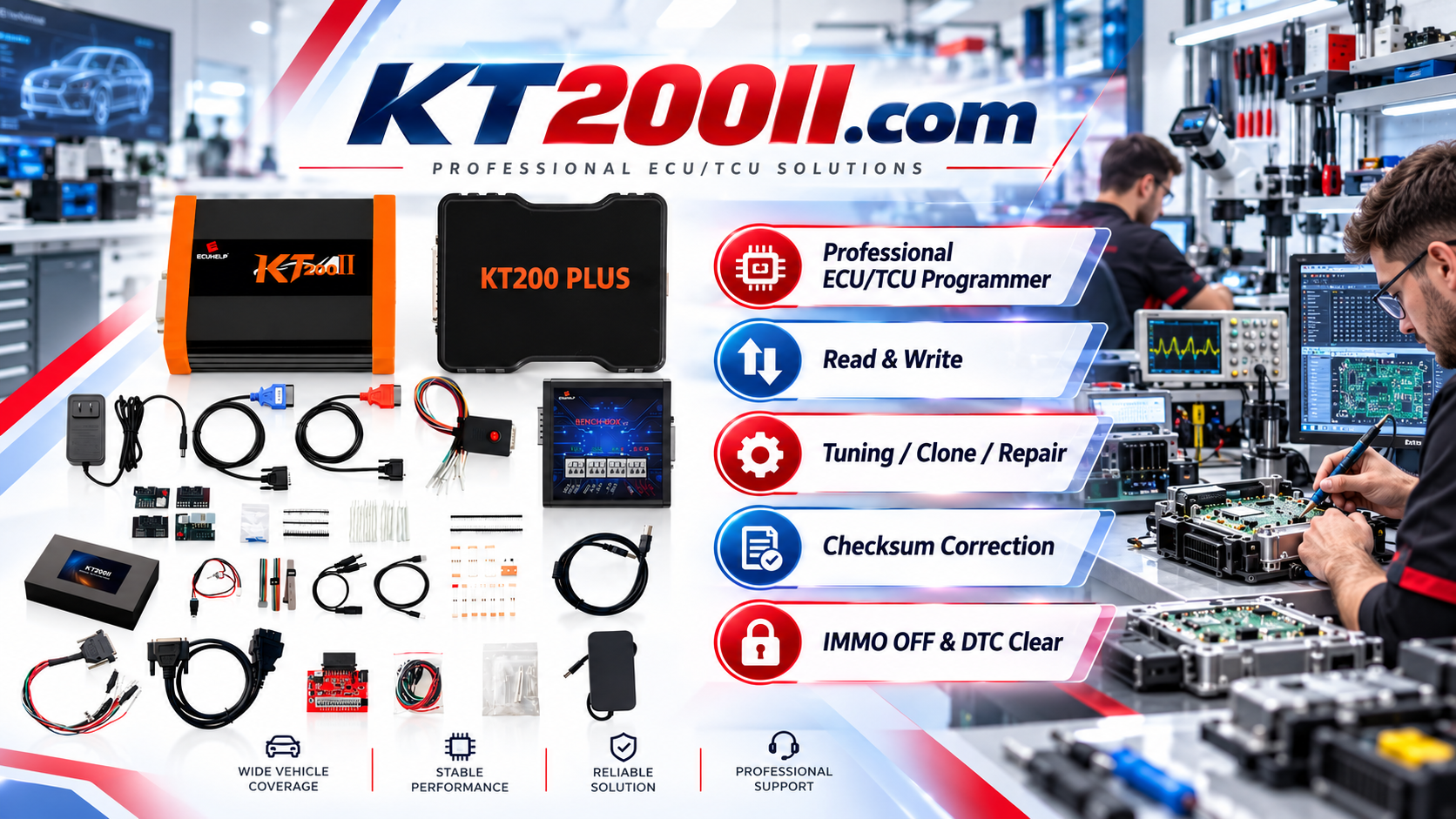
The KT200II ECU Programmer supports ECU and TCU reading, writing, backup and other supported programming operations.
Depending on the specific application, supported programming methods can include:
- OBD Mode
- Bench Mode
- Boot Mode
- JTAG Mode
- BDM Mode
Technicians can review the available programming methods through the KT200II Operation Modes Guide.
Check ECU and TCU Support Before Programming
Before starting a programming operation, technicians should verify the exact vehicle and module information.
Important information includes:
- Vehicle manufacturer
- Vehicle model
- Engine or transmission type
- ECU or TCU manufacturer
- Hardware number
- Software number
- Required programming method
The KT200II Support List provides compatibility information for supported applications.
Keep Programming Software Updated
Vehicle electronic systems continue to evolve, with manufacturers introducing new control units, processors and communication architectures.
Regular software updates can help technicians maintain compatibility with supported newer applications.
The latest resources are available through the KT200II Software Download page.
Best Practices for ECU and TCU Programming
- Identify the exact control module before programming
- Confirm hardware and software compatibility
- Check the required programming method
- Follow the correct wiring diagram
- Use stable power
- Save original data whenever possible
- Keep original and modified files separate
- Verify programming results
- Perform diagnostic checks after programming
Conclusion
ECU and TCU programming are both important areas of modern automotive electronics, but the two control modules perform different functions and can require different programming procedures.
Whether working with an engine control unit or transmission control unit, technicians should begin with accurate module identification, compatibility verification and original data backup.
By selecting the correct programming method and following a structured workflow, automotive workshops can perform supported ECU and TCU repair, cloning, replacement and programming operations more efficiently and reliably.




