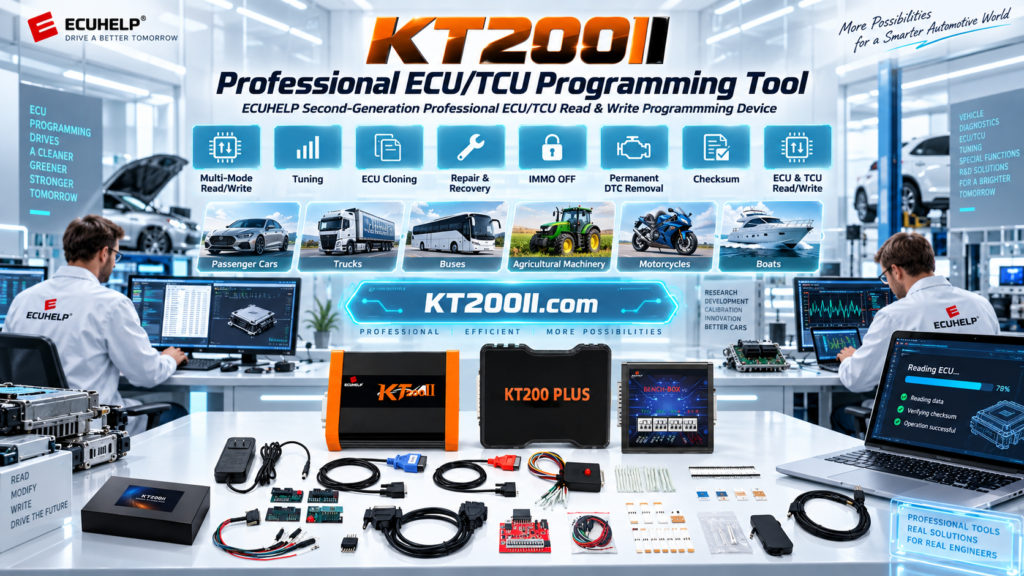

KT200II Delphi DCM3.5 Programming Guide
KT200II Delphi DCM3.5 Programming Guide: Protocol Check, Backup and Safe ECU Read/Write
Delphi DCM3.5 programming should always begin with complete ECU identification and exact protocol verification. DCM3.5 units can vary by vehicle manufacturer, engine application, hardware number, software version, processor, and available programming mode. KT200II users must confirm the exact supported entry before selecting OBD, Bench, Boot, or another operation.
This guide is intended for authorized ECU repair, replacement, calibration, and recovery work. It describes a controlled workflow for compatible Delphi DCM3.5 applications without assuming that every controller uses the same wiring or memory operation.
What Is Delphi DCM3.5?
Delphi DCM3.5 is a diesel engine control unit family used in selected vehicle applications. The same family name may appear across different brands and engines, so the label alone is not enough to choose a programming procedure.
Before connecting KT200II, record the following information:
- Vehicle manufacturer and model
- Production year and engine code
- Complete Delphi ECU part number
- Vehicle control-unit number
- Hardware number
- Software number
- Processor or MCU information, if available
- Previous programming or repair history
Why DCM3.5 Protocol Verification Matters
Searching for “DCM3.5” is only the first step. The exact KT200II protocol can provide different Read, Write, Backup, Clone, Checksum, or recovery functions depending on the application.
Use the official KT200II support list and confirm:
| Protocol Item | What to Confirm |
|---|---|
| Vehicle application | Manufacturer, model, year, engine, and complete ECU identification |
| Operation mode | OBD, Bench, Boot, JTAG, BDM, or another mode listed for the exact entry |
| Available functions | Identification, Read, Write, Backup, Clone, or Checksum |
| Memory areas | Flash, EEPROM, Micro/MCU, virtual read, or full backup options |
| Connection instructions | Power, ground, CAN lines, adapter, and ECU pinout |
Never use a remembered DCM3.5 pinout on another vehicle application without comparing it with the current KT200II protocol instructions.
OBD, Bench, or Boot for DCM3.5?
The correct KT200II mode depends on the exact ECU and the required operation. OBD may be listed for compatible vehicle-connected operations, while Bench or Boot may be required for direct ECU work, recovery, or other supported functions.
| Mode | Typical Use | Main Requirement |
|---|---|---|
| OBD | Vehicle-connected identification, reading, or writing | Stable vehicle voltage and uninterrupted communication |
| Bench | ECU programming outside the vehicle with an external harness | Correct power, ground, communication wiring, and pinout |
| Boot | Direct access for compatible recovery, Read, Write, or cloning operations | Exact boot procedure, adapter, and controlled power |
Review the official KT200II operation modes before connecting the controller. When several methods are available, use the least invasive supported method that provides the required function.
Prepare a Stable DCM3.5 Workbench
For Bench or Boot programming, place the ECU on an insulated work surface and use a regulated power supply. Inspect the harness, adapter, and communication lines before starting identification.
Preparation Checklist
- Install the approved KT200II software from the official software page.
- Use a reliable USB connection and avoid loose extension cables.
- Connect power and ground exactly as shown by the selected protocol.
- Confirm CAN-H and CAN-L wiring where required.
- Use the correct adapter and harness for the ECU application.
- Keep the ECU and cables completely still during communication.
- Keep a second storage location available for original backup files.
Read and Save the Original DCM3.5 Data
Before modifying or replacing ECU data, create a secure original backup using the functions provided by the exact KT200II protocol.
- Connect the ECU using the verified operation mode.
- Run identification and save the report.
- Record hardware, software, and part numbers.
- Read every memory area listed by the protocol.
- Save Flash, EEPROM, Micro/MCU, or other available files separately.
- Create a second copy on a separate storage device.
- Check file size and confirm that the backup files open correctly.
A virtual read may be available for selected applications, but it should not automatically be treated as a complete physical backup. Confirm what the exact protocol reads before relying on it for recovery.
Validate the Target File Before Writing
Checksum correction alone does not prove that a DCM3.5 file is compatible. Compare the target file with the original ECU and the actual vehicle application.
| File Check | Why It Matters |
|---|---|
| Hardware number | Different ECU revisions may use different memory layouts. |
| Software number | Calibration and coding structures can differ between software versions. |
| Engine application | The same DCM3.5 family can be used with different engines and vehicles. |
| Memory size | The file must match the selected memory area and expected length. |
| Checksum status | Checksum must be corrected where supported, but it is only one validation item. |
| File source | Unknown or incorrectly labeled files increase programming risk. |
Controlled KT200II DCM3.5 Writing Workflow
After checking the ECU, protocol, wiring, backup, and target file, perform the Write operation in a controlled environment.
- Close unnecessary applications on the workshop computer.
- Confirm stable voltage and secure ECU connections.
- Select the exact DCM3.5 protocol in KT200II.
- Review the displayed ECU and memory information.
- Load the verified target file.
- Start writing without disconnecting power, USB, or the ECU harness.
- Wait until KT200II reports completion.
If the software reports a voltage warning, protocol mismatch, or communication error, stop and diagnose the cause. Do not repeatedly restart the same operation without correcting the setup.
Post-Programming Verification
After writing, run identification again and compare the final information with the intended file. When the ECU is returned to the vehicle, complete a controlled diagnostic scan and service check.
- Confirm ECU communication after programming.
- Check final hardware and software information.
- Cycle the ignition according to the vehicle procedure.
- Scan and record diagnostic trouble codes.
- Verify engine operation through an authorized service workflow.
- Save the final report with original and target file references.
Official KT200II Resources
For complete product information, visit the official KT200II product page. You can also review operation modes, download approved files from the KT200II software page, check the support list, and read additional guides on the KT200II blog.
Frequently Asked Questions
Can KT200II program every Delphi DCM3.5 ECU?
No. Confirm the exact vehicle application, hardware number, software number, and current KT200II protocol before programming.
Should I use OBD or Bench mode for DCM3.5?
Use the mode displayed for the exact supported protocol. OBD and Bench availability can vary by vehicle application and required operation.
Is a virtual read the same as a complete DCM3.5 backup?
Not necessarily. A virtual read may contain selected or reconstructed data. Confirm the memory areas included by the exact protocol.
Can I use a DCM3.5 file from another vehicle?
Do not assume compatibility based only on the ECU family name. Hardware, software, engine application, memory size, coding, and file source must be checked.
Where can I buy the official KT200II?
KT200II is developed by ECUHELP. Visit the official KT200II purchase page on Helpecu for current version and ordering information.
Need Help Checking a DCM3.5 Protocol?
Prepare the vehicle model, year, engine, complete ECU label, hardware number, software number, and required operation. ECUHELP support can help verify the correct KT200II protocol and connection method.
Visit the official ECUHELP KT200II product center or contact the technical support team before programming.
Conclusion: Reliable KT200II Delphi DCM3.5 programming begins with accurate ECU identification and protocol verification. Confirm the correct operation mode, prepare stable power and wiring, save the original data, validate the target file, and complete a post-write check. This structured workflow helps professional technicians reduce avoidable programming errors during ECU repair, replacement, cloning, and calibration work.