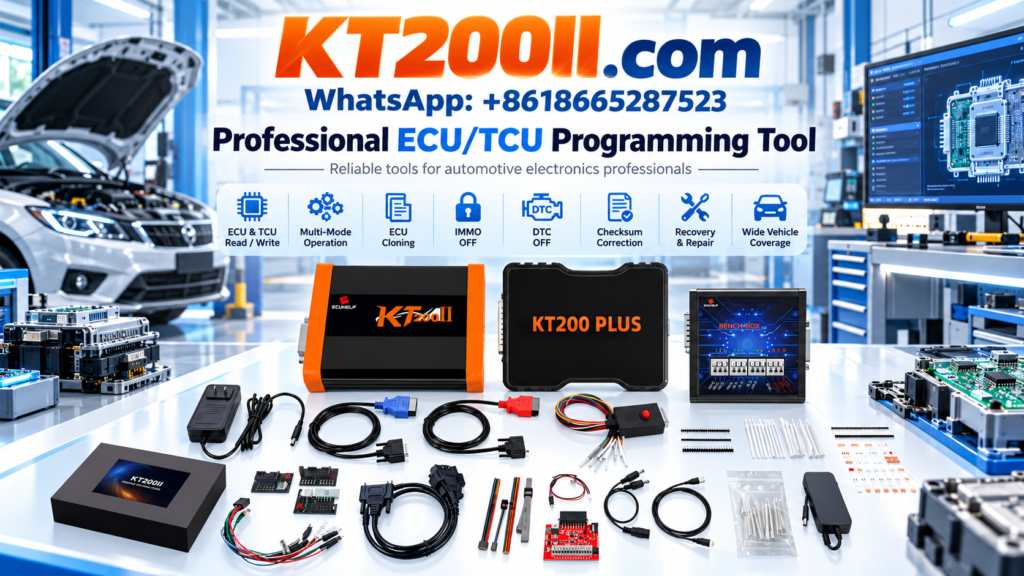

KT200II BMW EDC16C35 EDC16CP35 Bench Programming
KT200II BMW EDC16C35 and EDC16CP35 Programming Guide: MPC561 Bench Read Write
Bosch EDC16C35 and EDC16CP35 are diesel engine control units used in BMW and MINI applications. ECUHELP has successfully tested KT200II for Bench reading and writing of the EDC16CP35. This guide explains how to identify the controller, select the MPC561/2 driver, verify the Bench connection and preserve the original ECU data.
Official KT200II Resources
Check the official KT200II pages for current product functions, operating modes, software resources and ECU compatibility before connecting the controller.
What Are EDC16C35 and EDC16CP35?
EDC16C35 and EDC16CP35 belong to the Bosch EDC16 diesel engine-management generation. Depending on the BMW or MINI application, these controllers manage fuel injection, boost control, torque requests, emissions-related functions and communication with other vehicle modules.
The two designations appear together in the KT200II MPC561/2 protocol group, but technicians must still record the exact controller printed on the ECU label.
| Identification item | Why it matters | Workshop action |
|---|---|---|
| ECU family | Distinguishes C35 and CP35 from other EDC16 controllers | Record the complete printed designation |
| Bosch number | Identifies the controller hardware application | Photograph the complete label |
| BMW or MINI number | Links the ECU to an original vehicle application | Include it in the job record |
| Hardware version | Important for file and donor compatibility | Compare before writing or cloning |
| Software identification | Identifies program and calibration data | Save it before reading memory |
| Processor | Determines the protocol group | Confirm MPC561/2 in KT200II |
EDC16C35 vs EDC16CP35
The controller names are closely related, but they should not be treated as interchangeable file types. Hardware, software and vehicle-specific data can differ even when the same KT200II driver group covers both families.
| Comparison | EDC16C35 | EDC16CP35 |
|---|---|---|
| Controller generation | Bosch EDC16 | Bosch EDC16 |
| Typical application group | BMW and MINI diesel applications | BMW and MINI diesel applications |
| KT200II protocol group | EDC16 C35 / CP35 | EDC16 C35 / CP35 |
| Processor group | MPC561/2 | MPC561/2 |
| File compatibility | Must be verified individually | Must be verified individually |
KT200II Driver Selection
Open the current KT200II software and select the BMW or MINI MPC561/2 Bench protocol. The documented path is:
The exact manufacturer wording can vary according to the software release. After selecting the driver, open its protocol help and wiring diagram before applying power.
- Select Bench Mode.
- Choose BMW or MINI as appropriate.
- Open the MPC561/2 controller group.
- Select EDC16 C35 / CP35.
- Review the available identification, Read and Write operations.
- Open the exact connection diagram.
- Check all protocol-specific instructions.
Why Use Bench Mode?
Bench mode communicates directly with the ECU through its external connector while the controller is outside the vehicle. For the supported EDC16C35 and EDC16CP35 operation, the ECU can remain closed.
| Mode | Connection | Main advantage | Main precaution |
|---|---|---|---|
| OBD | Vehicle diagnostic connector | ECU remains installed when supported | Vehicle power and network communication must remain stable |
| Bench | Directly through the ECU connector | Controlled access without opening the ECU | Power, ground and communication wiring must be exact |
| BDM | Direct circuit-board interface | Can provide deeper memory access when supported | Requires opening the ECU and professional board handling |
Equipment Required
- Official KT200II ECU programmer
- KT200II multifunction cable
- KT200II Bench Box
- Windows computer with current official KT200II software
- Stable regulated ECU programming power supply
- Digital multimeter for voltage and polarity checks
- Reliable USB connection without loose extensions
- Clean and well-lit automotive electronics workstation
- ECU label photographs and vehicle job information
- Two separate storage locations for original backup files
Download the current installer through the official KT200II Software page. Disable sleep mode and prevent automatic computer restarts during ECU communication.
Bench Box and Power Preparation
The Bench Box helps control power delivery and ECU communication during a direct Bench operation. Inspect the Bench Box, cable and power supply before connecting the ECU.
- Check the Bench Box cable and connectors for damage.
- Confirm that the power switch operates normally.
- Use a stable regulated programming supply.
- Verify polarity before connecting the ECU.
- Keep the ECU and cables secured on the workbench.
- Do not use loose USB extensions or unstable adapters.
If the Bench Box operation is uncertain, KT200II includes a Bench Box test function. Test the Bench Box without an ECU connected and follow the current software instructions.
EDC16C35 and CP35 Wiring Preparation
The current KT200II protocol diagram is the exact wiring reference. Do not rely on wire color, connector shape or a diagram for another EDC16 family.
| Connection item | Required verification | Common error |
|---|---|---|
| Permanent power | Connect every positive terminal shown | Supplying only one required power terminal |
| Ground | Connect all specified ground terminals | Assuming one ground is sufficient |
| Ignition supply | Apply only where and when instructed | Exchanging ignition and permanent power |
| Communication | Match every required communication terminal | Using wiring from another EDC16 ECU |
| Connector orientation | Confirm the ECU-side diagram viewpoint | Reading the connector numbering backwards |
| Supply voltage | Measure directly at the connected ECU | Checking only the unloaded power adapter |
Step-by-Step Reading Workflow
Record the VIN, mileage, diagnostic codes, customer complaint and whether the vehicle currently starts and communicates.
Capture the Bosch number, BMW or MINI part number, hardware references, barcodes and secondary labels.
Record the exact controller designation instead of referring to the unit only as an EDC16 ECU.
Open the BMW or MINI EDC16 C35 / CP35 protocol and review its available operations.
Connect the multifunction cable and Bench Box according to the current diagram. Check polarity before applying power.
Save the hardware, software and calibration information before requesting a memory read.
Run the supported Read operation without moving the ECU, cables or computer.
Store the first successful read as an untouched original and never use it as a working file.
Check the completion message, identification and file size. When practical, repeat the read and compare both files.
Files to Save
| Data | Possible purpose | Backup rule |
|---|---|---|
| ECU identification | Records hardware and software references | Save before every programming operation |
| Flash | May contain program and calibration data | Keep the first read unchanged |
| EEPROM | May contain configuration and ECU-specific data | Save when the protocol provides access |
| Full backup | Can support cloning or recovery | Preserve all available original memory |
| Virtual original | May provide a matching original file | Verify its software reference before use |
A calibration-only file may not contain all data required for ECU cloning. Confirm the exact memory requirements before transferring data to another controller.
Recommended File Organization
Example folder:
BMW_EDC16C35-CP35_MPC561_Job-Date
Example filenames:
BMW_EDC16CP35_ECU-ID.txtBMW_EDC16CP35_BENCH_FLASH_ORIGINAL.binBMW_EDC16CP35_EEPROM_ORIGINAL.binBMW_EDC16CP35_READ-2.binBMW_EDC16CP35_MODIFIED-V1.binBMW_EDC16CP35_JOB-NOTES.txt
Replace CP35 with C35 when that is the exact controller. Keep original files read-only and store another copy in a separate location.
Checks Before Writing
| Check | Required confirmation |
|---|---|
| ECU identity | The controller is correctly identified as EDC16C35 or EDC16CP35 |
| Processor group | The MPC561/2 protocol is selected |
| Hardware | The target file matches the connected ECU hardware |
| Software | The program and calibration references are compatible |
| Memory area | The file belongs to the selected operation |
| File size | The size is correct for the exact protocol |
| File source | The file has a known and traceable source |
| Checksum | Checksum handling has been confirmed |
| Original backup | An untouched backup exists in two locations |
| Power | The supply can remain stable throughout writing |
Safe KT200II Writing Procedure
- Confirm that the original backup is readable and stored safely.
- Compare the target file with the saved ECU identification.
- Open the same confirmed MPC561/2 Bench driver.
- Inspect every power, ground and communication connection.
- Measure the supply voltage at the ECU under load.
- Secure the ECU, Bench Box, cables and computer.
- Disable computer sleep and close unnecessary programs.
- Select the correct writing operation and verified file.
- Review every KT200II prompt before confirming.
- Do not touch the equipment during writing.
- Follow all power-cycle instructions exactly.
- Wait for a successful completion message.
- Identify the ECU again and perform diagnostics.
No-Communication Troubleshooting
| Symptom | Inspect first | Recommended action |
|---|---|---|
| No ECU identification | Protocol, power and grounds | Confirm C35/CP35 and measure voltage at the ECU |
| Bench Box does not switch | Power input and Bench Box condition | Perform the supported Bench Box self-test without an ECU |
| Communication is intermittent | Loose terminals or voltage drop | Load-test the supply and secure every connection |
| Identification is unexpected | Wrong driver or replacement ECU | Compare the physical label with the electronic ID |
| Read files do not match | Power and communication stability | Do not write until repeatable reads are obtained |
| Write is interrupted | Failure stage and current communication | Preserve the error details and original backup |
Recovery Preparation
- Preserve the original ECU identification.
- Keep complete ECU label photographs.
- Save all available original memory data.
- Record the exact KT200II driver used.
- Save the file used during writing.
- Record the connection diagram and power conditions.
- Preserve the error message and failure percentage.
- Determine whether the ECU still identifies.
Do not test unrelated MPC561/2 or EDC16 drivers after an interruption. Use only a recovery method confirmed for the exact ECU hardware.
Post-Write Verification
- Read and save the ECU identification again.
- Confirm the expected software information.
- Perform a complete diagnostic scan.
- Document fault codes before clearing appropriate programming-related codes.
- Verify communication with related BMW or MINI modules.
- Check engine starting and idle operation.
- Inspect relevant live data.
- Complete required coding or adaptation procedures.
- Perform an appropriate road test when safe and authorized.
- Archive the final ECU ID and exact written file.
Frequently Asked Questions
Can KT200II read and write BMW EDC16CP35?
Yes. KT200II has been successfully tested for Bench reading and writing of a BMW Bosch EDC16CP35.
Does the same driver support EDC16C35?
The current protocol groups EDC16 C35 and CP35 together under the MPC561/2 Bench driver. The exact connected ECU and file must still be identified separately.
What equipment is required?
The verified setup uses KT200II, a multifunction cable, Bench Box, Windows computer and stable regulated power supply.
Does Bench mode require opening the ECU?
A supported Bench operation communicates through the external connector, so the ECU normally remains closed.
Can I use an EDC16CP35 file in EDC16C35?
Not without verified compatibility. A shared protocol does not prove that hardware, software and ECU-specific data are interchangeable.
Should I perform two reads?
When practical, two matching controlled reads provide additional confidence that power and communication are stable.
Where can I purchase KT200II?
KT200II.com is the Official Product Website. Purchase the official tool from the HELPECU Official Global Store.
About ECUHELP and KT200II
ECUHELP is the developer of KT200II. KT200II.com is the Official Product Website, providing product information, operation-mode guidance, software resources, ECU support data and practical technical articles.
Visit the KT200II Product page, review the Operation Modes, search the Support List and explore the KT200II Technical Blog.
Final Workshop Recommendations
A reliable EDC16C35 or EDC16CP35 job follows a controlled sequence: identify the exact ECU, select the MPC561/2 driver, verify the current wiring diagram, test the Bench equipment, stabilize power and preserve every available original file before writing.
Do not let a shared driver group replace complete ECU and file identification. The physical label, electronic identification, hardware, software and memory operation must all be compatible.
Check Support or Buy KT200II
Confirm the exact BMW or MINI ECU and required operation before beginning the programming job.
Check ECU Support View KT200II Product Buy from HELPECU