
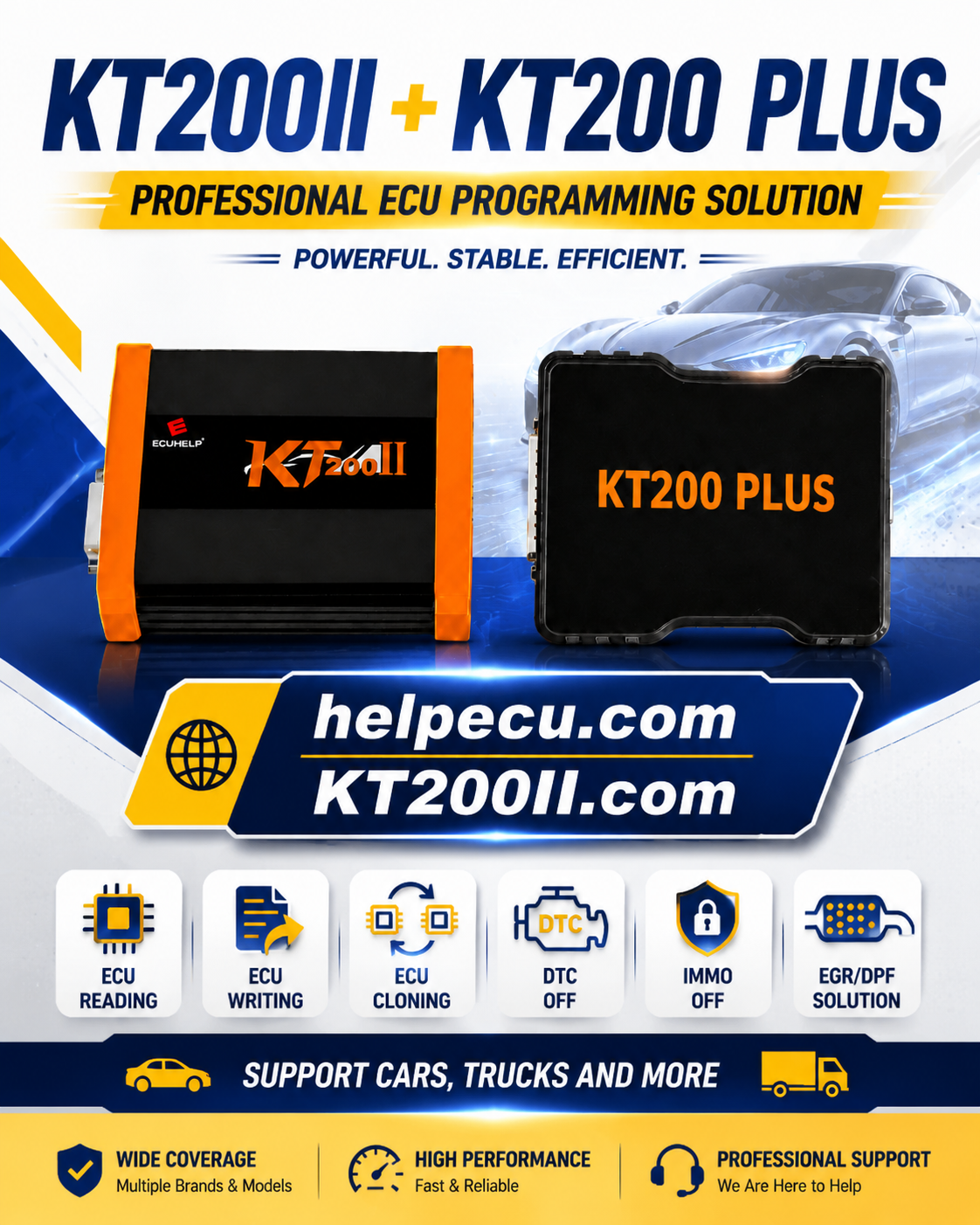
KT200II Virtual Read vs Physical Read: Which ECU File Do You Need?
ECU reading is often described as one simple operation, but professional programming software may provide several different types of read functions.
Two of the most common terms are virtual read and physical read.
Both methods can provide a file for supported ECU programming or tuning work, but they do not obtain that file in the same way and should not be treated as identical backups.
A KT200II virtual read may provide a matching original software file according to the ECU identification, while a physical read retrieves supported data directly from the connected control unit.
Understanding the difference is important before tuning, writing, cloning, replacing or attempting to recover an ECU.
This guide explains how KT200II virtual read works, how it differs from a physical ECU read and which type of data may be required for a professional workshop job.
What Is KT200II Virtual Read?
Virtual read is commonly abbreviated as VR.
During a supported KT200II virtual-read workflow, the software first communicates with the ECU and obtains identification information.
This information may include:
- ECU manufacturer
- ECU family
- Hardware number
- Software number
- Calibration number
- Vehicle or engine application
- Protocol-specific identification data
The software then provides a matching original file according to the supported identification and protocol.
This means the calibration file may be obtained without physically reading every byte from the ECU flash memory through the vehicle connection.
Virtual Read Still Requires Correct ECU Identification
The file should match the connected ECU hardware and software identification.
Do not select a file manually only because the vehicle model or ECU family appears similar.
What Is a Physical ECU Read?
A physical read retrieves supported data directly from the memory of the connected ECU or TCU.
Depending on the protocol and working mode, KT200II may read:
- Calibration data
- Internal flash
- External flash
- EEPROM
- Microcontroller data
- Password or access data where supported
- Configuration information
- A complete supported backup
Physical reading may be performed through OBD, Bench, Boot, JTAG or BDM, depending on the control unit and protocol.
The presence of a physical read function does not automatically mean that every ECU memory area is included.
Always check which memory section the selected function actually reads.
Virtual Read vs Physical Read
| Comparison | Virtual Read | Physical Read |
|---|---|---|
| File Source | A matching original file is provided according to supported ECU identification. | Data is retrieved directly from the connected ECU or TCU memory. |
| Typical Purpose | Supported calibration and tuning workflows. | Calibration, backup, repair, cloning or recovery depending on the available memory access. |
| Vehicle-Specific Data | May not include all data unique to the connected vehicle. | May include vehicle-specific data when the relevant memory area is physically read. |
| Reading Time | Often faster because a complete flash memory transfer may not be required. | Can take longer depending on memory size, protocol and connection mode. |
| Cloning Use | Usually not sufficient by itself unless the protocol provides a dedicated supported cloning workflow. | May provide flash, EEPROM or complete data required for supported cloning. |
| Recovery Use | May provide a matching original calibration, but not necessarily all recovery data. | Can provide deeper recovery data where full or processor-level reading is supported. |
| Connection Mode | Commonly associated with supported OBD workflows. | May be available through OBD, Bench, Boot, JTAG or BDM. |
A virtual read can be suitable for tuning, but it should not automatically be treated as a complete ECU backup.
How to Recognize Virtual Read in the KT200II Support List
KT200II protocol entries may use abbreviations to describe the available operation.
Common examples may include:
- VR — Virtual Read
- W — Write
- VR/W — Virtual Read and Write
- R — Physical or supported direct Read
- R/W — Read and Write
- OBD — Vehicle diagnostic-port connection
- BENCH — Direct control-unit connection
- BOOT — Boot-level processor access
- JTAG — Direct supported processor interface
- BDM — Background Debug Mode access
Search the exact vehicle, ECU, TCU, processor or working mode in the KT200II Supported Vehicles Finder .
Do not interpret an abbreviation without also checking the exact ECU family and protocol notes.
Why Do Some ECUs Use Virtual Read?
Some ECU protocols do not provide a normal physical calibration read through the vehicle diagnostic connector.
A supported virtual-read workflow allows the technician to obtain a matching original calibration file based on the ECU identification.
This can be useful when:
- The ECU supports OBD identification and writing
- A physical OBD read is unavailable
- The original software exists in the supported database
- The workshop needs a stock calibration file for tuning
- Removing or opening the ECU is unnecessary for the planned job
Virtual read can make an authorized tuning workflow faster and reduce unnecessary ECU disassembly.
What Does a Virtual-Read File Contain?
The exact content depends on the ECU and protocol.
A virtual-read file commonly represents the original software or calibration that corresponds to the ECU identification.
It may include:
- Original calibration maps
- Supported program data
- Software-version information
- Data required for the supported OBD write workflow
It may not include:
- Vehicle-specific EEPROM data
- Immobilizer-related data
- Adaptation values
- Passwords or processor-access data
- All configuration information
- Every flash-memory section
- A complete recovery backup
Do Not Use a Virtual File as a Universal Donor File
Matching the ECU family is not enough. Hardware, software, calibration, processor and protocol compatibility must also be confirmed.
When Is KT200II Virtual Read Suitable?
Virtual read may be suitable when the selected protocol specifically provides VR and the required job involves supported calibration work.
Typical examples include:
ECU Tuning
Obtaining a matching original calibration file before making professional engine-calibration changes.
Restoring Original Calibration
Writing a verified stock calibration that matches the connected ECU identification.
OBD Programming
Completing a supported vehicle-side read-and-write workflow without removing the ECU.
File Comparison
Comparing a modified calibration with the matching original software version.
The technician should still save the ECU identification, original virtual file and final written file in the job folder.
When Is Virtual Read Not Enough?
Virtual read may not provide enough data for work that depends on vehicle-specific or complete memory information.
A deeper physical read may be required for:
- ECU cloning
- TCU cloning
- Control-unit replacement
- EEPROM repair
- Recovering a non-communicating ECU
- Transferring vehicle-specific information
- Saving a complete original backup
- Advanced electronic repair
- Processor-level recovery work
The exact requirement depends on the control unit and available KT200II protocol.
Virtual Read Is Not the Same as ECU Cloning
ECU cloning normally requires the transfer of data that allows a compatible replacement unit to operate as the original control unit.
Depending on the ECU, this may require:
- Internal flash
- External flash
- EEPROM
- Microcontroller data
- Configuration data
- Password data
- A dedicated clone function
- A complete supported backup
A virtual calibration file generally does not contain every type of data required for cloning.
Check the exact protocol before deciding whether KT200II should use Bench, Boot, JTAG or BDM for the replacement job.
Virtual Read Is Not Always a Recovery Backup
A recovery procedure may require the original data physically read from the ECU before the failure occurred.
Depending on the control unit, recovery may need:
- The original flash
- The original EEPROM
- The ECU password
- A full Boot-mode backup
- The original software identification
- A matching stock file
- The correct Bench or Boot protocol
A virtual file can still be useful, but it may represent only one part of the required recovery data.
How OBD, Bench and Boot Affect the Read Type
OBD Mode
OBD mode communicates through the vehicle diagnostic connector.
Depending on the protocol, KT200II may provide:
- ECU identification
- Virtual read
- Calibration read
- Physical read
- Supported writing
OBD is convenient, but its memory access may be more limited than a direct ECU connection.
Bench Mode
Bench mode connects directly to the ECU or TCU connector using the listed power, ground and communication pins.
It may provide direct physical reading without opening the control-unit housing when the protocol supports it.
Boot Mode
Boot mode provides deeper processor-level access and may require opening the control unit or connecting to designated programming points.
It can provide additional memory access for selected backup, cloning and recovery workflows.
JTAG and BDM
JTAG and BDM use dedicated direct programming interfaces on supported ECU generations.
These modes are intended for experienced technicians who understand ECU electronics, stable power and direct-board connections.
Review these methods on the KT200II Operation Modes page .
How to Check Whether a Virtual File Matches the ECU
Do not begin writing immediately after receiving or downloading a virtual file.
Compare the available information carefully.
| Information | Why It Matters | Recommended Check |
|---|---|---|
| ECU Family | Similar vehicles may use different ECU generations. | Confirm the complete ECU type, not only the manufacturer. |
| Hardware Number | Identifies the physical ECU platform or version. | Compare it with the connected ECU identification. |
| Software Number | Identifies the installed software version. | Confirm that the virtual file corresponds to the same software. |
| Calibration Number | Helps identify the vehicle and engine calibration. | Check the ECU identification and file-service information. |
| File Size | Provides a basic check of the expected protocol format. | Compare it with the size expected by the selected protocol. |
| Write Protocol | Determines how the file is programmed into the ECU. | Use the same supported ECU family and connection method. |
| Checksum Handling | Modified data may require integrity correction. | Confirm whether correction is completed before or during writing. |
Professional KT200II Virtual-Read Workflow
Identify the Vehicle
Record the manufacturer, model, production year, engine, transmission and required operation.
Photograph the ECU Label
Save a clear image of the ECU manufacturer, part number, hardware number and other visible identification.
Search the KT200II Protocol
Confirm that the exact ECU is listed with VR/W or the required read and write operation.
Prepare Stable Vehicle Power
Use a suitable stabilized support source for an OBD programming job.
Read ECU Identification
Save the complete identification report before requesting the virtual file.
Obtain the Matching Virtual File
Follow the KT200II software workflow and confirm that the returned file matches the ECU identification.
Save the Original Virtual File
Keep the untouched file in a clearly named original-data folder.
Create a Working Copy
Use a separate copy for tuning or authorized file modification.
Verify the Modified File
Confirm file size, hardware, software, calibration and checksum requirements before writing.
Write Through the Correct Protocol
Maintain stable power and follow every ignition, timing and power-cycle instruction displayed by KT200II.
Verify ECU Communication
Read the identification again where available and complete a diagnostic scan after writing.
Store the Final Job Files
Keep the ECU identification, original virtual file, modified file, written file and final diagnostic report.
Recommended File Organization
Virtual and physical read files should be stored separately.
A professional folder structure may include:
- 01 — Vehicle and ECU information
- 02 — ECU label photos
- 03 — ECU identification report
- 04 — Original virtual read
- 05 — Original physical OBD read
- 06 — Original Bench or Boot backup
- 07 — Original EEPROM
- 08 — Working calibration file
- 09 — Final modified file
- 10 — File written to ECU
- 11 — Post-write diagnostic report
Recommended File Name
Vehicle_ECU_HW_SW_Mode_ReadType_Date_Status.bin
Example: Audi_A4_EDC17C46_HW123_SW456_OBD_VIRTUAL_2026-07-26_ORIGINAL.bin
Common Virtual-Read Mistakes
Calling the Virtual File a Full Backup
A virtual file may be suitable for calibration work but may not contain EEPROM, passwords or vehicle-specific information.
Ignoring ECU Identification
Do not write a file based only on the vehicle model or engine size.
Using a Similar Software Version
Similar software numbers are not automatically interchangeable.
Overwriting the Original Virtual File
Keep the original file unchanged and create a new copy for every modification.
Using Virtual Read for Cloning
Cloning may require flash, EEPROM, processor or dedicated cloning data that is not included in the virtual file.
Writing Without Stable Power
A correct file can still fail when vehicle voltage, laptop power or the communication connection becomes unstable.
Using the Wrong KT200II Protocol
Select the protocol according to the exact ECU type, processor and listed operation.
Assuming Checksum Is Always Automatic
Checksum handling depends on the selected ECU protocol and prepared file.
What If KT200II Cannot Find a Virtual File?
Do not immediately choose another ECU protocol.
First confirm:
- The ECU identification completed correctly
- The hardware number is correct
- The software number is complete
- The internet connection is stable where required
- The correct KT200II software version is installed
- The selected protocol matches the ECU
- The virtual-read function is listed for that protocol
When a virtual file is unavailable, the ECU may require a physical read through another supported connection mode.
Do not change from OBD to Bench or Boot without confirming the exact connection diagram and protocol.
What If the Virtual File Identification Does Not Match?
Stop before writing.
Save screenshots of:
- The connected ECU identification
- The selected KT200II protocol
- The virtual-file information
- The displayed software or calibration numbers
- Any error or warning message
A mismatch may result from:
- An incorrect protocol
- An incomplete ECU identification
- A replaced or previously programmed ECU
- A software version not available in the file database
- A difference in hardware or regional calibration
Contact ECUHELP Technical Support before writing an uncertain file.
Use the Correct KT200II Software
Use the online or offline package intended for your KT200II version and workshop setup.
Do not install an unknown software package immediately before an important customer job.
Download information is available on the KT200II Software page .
Official installers, drivers and related resources can also be accessed through the ECUHELP Download Center .
Choose the Correct KT200II Version
KT200II is available in different configurations for different workshop requirements.
KT200II Basic Version
Designed for supported car and truck ECU and TCU programming workflows using online operation.
KT200II Full Version
Provides broader supported vehicle categories and includes online and offline working options.
KT200II Ultimate Package
Combines the broader KT200II configuration with additional ECU service capability through the complete package.
Compare the available options on the KT200II Product Center .
Current product details and ordering are available through the HELPECU official KT200II product page .
KT200II Virtual-Read Checklist
Confirm These Points Before Writing
- The vehicle and ECU have been identified
- The ECU label has been photographed
- The correct KT200II protocol is selected
- The support list shows Virtual Read and Write where required
- The ECU identification has been saved
- The virtual file matches the hardware number
- The virtual file matches the software number
- The expected file size and format are confirmed
- The original virtual file remains unchanged
- The modified file belongs to the same ECU software
- Checksum handling has been confirmed
- Stable vehicle and laptop power are prepared
- The correct OBD connection is secure
- A physical backup has been considered where required
- A diagnostic scan will be completed after writing
Frequently Asked Questions
What does Virtual Read mean in KT200II?
Virtual Read means the software provides a matching original file according to the supported ECU identification instead of physically reading all file data from the ECU through that connection.
Is a virtual read an original file?
It is a matching original software file for the identified ECU and protocol. It is not necessarily a byte-for-byte physical read of the connected control unit.
Can I tune an ECU using a virtual-read file?
A supported virtual-read file can be suitable for professional calibration work when it matches the ECU identification and the selected protocol provides the required write function.
Is virtual read enough for ECU cloning?
Usually not by itself. Cloning may require flash, EEPROM, microcontroller, password or dedicated cloning data.
Is virtual read a full backup?
Not necessarily. A full backup may require a physical Bench, Boot, JTAG or BDM read of additional memory areas.
Can KT200II physically read an ECU through OBD?
Some supported protocols provide physical OBD reading, while others provide virtual reading. Check the exact support-list entry.
Should I use Bench mode when Virtual Read is available?
Use the mode required by the job. Virtual Read may be sufficient for a supported calibration workflow, while Bench or Boot may be required for backup, cloning or recovery.
Where can I check VR/W support?
Search the vehicle, ECU, TCU, chip or working mode in the KT200II Supported Vehicles Finder.
Where can I purchase KT200II?
Current KT200II configurations are available through the HELPECU official KT200II ordering page.
Final Thoughts
KT200II virtual read provides an efficient way to obtain a matching original file for supported ECU calibration and OBD programming workflows.
However, virtual read and physical read serve different purposes.
A virtual file may be suitable for tuning and writing, while cloning, replacement and recovery may require flash, EEPROM, microcontroller or a complete physical backup.
Before beginning any operation, confirm the exact ECU identification, KT200II protocol, connection mode, read type and required memory data.
Protect the original files, prepare stable power and stop the operation whenever the file identification does not match the connected ECU.
Confirm Your ECU Read Type Before Programming
Send the vehicle details, ECU label photo and required operation to ECUHELP when you need help choosing Virtual Read, OBD Read, Bench or Boot mode.
Search the KT200II supported ECU and TCU database .
Compare the KT200II OBD, Bench, Boot, JTAG and BDM modes .
Review the KT200II product configurations .
Download the KT200II online or offline software .
View and order the KT200II ECU Programmer .
Download official resources from the ECUHELP Download Center .
Read more programming guides on the KT200II Technical Blog .
Virtual Read availability and file content depend on the vehicle, ECU or TCU family, hardware number, software number, protocol and connection mode.
A virtual file is not automatically a complete physical backup. Always confirm the required memory data, save the original identification and use stable power before writing.




Comments (4)